
The Wavefront: A Surface of Constant Phase
Drop a stone in a calm pool: circular ripples spread out. At any instant, all points on one ripple-circle oscillate in phase (they are equidistant from the source). Such a locus is a wavefront:
A wavefront is a surface of constant phase. The wave's speed is the speed at which the wavefront advances; energy travels perpendicular to the wavefront.
Shapes worth knowing on sight:
- Point source → spherical wavefronts (diverging).
- Far from any source (e.g. starlight) → a small portion of the giant sphere is effectively a plane wavefront.
- Line/slit source → cylindrical wavefronts.
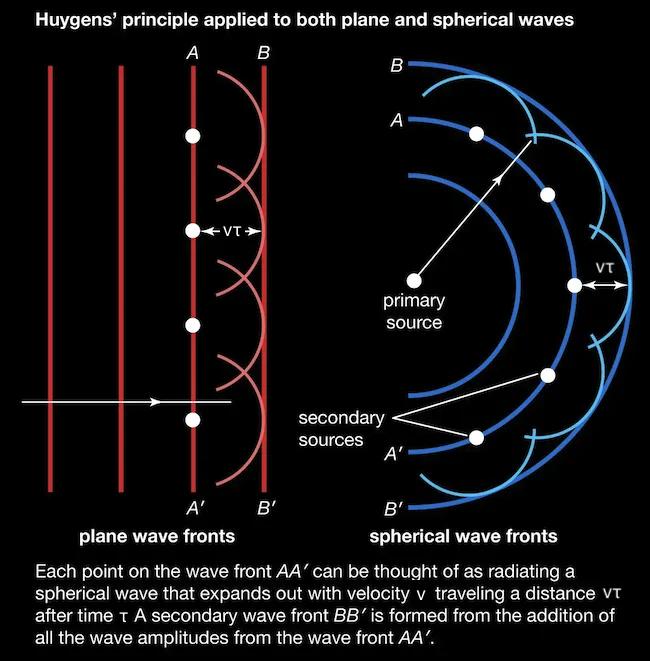
Huygens' Principle: The Wavefront-Forecasting Machine
Given the wavefront now, where is it a moment later? Huygens' two-part recipe:
- Each point of a wavefront acts as a fresh source of secondary wavelets, spreading out in all directions with the speed of the wave.
- The new wavefront is the forward envelope (common tangent surface) of all these secondary wavelets at the later time.
For a plane wave: wavelets of radius drawn from every point of the wavefront have a plane forward envelope — the wavefront advances by , staying plane. A sphere stays spherical. Simple, geometric, powerful.
The backwave problem: the same construction also suggests a wavefront travelling backwards — which is never observed. Huygens had to assume the back-directed amplitude is zero (in the rigorous wave theory the obliquity factor makes it vanish). NCERT flags this honestly — and so do examiners.
[NEET Important] One-liners that recur: wavefront ⟂ ray; spherical / plane / cylindrical shapes matched to source type; 'envelope of secondary wavelets' as the exact phrase; the absent backwave.
Solved Examples
Example 1: Shape spotting [NEET pattern]
State the wavefront shape for: (a) a point source, (b) light from a distant star, (c) a long narrow slit, (d) a parallel beam.
Solution:
- (a) Spherical (diverging).
- (b) Plane — a tiny patch of an enormous sphere.
- (c) Cylindrical.
- (d) Plane (that's what 'parallel beam' means in wave language).
Example 2: Wavefront vs ray
How are rays related to wavefronts?
Solution:
- Rays are perpendicular to wavefronts, pointing along the energy flow.
- Spherical wavefronts ↔ radial rays; plane wavefronts ↔ parallel rays.
- Bend the wavefront (lens, prism) and the rays re-aim accordingly — two pictures, one physics.
Example 3: Advancing a plane wave [JEE Numerical]
A plane wavefront in air advances for 2 ns. Using Huygens' construction, how far does the new wavefront lie from the old, and what is its shape?
Solution:
- Each point emits a wavelet of radius m.
- The forward envelope of equal-radius spheres centred on a plane is a parallel plane 0.6 m ahead.
- Plane stays plane; the construction reproduces straight-line propagation.
Example 4: The sphere stays a sphere
Show via Huygens that a spherical wavefront from a point source remains spherical.
Solution:
- Every point of the sphere (radius R) emits a wavelet of radius .
- The forward envelope is the concentric sphere of radius .
- Symmetry does all the work — the construction preserves the shape dictated by the source.
Example 5: Phase on a wavefront
Two points lie on the same wavefront. What is the phase difference between their oscillations, and why?
Solution:
- Zero — a wavefront is defined as a surface of constant phase.
- For a point source this is automatic: equal distances from the source mean equal travel times.
- This zero-phase property is what makes wavefront points legitimate 'in-phase secondary sources' in every later derivation.
Example 6: The missing backwave
Why doesn't Huygens' construction produce a wave travelling backwards?
Solution:
- The raw construction does suggest a backward envelope.
- Huygens assumed zero amplitude backwards (no backwave is ever observed).
- Rigorous wave theory later justified it (the amplitude of secondary wavelets vanishes in the backward direction). Quote the assumption honestly — it earns the mark.
Example 7: Starlight's flatness [JEE Numerical]
A star is m away. Over a 1 m telescope aperture, estimate how much its spherical wavefront deviates from a perfect plane.
Solution:
- Sagitta of an arc: .
- m — about a hundredth of a proton's radius!
- 'Plane wavefront' is not an approximation to apologise for; it is fabulously exact.
Example 8: Energy direction
In which direction does a wave's energy travel relative to its wavefront, and what does this mean behind a lens?
Solution:
- Perpendicular to the wavefront, always.
- A convex lens turns an incoming plane wavefront into a converging spherical one; perpendiculars to those spheres all aim at the focus.
- Energy follows the perpendiculars — which is exactly why the focus is bright (Section 3 draws these pictures).
Example 9: Wavelets at an aperture (preview) [JEE pattern]
A plane wave hits an opaque screen with a small hole. Using Huygens, what does the emerging wavefront look like?
Solution:
- Only the wavefront points within the hole act as secondary sources.
- With few wavelets, the envelope is no longer plane — it bulges and spreads beyond the geometric beam.
- That spreading IS diffraction (Section 6); Huygens' principle contains it from the start.
Example 10: Why the construction is 'forward-looking'
Summarise Huygens' principle in two sentences suitable for a Board answer.
Solution:
- Every point on a given wavefront is a source of secondary wavelets, which spread in all directions with the speed of the wave.
- The new wavefront at a later instant is the forward envelope (common tangent) of all these secondary wavelets; the backward wave is absent (assumed zero amplitude).
- Two sentences, full marks — and the engine of the next section's derivations.