Organism and Its Environment - The Major Abiotic Factors
Ecology asks how living things act on one another, and how the non-living (abiotic) surroundings act on them; the answers explain where a species is found and in what numbers. It works at four levels of biological organisation: organisms, populations, communities and biomes. Indian ecologists have made pioneering contributions to the subject, and that work fed into the national machinery for environmental planning that took shape in the early 1970s.
Why environments differ. The earth spins on an axis tilted about 23.5 degrees while it revolves around the sun, so the angle and the daily duration of solar radiation reaching a place change through the year. That is what produces seasons and, with annual variation in precipitation, the major biomes - desert, rain forest, tundra and others. Regional and local variations within each biome create a huge variety of habitats.
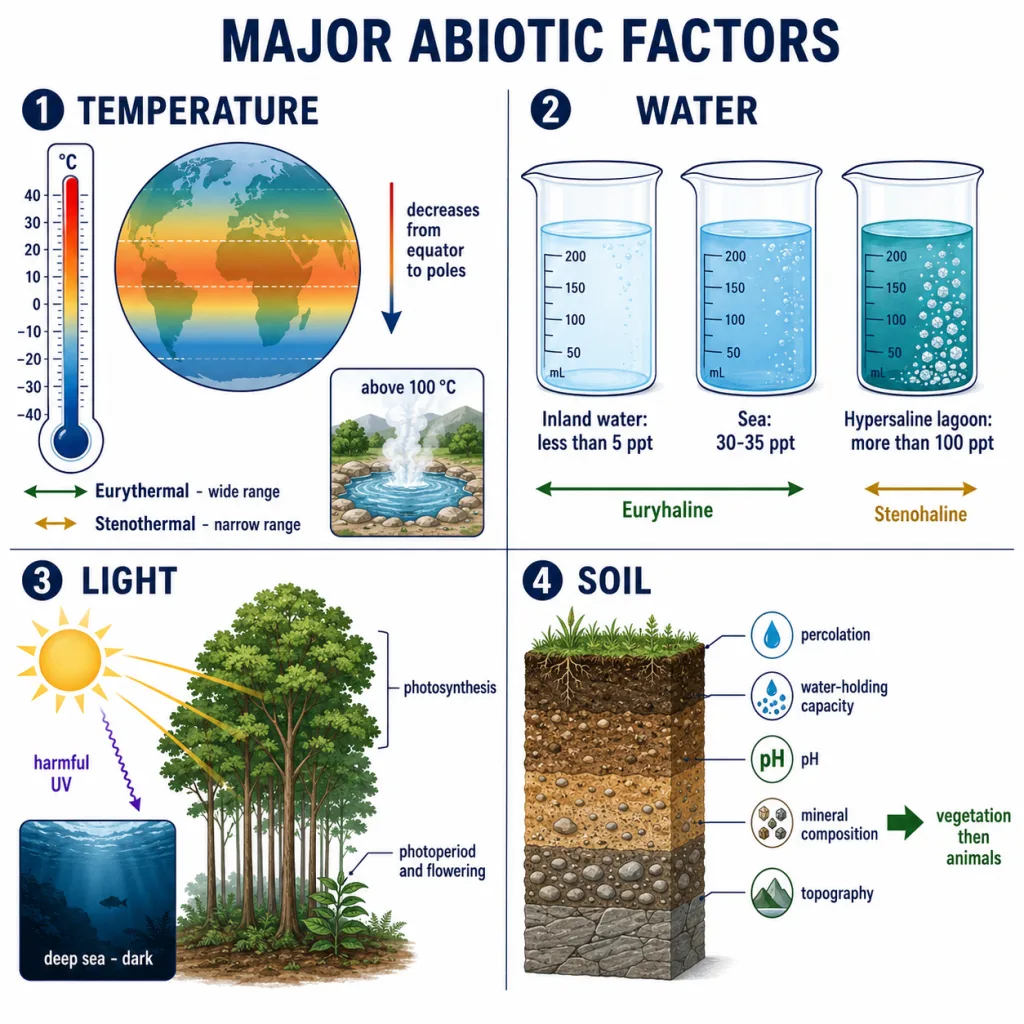
The four major abiotic factors: Temperature, Water, Light and Soil.
1. Temperature - the most ecologically relevant factor. Average temperature falls as you move from the equator towards the poles and from the plains to the mountain tops. How wide is the span on the earth? Read it as a ladder:
- below 0 degrees C in polar regions and on high mountains;
- above 50 degrees C in a tropical desert at the height of summer;
- past 100 degrees C in thermal springs, and in the hydrothermal vents of the deep sea.
Why do a few degrees matter so much? Enzyme kinetics are temperature sensitive, and everything a body does - the fuel it burns at rest, how actively it moves, how its organs run - is enzyme driven, so a shift in temperature shifts all of it together. That is why mango does not grow in temperate countries, snow leopards are not found in Kerala, and tuna fish are rare beyond tropical latitudes.
Two prefixes carry a lot of weight here: eury- means wide, steno- means narrow. A eurythermal species copes across a broad span of temperature (humans, the common crow); a stenothermal one is confined to a narrow span (the snow leopard).
2. Water. Life on land is limited by water availability, and the productivity and distribution of plants depend heavily on it. For aquatic organisms the quality (chemical composition, pH) of water matters more than the quantity. Salinity measured in parts per thousand is less than 5 in inland waters, 30-35 in the sea and more than 100 in some hypersaline lagoons.
- The same two prefixes return: euryhaline organisms tolerate a wide range of salinities; stenohaline organisms a narrow range.
- Many freshwater animals cannot live for long in sea water and vice versa because of the osmotic problems they would face.
3. Light. Since plants produce food through photosynthesis, the sun is the ultimate source of energy. Light is not evenly available: in a dense forest the tall trees intercept most of it, so the herbs and shrubs living in their shade have evolved to run photosynthesis efficiently at very low intensities. Photoperiod - the daily length of the light period - works as a calendar: plants read it before they flower, and animals read it when timing feeding, breeding and long-distance movement. Spectral quality counts as much as quantity - only part of sunlight is photosynthetically active radiation (PAR), while ultraviolet wavelengths damage living tissue rather than fuel it. In water, light thins rapidly with depth, so the ocean floor lies in permanent darkness, and many small animals of open water track the shifting gradient, moving up and down through the day and across the seasons.
4. Soil. The nature and properties of soil vary and depend on the climate, the weathering process, whether the soil is transported or sedimentary, and how soil development occurred. Soil composition, grain size and aggregation determine the percolation and water-holding capacity of soil. There is a chain worth remembering: soil properties settle which plants grow, and the plants settle which animals a place can feed and shelter. The mineral composition of the soil, its pH and the topography of the land act at the first link. Under water the same logic runs through sediment-characteristics, which set which bottom-dwelling (benthic) animals a site will hold.