
Responses to Abiotic Factors and Adaptations
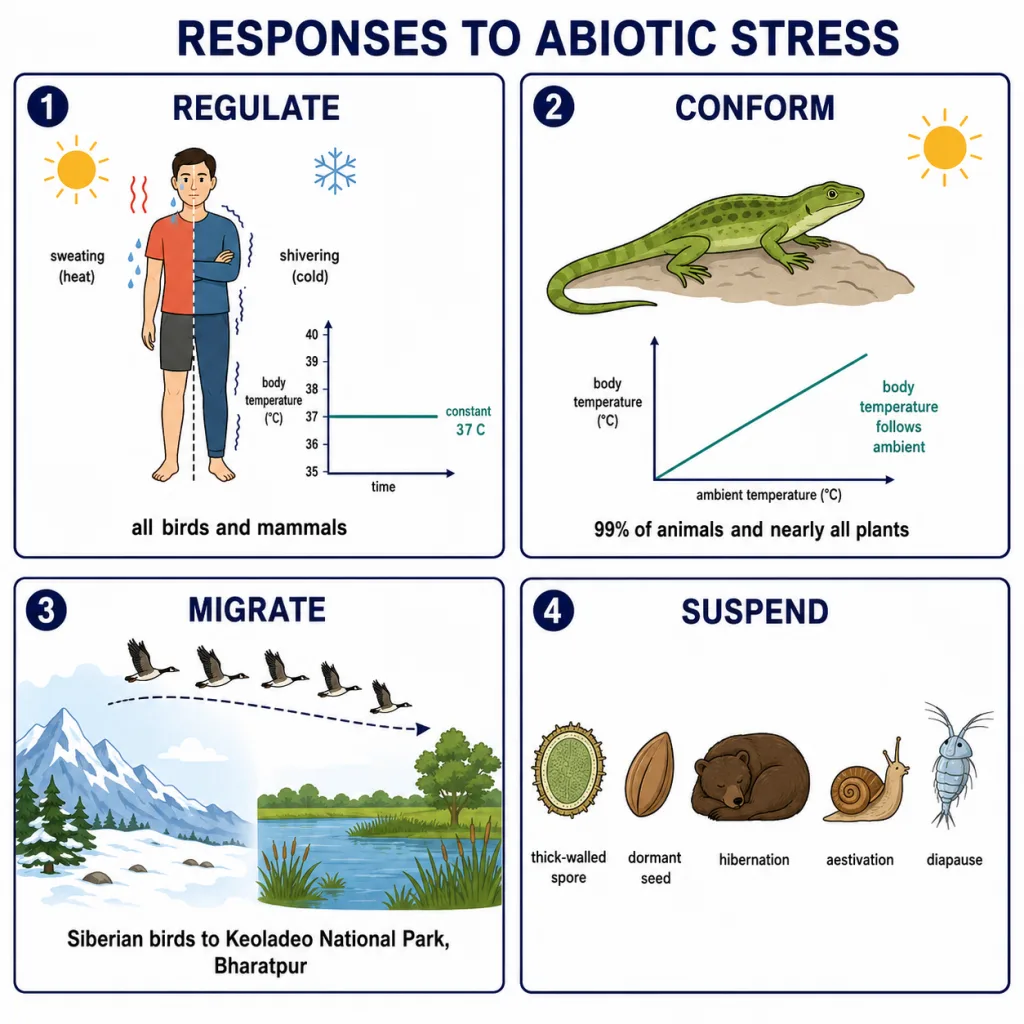
The internal environment of an organism helps to buffer it against external changes. A constant internal environment - homeostasis - permits optimal performance. Faced with a stressful abiotic condition an organism has four options, taken up in turn below: regulate, conform, migrate, suspend.
1. Regulate. Some organisms maintain homeostasis by physiological (sometimes behavioural) means which ensures constant body temperature and constant osmotic concentration. The ability is not widespread: birds and mammals all possess it, while among the lower vertebrates and invertebrates only a very small minority does. We maintain a constant body temperature of 37 degrees C: in summer we sweat profusely and the resulting evaporative cooling brings the temperature down; in winter we shiver, a kind of exercise which produces heat and raises the body temperature.
2. Conform. 99 per cent of animals and nearly all plants cannot maintain a constant internal environment - they are conformers. A conformer simply tracks its surroundings: warm outside, warm inside; cold outside, cold inside. In water the same passivity applies to salt, the osmotic concentration inside drifting to match the medium around it. Why has regulation not evolved everywhere? Because it is energetically expensive, and the bill rises steeply as body size falls: the surface-area-to-volume ratio climbs as an animal gets smaller, so a shrew or a hummingbird sheds heat far faster than a large mammal and must burn fuel continuously to replace it. This is why very small animals are rarely found in polar regions.
3. Migrate. Some organisms simply leave. They vacate a place while it is hostile and return once the bad period has passed. Every winter the famous Keoladeo National Park (Bharatpur) in Rajasthan hosts thousands of migratory birds coming from Siberia and other extremely cold northern regions.
4. Suspend. Bacteria, fungi and lower plants wait out bad times inside spores whose thick walls resist drying and heat; the spore germinates once moisture and warmth return. In higher plants, seeds and some other vegetative reproductive structures serve as means to tide over stress: they reduce their metabolic activity and go into a state of dormancy. In animals:
- Hibernation - winter sleep, e.g. bears go into hibernation during winter.
- Aestivation - summer sleep to avoid heat and desiccation, e.g. some snails and fish.
- Diapause - development itself is put on hold rather than merely slowed, e.g. zooplankton of lakes and ponds do this when conditions turn against them.
Adaptations. An adaptation is any feature of an organism - in body form, in body chemistry, or in behaviour - that improves its chances of surviving and leaving offspring where it lives. Most are genetically fixed, built up over long evolutionary time rather than acquired within a single lifetime.
- Kangaroo rat in North American deserts is capable of meeting all its water requirements through internal fat oxidation (in which water is a byproduct), and it has the ability to concentrate its urine so that a minimal volume of water is used to remove excretory products.
- Desert plants have a thick cuticle and sunken stomata to minimise water loss through transpiration, and a special photosynthetic pathway (CAM) that enables their stomata to remain closed during the day. Some desert plants like Opuntia have no leaves - they are reduced to spines - and photosynthesis is carried out by the flattened stems.
- Allen's Rule: mammals from colder climates generally have shorter ears and limbs to minimise heat loss.
- In polar seas, aquatic mammals like seals have a thick layer of fat (blubber) below the skin that acts as an insulator and reduces loss of body heat.
- Altitude sickness occurs at high altitudes (above 3,500 m, e.g. Rohtang Pass near Manali and Mansarovar in Tibet) because of the low atmospheric pressure, so the body does not get enough oxygen; symptoms include nausea, fatigue and heart palpitations. Acclimatisation then works along three lines: more red blood cells are made, haemoglobin's binding affinity for oxygen is lowered so that oxygen is handed over to the tissues more readily, and the breathing rate goes up.
- Behavioural adaptation: desert lizards lack the physiological ability of mammals to deal with high desert temperatures. They bask in the sun and absorb heat when their body temperature drops below the comfort zone, move into shade when the ambient temperature starts increasing, and some burrow into the soil to escape the above-ground heat.
- Some organisms are adapted to extremes: archaebacteria thrive in hot springs and deep-sea hydrothermal vents where temperatures far exceed 100 degrees C.