
Population Interactions - Advanced and Integrated
This set is not a test of what you can recall. Almost every item hands you a described case, a small set of measurements, or a claim somebody has made, and asks you to judge it. The list below is a checklist of what you must be able to do before you attempt the set, together with the material the chapter supplies for doing it. It names the topics and the worked examples; it does not rehearse the arguments, because supplying those is what the questions are for.
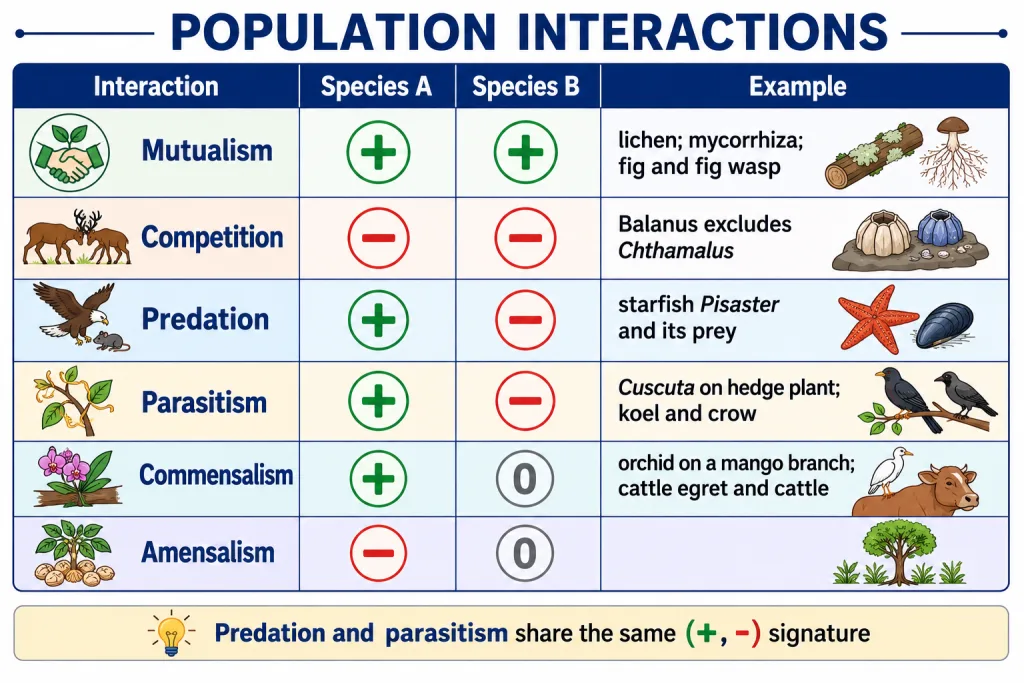
1. The six interactions. Competition, predation, parasitism, mutualism, commensalism and amensalism. For each, be able to give the effect on each partner separately - benefit (+), harm (-) or no effect (0) - and then to work in the harder direction, from a case described to you towards its name. More than one interaction can carry the same pair of signs, so the pair by itself does not always finish the job.
2. Predation. The chapter assigns predators three distinct services; know all three and keep them apart. Know the practical use it makes of one of them - biological control in agricultural pest management, with the prickly pear brought under control in Australia as the standing example.
3. Prey defences. Morphological and chemical, in animals and in plants. Know the chapter's named examples on both sides, the Monarch butterfly and Calotropis among them.
4. Competition. Learn the chapter's definition of competition in its own words, the qualifier it places on the fitness comparison included. Competition is not confined to members of different species. Know the two mechanisms the chapter distinguishes, and the condition it attaches to the elimination of a competitor. The barnacles of the Scottish coast, and the Abingdon tortoise displaced by introduced goats, are its two worked field cases.
5. Parasitism. Know the adaptations parasitism selects for and, for each, what it is for - a feature is not an adaptation until you can say what it is for. Know the two categories into which the chapter sorts parasites, its plant and animal examples of each, and brood parasitism as a special case. Assertion-Reason items appear in this set; judge each half as a separate claim.
6. Mutualism. Know the mutualisms the chapter names, the lichen among them, and what each partner supplies to the other.
7. Two integrated ideas. (i) Darwinian fitness. The chapter ties reproductive fitness to one particular quantity; know which. (ii) The reproductive budget. Know how the chapter treats an organism's investment in reproduction.
How to use this set. Attempt all 18 in a single timed sitting of 40 to 55 minutes with these notes closed, then read every explanation - including for the items you answered correctly.