
Populations - Attributes, Density and Age Structure
How to use this set. These notes name the vocabulary, the definitions and the one equation the set needs, and stop there. They work no example, quote no figure and settle no case, because deciding which rule applies to a described situation is what every question below asks. Treat the headings as a checklist of skills, not as an answer key. Read them, close them, and attempt all 17 in a single timed sitting of 35 to 50 minutes; then read every explanation, including for the items you answered correctly.
1. What a population is. Population ecology is an important area of ecology, and the chapter opens by defining a population. Learn that definition in the chapter's own wording, and practise applying it to a group of plants that has been described to you rather than named.
2. Habitat and niche. These are separate ideas, and the chapter uses each with a settled meaning. Be able to fasten the right one on to a way of living that is described rather than labelled.
3. Attributes a population has and an individual does not. An individual has births and deaths; a population has birth rates and death rates, a sex ratio and an age distribution.
- Natality (birth rate) and mortality (death rate) are per capita rates - the change in number with respect to the members of the population. Know what a per capita figure has been divided by, and remember that such a rate is not a constant of the species.
- Sex ratio may be quoted as a share rather than as a count. In a dioecious plant the two sexes sit on separate individuals.
4. Population density (N). Population size, technically called population density and designated N, is the most important attribute of a population, and it need not necessarily be measured in numbers only. The chapter lists numbers per unit area, per cent cover of the substratum, biomass and a relative density such as a catch per unit of effort, and it notes that indirect signs are sometimes used in place of the organisms themselves. Know each measure and the counting problem it answers, because more than one item below hands you a survey and asks you to judge the measure it used.
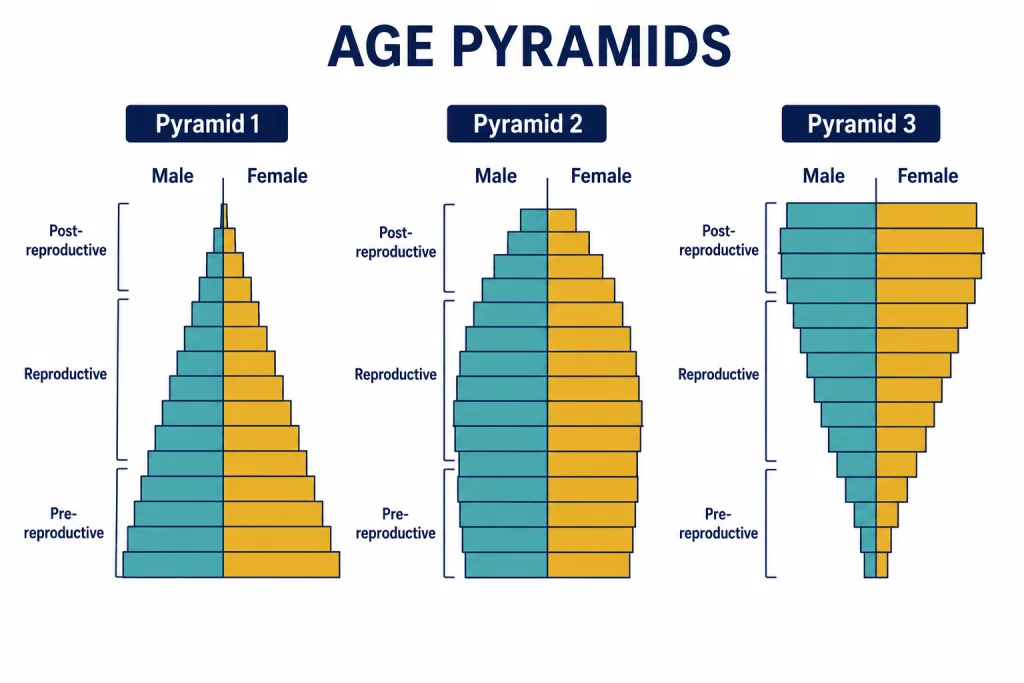
5. Age distribution and age pyramids. A population is composed of individuals of different ages. The age distribution plotted for a population gives its age pyramid, whose tiers are conventionally the pre-reproductive, reproductive and post-reproductive cohorts, the youngest at the base. For human populations an age pyramid generally shows males and females in a combined diagram. Know what quantity the tiers actually carry - the chapter is explicit about it - and be able to read growth status off the relative widths of the tiers rather than off a memorised outline.
6. Four processes change population density. If N is the population density at time t, its density at time t + 1 is:
N(t+1) = Nt + [(B + I) - (D + E)]
where B = number of births, I = number of immigrations, D = number of deaths and E = number of emigrations during the period.
- Natality (B) - births during the period, added to the initial density.
- Mortality (D) - deaths during the period.
- Immigration (I) - individuals of the same species that have come into the habitat from elsewhere in the period.
- Emigration (E) - individuals who have left the habitat and gone elsewhere in the period.
Read every symbol as a quantity attached to a particular area over a particular period. The equation can be run forwards to find N(t+1) and rearranged to recover any single term that has been left unknown. The chapter also makes a remark about which of the four processes ordinarily carries most of the change, and about the circumstances under which that ordinary case does not hold. Know the remark in its own words.
7. Beyond the population itself. The chapter describes a life cycle that runs through more than one kind of organism, and distinguishes the parts those organisms play in it; be able to tell those parts apart from a cycle described to you. Separately, the abiotic setting decides where a species can live at all, and water is among the factors the chapter treats - know what it says water governs on land.