
Population Growth Models and Life History Variation
Read what follows as a checklist of skills, not as an answer key. Each line names something you must be able to do before you attempt the set, and deliberately withholds the values, the wordings and the decision rules themselves, because those are exactly what is being tested.
(a) Exponential or geometric growth. Resource (food and space) availability is essential for the unimpeded growth of a population. For a population of size N with per capita birth rate b and per capita death rate d - rates per individual per unit time, and not head counts - the change in N during a unit of time t is:
dN/dt = (b - d) x N
Writing (b - d) = r:
dN/dt = rN
r is the intrinsic rate of natural increase, a very important parameter chosen for assessing the impact of any biotic or abiotic factor on population growth. The integral form of the same equation is:
Nt = N0 e^(rt)
where Nt = density after time t, N0 = density at time zero, r = intrinsic rate of natural increase and e = the base of natural logarithms (2.71828). A plot of N against t gives a J-shaped curve, and such a population can reach enormous densities in a short time.
(b) Verhulst-Pearl logistic growth. Competition for what is limited follows wherever a population needs more than there is, and the 'fittest' individuals survive and reproduce. A given habitat has enough resources to support only a maximum possible number of a given species, and that limit is the habitat's carrying capacity (K) for that species. A plot of N against t is then a sigmoid curve:
dN/dt = rN [(K - N)/K]
where N = density at time t, r = intrinsic rate of natural increase and K = carrying capacity.
The sigmoid curve is divided into four named phases: acceleration, asymptote, deceleration and lag - listed here in alphabetical order on purpose. Know the order in which they actually occur.
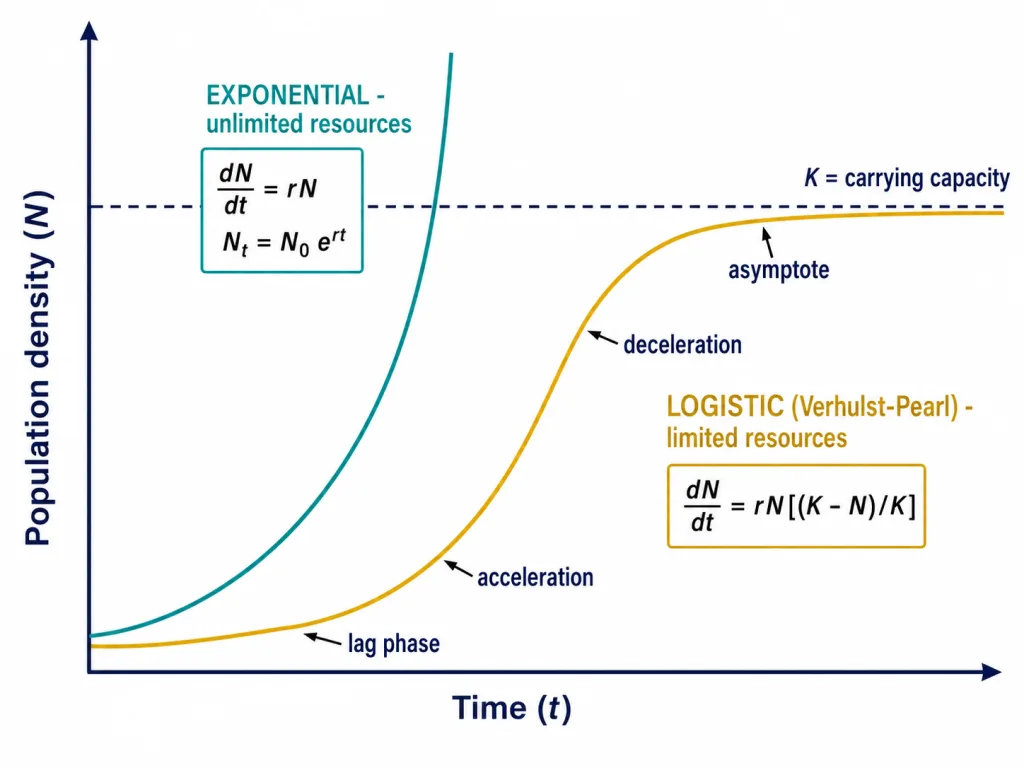
What you should be able to do with the two equations.
- Each of the two forms carries an assumption about the habitat it is describing. Know which assumption belongs to which form, and be able to read a habitat described to you in words and decide which of the two that description satisfies. The wrong pairing is a favourite distractor.
- Keep per capita rates and counts apart, and know what each symbol is a rate of. A quantity written 'per unit time' and one written 'per individual per unit time' can never be equated or compared directly, so carry the units through every line of working.
- Either equation can be run backwards: given a growth rate and the remaining quantities you can solve for r, for K or for a starting density.
- Measured r values are quoted for a rodent, for an insect and for a human population - learn what those three values are.
- Be able to read a run of census figures and say what stage of growth they describe.
- The bracket in the logistic form does not have the same value at every density. Work out what it is doing at the density you have been given, rather than assuming it.
Life history variation. Under a particular set of selection pressures, organisms evolve towards the most efficient reproductive strategy in the habitat they occupy, and life history traits have evolved in relation to the constraints imposed by the abiotic and biotic components of that habitat. Two axes of variation are described:
- how often an organism breeds - only once in its lifetime, or many times;
- how many and how large its offspring are - many small ones, or few large ones.
NCERT names particular organisms for each of these patterns; be able to place every named example on the correct axis, and also to place an organism you have never met, given nothing but its habits. What either axis does or does not imply about the other is itself examined, so settle that relation for yourself instead of assuming one. Given an unfamiliar habitat described to you, practise working out which reproductive pattern selection would be expected to favour there, and on what reasoning.
Further ground this set covers.
- An evolved attribute against an adjustment made within a lifetime. The chapter separates these two by a single clause. Know which clause it is, be able to apply it to a response that is described rather than named, and be able to say what evidence would be needed to settle such a case either way.
- Interspecific interactions. Know the chapter's definitions of the named interactions in its own wording, qualifiers included, and be able to reach for the right one from a case or an experiment described to you rather than from a name you happen to recognise.
- Parasitism and plant defence. The chapter names several properties that recur across parasitic associations, and it names both morphological and chemical defences that plants, unable to move away from a grazer, have evolved. Know the named examples on both sides, and be prepared to judge a statement about how such a defence works and what it is for, not merely to recall that it exists.
One last point. Be clear about the level of biological organisation this chapter takes as its subject, and about why population ecology is said to sit at an interface with other branches of biology.
How to use this set. Attempt all 17 in a single timed sitting of 35 to 50 minutes with these notes closed, then read every explanation - including for the items you answered correctly.