
Levels of Organisation
The classification of animals is not settled by how an animal earns its living. It rests on a short list of fundamental features that cut across every phylum: the arrangement of cells, body symmetry, the nature of the coelom, and the patterns of the digestive, circulatory and reproductive systems. Segmentation and the presence or absence of a notochord are set alongside them as further axes. Mode of nutrition, mode of locomotion, habit and habitat are not on that list - they vary too freely inside a single phylum to separate one phylum from another.
All members of Animalia are multicellular, but they do not all exhibit the same pattern of organisation of cells. Four grades are recognised, and every animal in this chapter sits on one of them.
Cellular level. In sponges the cells are arranged as loose cell aggregates. No tissue is formed, yet some division of labour does occur among the cells, different cells taking up different activities. Sycon, Spongilla and Euspongia are sponges and all belong here.
Tissue level. In coelenterates the arrangement is more complex: cells performing the same function are arranged into tissues. Hydra is a coelenterate. Ctenophores stand at the same grade.
Organ level. In Platyhelminthes and other higher phyla, tissues are grouped together to form organs, each specialised for a particular function. Planaria and Fasciola are flatworms.
Organ-system level. In annelids, arthropods, molluscs, echinoderms and chordates, organs have associated to form functional systems, each system concerned with one specific physiological function. Pheretima (the earthworm) is an annelid, Apis (the honey bee) an arthropod and Pila a mollusc.
The four grades form a ladder, so an animal at the organ-system level also possesses organs, and an animal with organs also possesses tissues.
Within the organ-system grade the systems themselves show various patterns of complexity, and two are named. A digestive system may be incomplete, with a single opening to the outside serving as both mouth and anus, or complete, with two openings, a mouth and an anus. A circulatory system may be open, the blood being pumped out of the heart so that the cells and tissues are directly bathed in it, or closed, the blood being circulated through a series of vessels of varying diameters - arteries, veins and capillaries.
[NEET Important] Gut completeness and circulation type are two sub-patterns within the organ-system grade, and the two vary independently of each other. Where an option pairs two such terms, check each half on its own; an examiner crosses the axes deliberately.
Symmetry
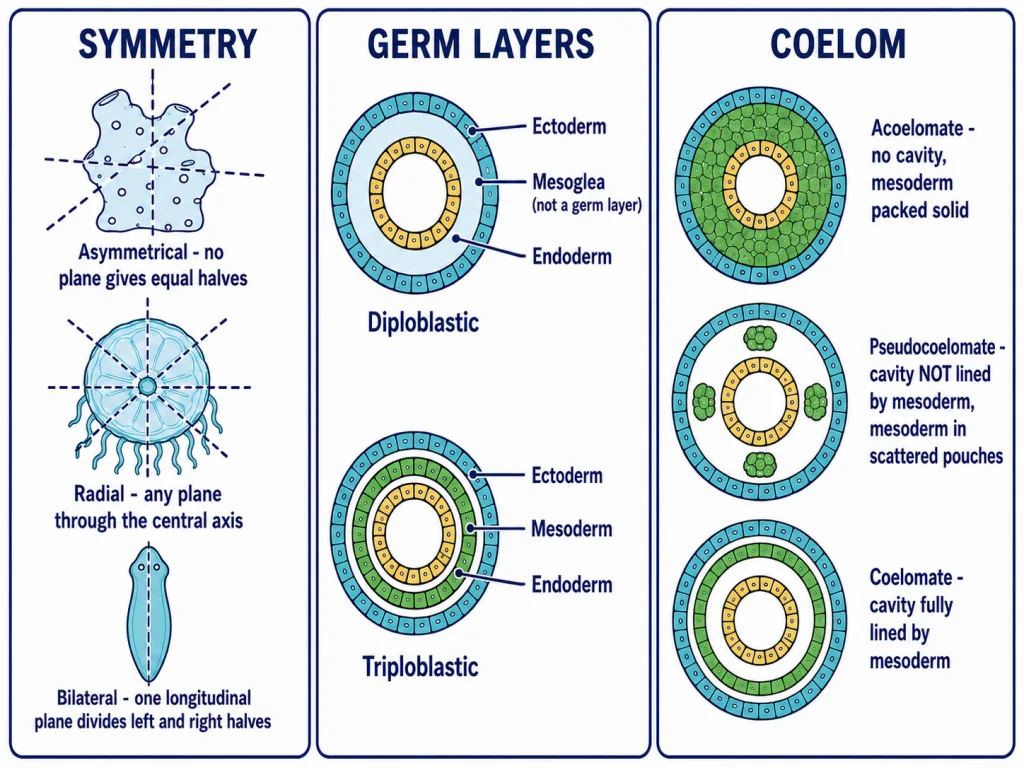
Sponges are mostly asymmetrical. No plane passing through such a body divides it into two equal halves. Asymmetry is the absence of any dividing plane, not a weaker variety of symmetry.
In radial symmetry, any plane passing through the central axis of the body divides it into two identical halves. Coelenterates and ctenophores show this plan. Adult echinoderms are radially symmetrical, but their larvae are bilaterally symmetrical, so the life stage must be checked before assigning their symmetry.
In bilateral symmetry the body can be divided into identical left and right halves in only one plane. Annelids and arthropods are the named examples.
A bilaterally symmetrical body is also differentiated along its axes. It has an anterior end and a posterior end, and a dorsal surface and a ventral surface, in addition to the matched left and right sides that the plane of symmetry creates.
Germ Layers
Animals whose cells are arranged in two embryonic layers - an external ectoderm and an internal endoderm - are diploblastic. Coelenterates and ctenophores are diploblastic. An undifferentiated layer, the mesoglea, jelly-like and giving rise to no organs, is present in between the ectoderm and the endoderm.
Animals in which the developing embryo has a third germinal layer, the mesoderm, in between the ectoderm and the endoderm, are triploblastic. This holds from Platyhelminthes to the chordates.
[NEET Important] Mesoglea is not mesoderm. It occupies the very position a mesoderm would occupy, but it stays undifferentiated, so a coelenterate that carries it is still diploblastic. Keep the arrangement straight as well as the names: ectoderm is the outer layer, endoderm the inner layer, and in a triploblastic animal the mesoderm lies between the two, never outside them.
Coelom
Presence or absence of a body cavity lined by mesoderm, the coelom, is one further axis on which the phyla are placed. Animals that possess such a cavity are coelomates; NCERT places annelids, molluscs, arthropods, echinoderms, hemichordates and chordates in this category. In some animals the cavity is not lined by mesoderm; the mesoderm is instead present as scattered pouches in between the ectoderm and the endoderm, and a body cavity of that kind is a pseudocoelom. Aschelminthes are pseudocoelomates. Animals in which a body cavity is absent altogether are acoelomates; Platyhelminthes are acoelomates.
[NEET Important] Keep the three-way mapping fixed: Platyhelminthes - acoelomate; Aschelminthes - pseudocoelomate; Annelida onwards - coelomate.
Segmentation
In some animals the body is externally and internally divided into a serially repeated series of segments, with a repetition of at least some organs. This condition is called metameric segmentation and the phenomenon is known as metamerism. The earthworm is the standard example.
[NEET Important] Surface rings prove nothing on their own. External ring-like markings may be present without any internal repetition, and it is the internal serial repetition of organs that does the classifying. A long, worm-shaped body is no evidence either. Settle every case on what is repeated inside the animal, never on what shows on the outside of it.
Presence or Absence of Notochord
The notochord is a mesodermally derived rod-like structure formed on the dorsal side during embryonic development. Animals in which it is never formed at any stage of life are non-chordates; animals in which it is formed are chordates.
NCERT uses the sentence that animals from Porifera to Echinodermata are non-chordates. This names the continuous sequence presented before Hemichordata; it is not an exhaustive endpoint for all non-chordates. Hemichordata is also placed under non-chordata, and its stomochord is not a notochord.
[NEET Important] The definition of a notochord has two halves - the germ layer the rod is derived from, and the side of the body on which it lies - and a description is correct only if both halves are right together. Also keep stomochord and notochord separate.
These axes are not alternatives to one another; the same animal is placed on every one of them at once.
Porifera
Commonly called sponges, most of these animals live in the sea, and in most of them no plane divides the body into two equal halves. They are held at the cellular level of organisation, and they are the only phylum in this chapter placed on that grade.
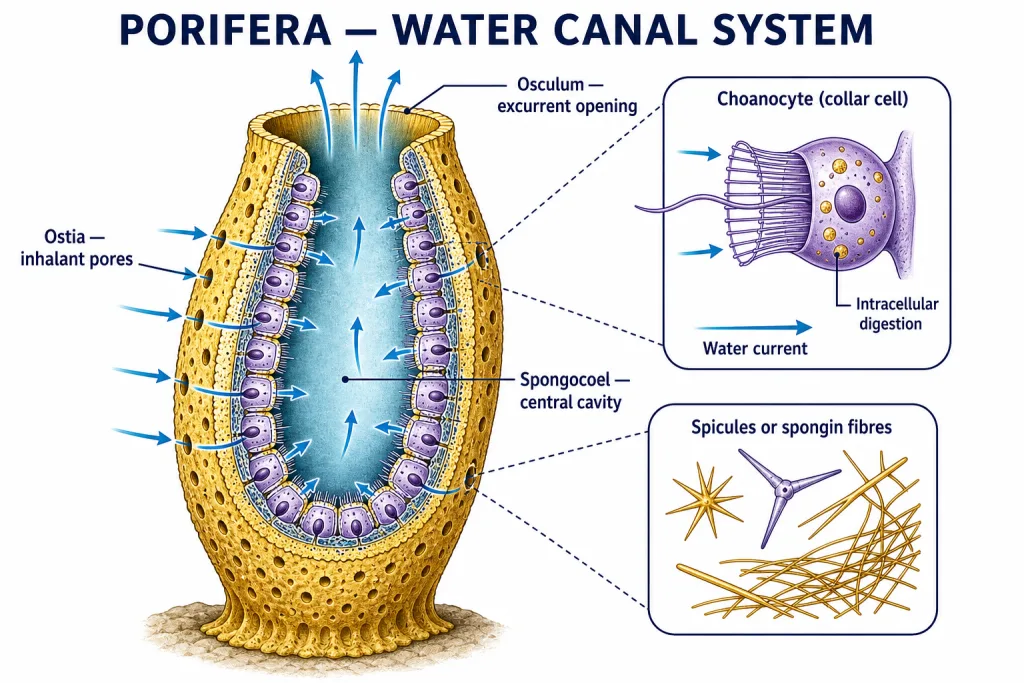
The defining feature is the water transport system, also called the canal system. Water enters through minute pores, the ostia, set in the body wall. It passes into the central cavity, the spongocoel, and leaves through an excurrent opening called an osculum; a sponge may have more than one such opening. The current that travels this route is put to three uses at once, and they are not alternatives: it brings in the particles the animal feeds on, it serves the animal's respiratory exchange, and it carries the waste out of the body.
Choanocytes, the collar cells, line the spongocoel and the canals. Digestion is intracellular, taking place inside cells rather than in any cavity.
The body is supported by a skeleton of spicules or by fibres of spongin.
Sexes are not separate, that is, sponges are hermaphrodite: eggs and sperms are produced by the same individual. They reproduce asexually by fragmentation and sexually by the formation of gametes. The eggs are fertilised inside the body of the parent, and the development that follows is indirect, passing through a larval stage which is distinct in form from the adult.
Examples: Sycon (Scypha), Spongilla, the fresh water sponge, and Euspongia, the bath sponge.