
Echinodermata
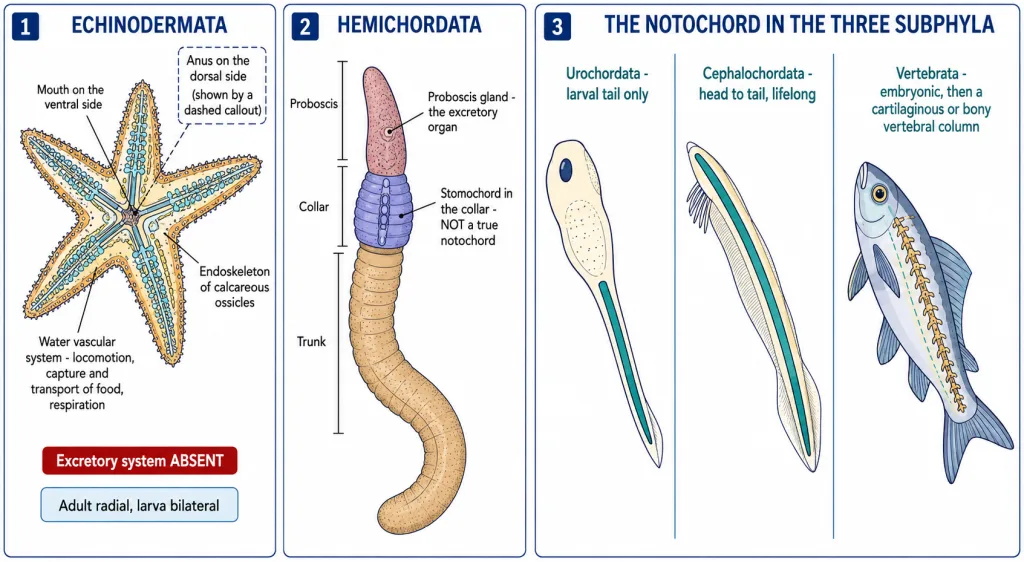
These animals are all marine and show the organ-system level of organisation. They are triploblastic and coelomate. Their symmetry changes with the life stage: adults are radially symmetrical, whereas larvae are bilaterally symmetrical.
The name of the phylum records a body surface set with spines, and the reason for those spines is an endoskeleton of ossicles made of calcium carbonate.
A water vascular system is present, with the tube feet as its organs. It helps in locomotion, the capture and transport of food, and respiration.
The mouth opens on the lower (ventral) surface and the anus on the upper (dorsal) surface, so the gut runs between the two faces of the animal rather than from a head end to a tail end. The digestive system is complete. An excretory system is absent.
Being all marine is an unqualified statement here, and it is worth setting against the phyla whose habitat is recorded with a hedge: Porifera is primarily marine but a few of its members live in fresh water, Annelida is aquatic (marine and fresh water) or terrestrial, and Mollusca is terrestrial or aquatic.
Sexes are separate. Reproduction is sexual, fertilisation is usually external, and development is indirect, passing through a free-swimming larval stage.
Examples, each with the common name attached to it: Asterias (star fish), Echinus (sea urchin), Antedon (sea lily), Cucumaria (sea cucumber), Ophiura (brittle star).
[NEET Important] Do not assign one symmetry to every life stage: adult radial, larva bilateral is the NCERT distinction. In genus matching, fix a secure pair first and eliminate every option that contradicts it.
Hemichordata
Hemichordata was earlier treated as a sub-phylum of Chordata. It is now ranked as a separate phylum, placed among the non-chordates. Hemichordates possess a rudimentary structure in the collar region called the stomochord. It resembles a notochord but is not a true notochord.
The phylum holds a small group of worm-like marine animals with an organ-system level of organisation. They are bilaterally symmetrical, triploblastic and coelomate.
The body is cylindrical and is built of three regions. The anterior region is the proboscis. Behind the proboscis lies the collar. The remainder of the body is a long trunk.
- Circulatory system: open type
- Respiration: through gills
- Excretory organ: the proboscis gland
Sexes are separate, fertilisation is external, and development is indirect. The two genera named for this phylum are Balanoglossus and Saccoglossus, and both are marine.
[NEET Important] A stomochord in a hemichordate is not the mesodermal notochord that defines Chordata. Echinodermata and Hemichordata share marine habitat, separate sexes, external fertilisation and indirect development. Adult echinoderms are radially symmetrical and lack an excretory system; hemichordates are bilaterally symmetrical, have open circulation and excrete through a proboscis gland.
Chordata and its three subphyla
Chordates are bilaterally symmetrical, triploblastic, coelomate animals with an organ-system level of organisation. Their fundamental characters are a notochord, a dorsal, hollow and single nerve cord, paired pharyngeal gill slits, a ventral heart, and a post-anal tail. Their circulatory system is closed. The notochord is a mesodermally derived rod formed on the dorsal side during embryonic development.
Chordates versus non-chordates
- Chordates have a notochord; non-chordates do not.
- The chordate central nervous system is dorsal, hollow and single; in non-chordates it is ventral, solid and double.
- The chordate pharynx is perforated by gill slits; these are absent in non-chordates.
- The chordate heart is ventral; in non-chordates it is dorsal, if present.
- A post-anal tail is present in chordates and absent in non-chordates.
Chordata is divided into three subphyla: Urochordata, also called Tunicata; Cephalochordata; and Vertebrata.
The notochord has a different fate in each of the three:
- Urochordata - present only in the larval tail.
- Cephalochordata - extends from the head to the tail region and persists throughout life.
- Vertebrata - present during the embryonic period and replaced in the adult by a cartilaginous or bony vertebral column. Thus, all vertebrates are chordates, but all chordates are not vertebrates.
Besides the basic chordate characters, vertebrates possess a ventral muscular heart with two, three or four chambers, kidneys for excretion and osmoregulation, and paired appendages that may be fins or limbs.
Examples: Urochordata - Ascidia, Salpa, Doliolum. Cephalochordata - Branchiostoma, also called Amphioxus or the Lancelet. Urochordata and Cephalochordata together are referred to as protochordates, and they are exclusively marine.
Classification of Vertebrata
- Division Agnatha lacks jaws and is represented by class Cyclostomata.
- Division Gnathostomata bears jaws. Its superclass Pisces bears fins and includes Chondrichthyes and Osteichthyes; superclass Tetrapoda bears limbs and includes Amphibia, Reptilia, Aves and Mammalia.
[NEET Important] Keep extent and duration separate when comparing the notochord, and remember that the vertebrate notochord is replaced by the adult vertebral column. In classification questions: Agnatha -> Cyclostomata; Gnathostomata -> Pisces and Tetrapoda.
Cyclostomata
All living cyclostomes are ectoparasites on some fishes. Their elongated body bears 6-15 pairs of gill slits for respiration. The mouth is circular and suctorial and lacks jaws, which places the class under division Agnatha. The body has no scales and no paired fins. The cranium and vertebral column are cartilaginous, and circulation is of the closed type.
Cyclostomes are marine, but they migrate into fresh water for spawning. Within a few days after spawning, the adults die. Their larvae return to the ocean after metamorphosis.
Examples: Petromyzon (lamprey) and Myxine (hagfish).
[NEET Important] Do not confuse a jawless cyclostome with a cartilaginous fish. Cyclostomata lacks jaws, scales and paired fins; Chondrichthyes has powerful jaws, placoid scales and paired fins. The cyclostome lifecycle adds a separate trap: adults spawn and die in fresh water, while metamorphosed larvae return to the sea.
Chondrichthyes
Marine fishes with a streamlined body and a cartilaginous endoskeleton. The mouth is located ventrally and the notochord is persistent throughout life. Gill slits are separate and are not covered by an operculum. The tough skin bears minute placoid scales, and the teeth are modified placoid scales, directed backwards. The jaws are very powerful and these fishes are predaceous.
The air bladder is absent, so they have to swim constantly to avoid sinking - a matter of buoyancy.
The heart is two-chambered, one auricle and one ventricle; they are cold-blooded (poikilothermous) and cannot regulate their body temperature. Some of them have electric organs (e.g. Torpedo) and some possess a poison sting (e.g. Trygon). Sexes are separate; in males the pelvic fins bear claspers, fertilisation is internal, and many are viviparous - live birth is unusual in a fish. Examples: Scoliodon, Pristis, Carcharodon (great white shark), Trygon (sting ray).
Osteichthyes
Both marine and fresh water fishes, with a bony endoskeleton. The mouth is mostly terminal. Four pairs of gills are covered by an operculum on each side. The skin carries scales of the cycloid and the ctenoid kinds. The operculum hides the gill openings, so the separate slits seen on a cartilaginous fish are simply not visible on a bony one. The air bladder is present and regulates buoyancy.
Heart two-chambered; cold-blooded. Sexes are separate, fertilisation is usually external, most are oviparous, and development is direct - what hatches already resembles a small adult. Examples: marine Exocoetus and Hippocampus (sea horse); fresh water Labeo (rohu), Catla and Clarias (magur); aquarium Betta and Pterophyllum.
The example genera are set out under three headings. Exocoetus and Hippocampus are listed as marine. Labeo, Catla and Clarias are listed as fresh water. Betta and Pterophyllum are listed under a third heading, Aquarium, alongside the marine and the fresh-water lists.