
Annelida
Aquatic, both marine and fresh water, or terrestrial; free-living and sometimes parasitic. They are bilaterally symmetrical, triploblastic, metamerically segmented and coelomate, at the organ-system level, the topmost of the four grades that run cellular, tissue, organ and organ-system, and the grade that Arthropoda and Mollusca share with them.
The phylum name records the look of the animal. Its body surface is distinctly marked out into segments, or metameres, so the worm appears to be built of small rings set one behind another, and the name Annelida was taken from the Latin annulus, a little ring. The marking is not a surface pattern only; the divisions run through the body, and that is what metameric segmentation means.
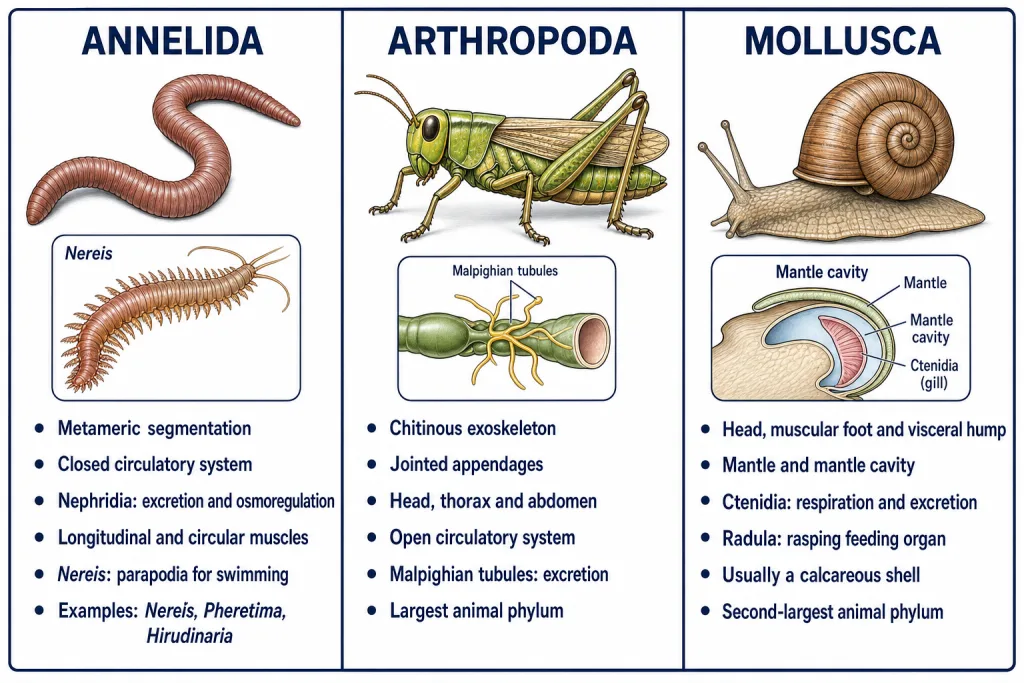
Segmentation is the headline character, but the muscles are examinable too. Annelids possess longitudinal and circular muscles which help in locomotion. Aquatic annelids such as Nereis possess paired lateral outgrowths, the parapodia, which help in swimming.
The body cavity is a true coelom, lined by mesoderm, and on that count the segmented worms stand with the arthropods and the molluscs and apart from the flattened and the round worms below them.
A closed circulatory system is present, the transported fluid staying within a continuous set of vessels. Nephridia help in osmoregulation and excretion - both jobs, not one. The neural system consists of paired ganglia connected by lateral nerves to a double ventral nerve cord. Reproduction is sexual.
Watch the trap on the animals themselves. Nereis is the aquatic annelid of the set and is dioecious; Pheretima (earthworm) burrows in soil and Hirudinaria (the blood-sucking leech) lives as a parasite, and both are monoecious. One phylum holds both sex conditions and three ways of life.
Arthropoda
The largest phylum of Animalia. Over two-thirds of all named species on earth are arthropods; Mollusca stands second.
They show the organ-system level of organisation and are bilaterally symmetrical, triploblastic, segmented and coelomate. The body is covered by a chitinous exoskeleton and is built in three regions, head, thorax and abdomen. Its appendages are jointed, and the phylum name was taken from that character (arthros - joint, poda - appendages). The body is segmented as an annelid's is, but here the segments are sheathed in a hard case and bear appendages divided by movable joints, neither of which the worm has.
- Respiratory organs: gills, book gills, book lungs or a tracheal system
- Circulatory system: open type
- Sensory organs: antennae, eyes (compound and simple) and statocysts, the organs of balance
- Excretion: Malpighian tubules
The reproductive account runs in four steps and every one of them is hedged. They are mostly dioecious; fertilisation is usually internal; they are mostly oviparous; and development is either direct or indirect, so neither route can be claimed for the phylum as a whole. An unhedged reading of any of the four is the standard error here.
Economically important members are Apis (honey bee), Bombyx (silkworm) and Laccifer (lac insect). Vectors of disease are Anopheles, Culex and Aedes, the three mosquitoes of the roster. Locusta (locust) is a gregarious pest of standing crops, and Limulus (king crab) is a living fossil. Sort the roster by the part each animal plays and it holds together: three are kept or harvested for a product, three carry disease, one destroys standing crops and one is quoted for its antiquity.
[NEET Important] Annelida and Arthropoda sit side by side and both are segmented, so the examiner separates them on the systems: annelid fluid runs in a closed circuit, arthropod fluid in an open one; excretion is by nephridia in the one and by Malpighian tubules in the other. In NCERT's diagnostic list, antennae, eyes and statocysts are named under Arthropoda; they are not presented there as defining annelid characters. One structure is offered again and again beside these three phyla and belongs to none of them: tube feet are structures of Echinodermata, a phylum outside this set. No annelid, no arthropod and no mollusc carries them.
Mollusca
The second largest animal phylum. Molluscs are terrestrial or aquatic, and the aquatic members occupy both the sea and fresh water, so the phylum is tied to no single medium and cannot be described as a marine group. They stand at the organ-system level of organisation, and are bilaterally symmetrical, triploblastic and coelomate.
The body is covered by a calcareous shell and is unsegmented, with a distinct head, a muscular foot on which the animal creeps, and a visceral hump. A soft and spongy layer of skin forms the mantle over that hump. The space between the hump and the mantle is the mantle cavity, and feather-like gills, the ctenidia, lie inside it. Water is drawn steadily through this cavity and over the gills, and the gills have respiratory and excretory functions together.
In front, the head bears sensory tentacles. The mouth contains a file-like rasping organ, the radula, used in feeding.
They are usually dioecious and oviparous, with indirect development, so the young do not, as a rule, hatch as small copies of the parent. The hedge matters: the account is written as the usual case, not as a rule without exception. Their body cavity is a coelom, but their body, unlike that of the annelid and the arthropod, is not divided into segments at all.
Examples: Pila (apple snail), Pinctada (pearl oyster), Sepia (cuttlefish), Loligo (squid), Octopus (devil fish), Aplysia (sea hare), Dentalium (tusk shell) and Chaetopleura (chiton). The genus seldom announces the animal behind it, so each pairing has to be fixed on its own; there is no rule that will generate them.
[NEET Important] Count the body regions before you answer: there are three - head, foot and visceral hump - and the mantle is not a fourth. It is the layer of skin draping the hump, with the mantle cavity and its gills beneath it, so an examiner offering a fourth region is offering a covering as a division. Then site each structure on its own region: the tentacles are borne in front on the head, the gills lie in the mantle cavity, and what lies in the mouth is the rasping organ. The foot does the creeping and carries none of the three.