
Amphibia
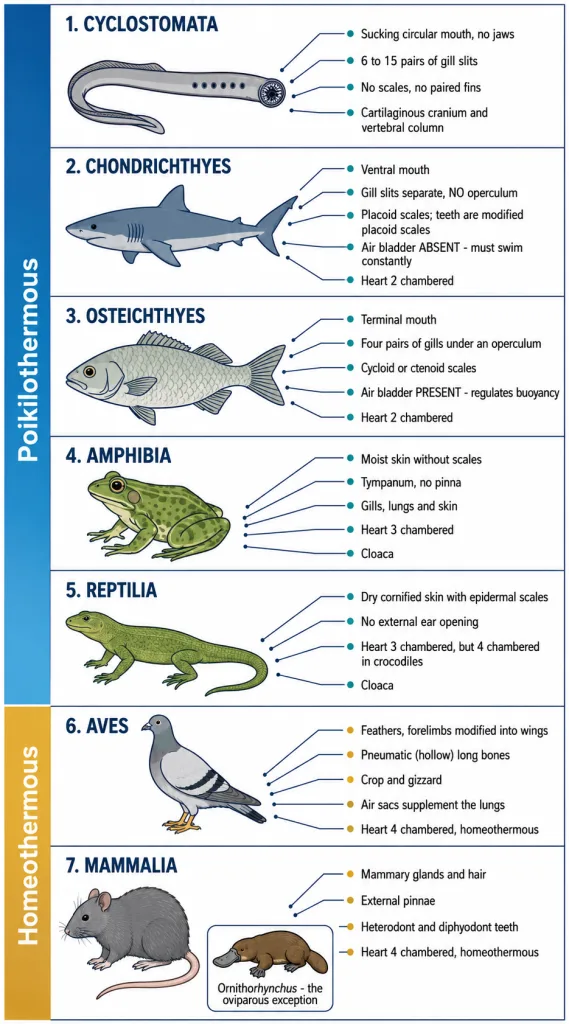
Amphibians live in both aquatic and terrestrial habitats, passing between water and damp land; no other tetrapod class is described in those terms. Most have two pairs of limbs; Ichthyophis is limbless, and it is the one limbless amphibian named among the examples. The body is divisible into head and trunk, and a tail may be present in some members and wanting in others. The skin is moist and without scales, the eyes have eyelids, and a tympanum represents the ear - no ear projects from the head. The alimentary canal, the urinary tract and the reproductive tract open into a common chamber, the cloaca, which opens to the exterior - three tracts, one aperture.
Respiration is by gills, lungs and through the skin, and skin exchange works only while that surface stays moist. Heart three-chambered, with two auricles and one ventricle; cold-blooded (poikilothermous), so the body temperature follows that of the water or air about the animal. Sexes separate, fertilisation is external, they are oviparous, and development is indirect, meaning that a larval stage intervenes before the adult form. Examples, each with its own common name: Bufo (toad), Rana (frog), Hyla (tree frog), Salamandra (salamander), Ichthyophis (limbless amphibia). Toad, frog, tree frog and salamander are four separate animals carrying four separate generic names.
Reptilia
Most reptiles are terrestrial creeping or crawling forms, and the class takes its name from that mode of going. The body is covered by dry and cornified skin with epidermal scales or scutes - dry skin blocks water loss on land and rules out the skin breathing amphibians rely on. They do not have external ear openings; the tympanum represents the ear. Limbs, when present, are two pairs. Snakes and lizards shed their scales as a skin cast.
Heart usually three-chambered, four-chambered in crocodiles; poikilothermous, the body temperature not held constant. Sexes are separate, fertilisation internal, they are oviparous, and development is direct - no larval stage intervenes. Examples with their common names: Chelone (turtle), Testudo (tortoise), Chameleon (tree lizard), Calotes (garden lizard), Crocodilus (crocodile), Alligator (alligator), Hemidactylus (wall lizard), and the poisonous snakes Naja (cobra), Bungarus (krait) and Vipera (viper). Turtle and tortoise are two different animals under two different genera.
Aves
The characteristic feature is the presence of feathers, borne by every member of the class and by no member of any other. Most can fly, except flightless birds such as Struthio, which keeps the feathers, the wings and every other avian character while never leaving the ground. They possess a beak. Forelimbs are modified into wings. Hind limbs generally have scales and are modified for walking, swimming or clasping tree branches.
The skin is dry and without glands, apart from the oil gland at the base of the tail, which supplies the oil used on the plumage. Endoskeleton fully ossified, long bones pneumatic; the gut carries a crop and gizzard as extra chambers. Heart completely four-chambered; warm-blooded (homeothermous), the temperature held steady whatever the surroundings. Respiration is by lungs, and air sacs connected to the lungs supplement respiration. Sexes separate, fertilisation internal, oviparous, development direct. Examples: Corvus (crow), Columba (pigeon), Psittacula (parrot), Struthio (ostrich), Pavo (peacock), Aptenodytes (penguin), Neophron (vulture).
Mammalia
Found in a variety of habitats - polar ice caps, deserts, mountains, forests, grasslands and dark caves - a wider spread than is given for any other class here, and some of them have adapted to fly or to live in water: Pteropus takes to the air and Delphinus and Balaenoptera to the sea, and all three are counted in the class. The unique mammalian character is the presence of milk producing glands (mammary glands); by them the young are nourished on milk. The skin bears hair, and external ears or pinnae are present. They have two pairs of limbs, adapted for walking, running, climbing, burrowing, swimming or flying - one class, six ways of using the same two pairs, and no member of it is given fewer. Different types of teeth are present in the jaw - incisors, canines, premolars and molars, the heterodont condition, several distinct shapes of tooth standing in one and the same row.
Heart four-chambered; homeothermous; respiration by lungs. Sexes separate, fertilisation internal, viviparous with few exceptions, development direct. The egg-laying exception NCERT names is Ornithorhynchus (platypus). The remaining NCERT examples are viviparous: Macropus (kangaroo), Pteropus (flying fox), Camelus (camel), Macaca (monkey), Rattus (rat), Canis (dog), Felis (cat), Elephas (elephant), Equus (horse), Delphinus (common dolphin), Balaenoptera (blue whale), Panthera tigris (tiger) and Panthera leo (lion). The two aquatic genera are not the same animal: the common dolphin is Delphinus and the blue whale is Balaenoptera, and the flying member is Pteropus, the flying fox.
The four classes side by side. The body covering runs: moist scaleless skin in Amphibia, dry cornified skin with epidermal scales or scutes in Reptilia, feathers in Aves, hair in Mammalia. Fertilisation is external in Amphibia and internal in Reptilia, in Aves and in Mammalia. Amphibia, Reptilia and Aves lay eggs; Mammalia bears its young alive with few exceptions. Development is indirect in Amphibia and direct in the other three. Across the four classes the heart is three-chambered in Amphibia, usually three-chambered in Reptilia with the crocodile at four, and completely four-chambered in Aves and in Mammalia. The temperature is not held constant in Amphibia or in Reptilia and is held constant in Aves and in Mammalia. Respiration is by lungs in all four, with gills and the skin added in Amphibia and air sacs added in Aves. Limbs are two pairs in most amphibians, two pairs in those reptiles that carry limbs at all, a wing pair and a leg pair in birds, and two pairs in mammals.
[NEET Important] When a statement about a class carries all or every, test it against the exception named in that class's own paragraph before accepting it - almost every class here is stated with a hedge.