
Coelenterata (Cnidaria)
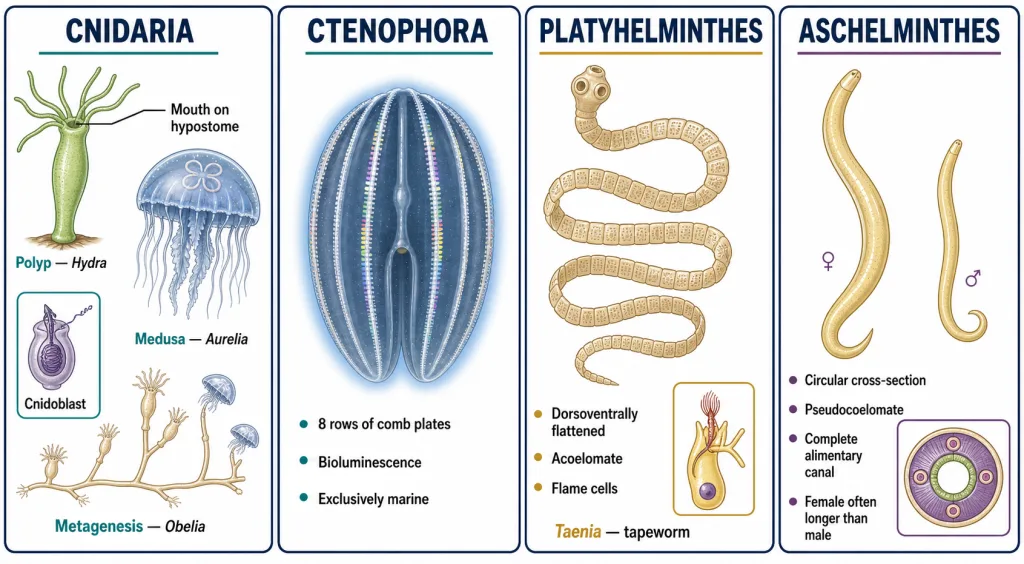
These are aquatic and mostly marine, either sessile or free-swimming, radially symmetrical, diploblastic, and at the tissue level of organisation. Mostly marine is a hedge and not a universal: the sea holds the greater number of them, but the phylum is not shut out of fresh water, and no member of it lives on land. Radial symmetry means that any plane passing through the central axis of the body cuts it into two identical halves, so such an animal has an upper and a lower side but no left and no right. Tissue level means the cells that discharge the same function are arranged together into tissues, but those tissues are not yet gathered into organs.
Diploblastic means the body wall is laid down in two embryonic layers, an outer ectoderm and an inner endoderm, with an undifferentiated mesogloea lying between them. There is no third germ layer.
The name comes from the cnidoblasts, or cnidocytes, present on the tentacles and on the body. Each one encloses a stinging capsule, the nematocyst, and these cells are used for anchorage, defence and the capture of prey.
There is a central gastro-vascular cavity, the coelenteron, with a single opening, the mouth, located on a raised region called the hypostome. The mouth serves for entry and as the route of exit. A gut of that pattern, opening to the outside at one aperture only, is an incomplete one. A complete gut, by contrast, opens at a mouth at one end and at a separate anus at the other, so that incoming food and outgoing residue keep to their own doors. Digestion is extracellular and intracellular both.
Some forms secrete a skeleton of calcium carbonate. These are the corals, such as Meandrina, the brain coral.
Two body forms occur:
- The polyp, sessile and cylindrical, as in Hydra and Adamsia
- The medusa, free-swimming and umbrella-shaped, as in Aurelia, the jelly fish
Species that show both forms alternate between them, the polyp producing medusae asexually and the medusae forming polyps sexually. That alternation is metagenesis, and Obelia is the genus named for it.
Genera and their common names: Physalia, the Portuguese man of war; Adamsia, the sea anemone; Pennatula, the sea pen; Gorgonia, the sea fan; Meandrina, the brain coral.
Ctenophora
Commonly called sea walnuts or comb jellies, ctenophores are exclusively marine, radially symmetrical, diploblastic, and at the tissue level of organisation. So far this reads as a near copy of Coelenterata, which is precisely why the phylum must be separated on the few points that differ.
The body bears eight external rows of ciliated comb plates, and these plates help in locomotion. The rows are described as external, so they lie on the outside of the body wall rather than within it, and the number recorded for the phylum is eight. It is the only count fixed for these animals. Digestion here too is extracellular and intracellular.
Bioluminescence, the property of a living organism to emit light, is well marked in ctenophores.
Sexes are not separate, so one individual yields both kinds of gamete. Reproduction takes place only by sexual means. Fertilisation is external, the gametes meeting outside the body, and development is indirect, the young passing through an intervening stage before the adult form is reached. Those last two are separate records, and neither settles the other: where the egg is fertilised says nothing about the form the young takes, so each has to be recalled on its own.
Examples: Pleurobrachia and Ctenoplana. Two genera only stand for this phylum, so both names have to be carried; knowing the better known one does not supply the other.
[NEET Important] Comb jellies and coelenterates agree on symmetry, on germ layers and on grade of organisation, so no option can be settled from a feature the two share. Work only on the lines where the paragraphs above differ. Read each option twice as well, once for the taxon it names and once for the strength of the claim, because well marked in and confined to are not the same assertion.
Platyhelminthes
Flatworms have a dorsoventrally flattened body and are mostly endoparasites found in animals including human beings.
They are bilaterally symmetrical and triploblastic, with the organ level of organisation. Bilateral symmetry means that one plane, and one only, divides the body into two halves that are mirror images of each other, so the animal has a definite left and right and a definite front and hind end. Triploblastic means a third germ layer, the mesoderm, is laid down in the developing embryo between the ectoderm and the endoderm. Organ level means that tissues here are grouped into organs, each organ carrying out one definite function. There is no body cavity between the gut and the body wall, so these worms are acoelomate.
Hooks and suckers are present in the parasitic forms, holding the worm to the tissue of its host. Some members absorb nutrients from the host directly through the general surface of the body, taking food across the body wall instead of through a mouth.
Specialised cells called flame cells help in osmoregulation and excretion. Both duties belong to the same cells; naming only one of the two is naming half the fact.
Sexes are not separate. Fertilisation is internal and development is through many larval stages. Planaria is one of the members that can rebuild the whole animal from a small piece cut out of its body, and that power is what the genus is noted for.
Examples: Taenia, the tapeworm, and Fasciola, the liver fluke.
[NEET Important] Compound claims are the trap in this phylum. Much of what is written above is stated in pairs, either two jobs discharged by one structure or two things asserted of one process, and an option that reproduces only half of such a pair is false however familiar the half it keeps. Test the quantifier as well: a feature the paragraph gives to some members or to the parasitic forms may not be carried across to the whole phylum.
Aschelminthes
The roundworms. The name records the body outline: these worms are circular in cross section. Members are free living, aquatic and terrestrial, or parasitic in plants and animals. They are bilaterally symmetrical and triploblastic, and they show the organ-system level of body organisation, which means the organs are further associated into systems, each system discharging one physiological function. The body cavity is a pseudocoelom: a cavity is present, but it is not lined by mesoderm throughout.
The alimentary canal is complete. It opens at a mouth, passes through a well developed muscular pharynx, and ends at a separate anus, so undigested residue has its own exit. Nitrogenous waste is handled by a different route altogether: an excretory tube gathers it from the body and discharges it through the excretory pore. Two exits, then, for two unlike materials, and the item that names one of them is not naming the other.
Sexes are separate (dioecious), males and females being distinct animals, and often the females are longer than the males, so two adults of one species taken from a single host may differ plainly in size. The hedge matters: it is often, not always. Fertilisation is internal and is completed inside the female. Development may be direct, the hatchling resembling the adult, or indirect; both routes are recorded for the group, so neither can be denied of it.
Examples: Ascaris (round worm), Wuchereria (filaria worm), Ancylostoma (hookworm).
[NEET Important] Keep the phylum-level statement and the genus-level statement apart. What is set down above is set down for Aschelminthes as a whole, and a phrase that is true of the phylum need not be true of the one genus in front of you. Read the quantifiers with the same care: where the record is often, an option that says always asserts more than these animals allow, and where two routes of development are open to the group, an option that allows one asserts less.