
Blood: plasma and formed elements
Blood and plasma
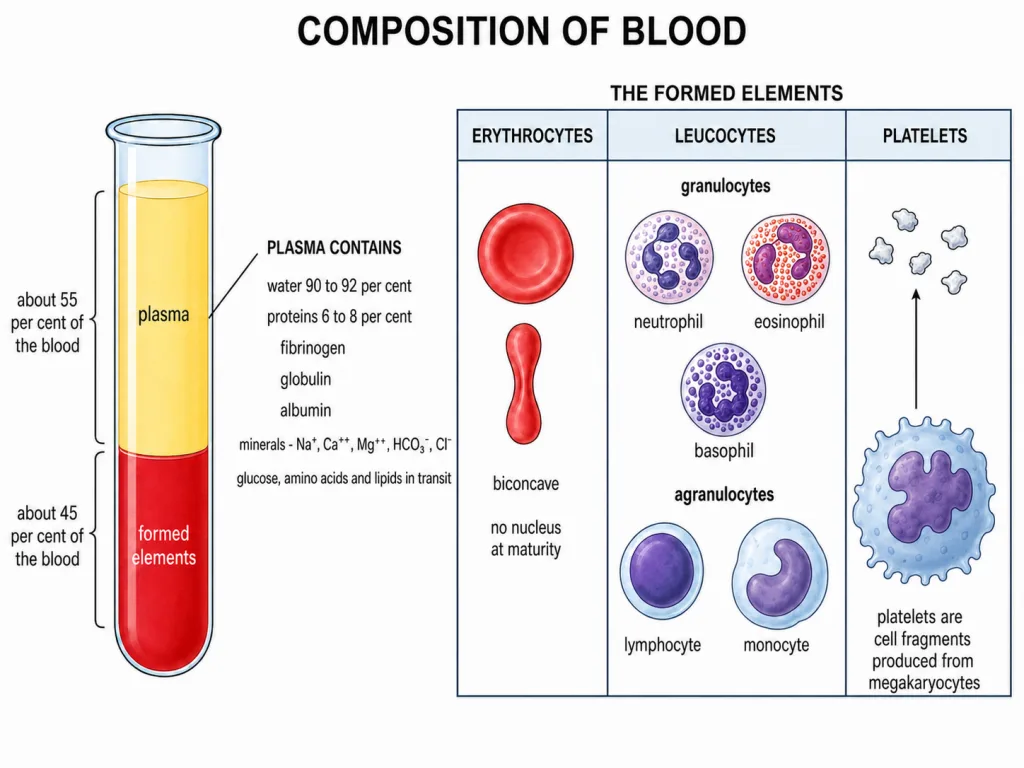
Blood is a special connective tissue consisting of a fluid matrix, plasma, and the formed elements. In an anticoagulated sample separated into fractions, plasma forms nearly 55% of blood and formed elements nearly 45%.
Plasma is a straw-coloured, viscous fluid containing 90-92% water and 6-8% proteins. The major proteins are:
- Fibrinogen: required for coagulation
- Globulins: primarily involved in defence
- Albumins: help maintain osmotic balance
Plasma also contains small amounts of minerals such as , , , and , along with glucose, amino acids and lipids in transit. Coagulation factors occur in plasma in inactive forms. Serum is plasma without the clotting factors.
Erythrocytes
The formed elements are erythrocytes, leucocytes and platelets. Erythrocytes or red blood cells are the most abundant cells in blood. NCERT reports an average of 5-5.5 million RBCs per cubic millimetre in a healthy adult man.
In adults, RBCs are formed in the red bone marrow. They are biconcave, and in most mammals they are devoid of a nucleus at maturity. Their red colour comes from the iron-containing protein haemoglobin, present at 12-16 g per 100 mL of blood in a healthy individual. Haemoglobin plays a major role in transporting respiratory gases.
RBCs live for about 120 days and are then destroyed in the spleen, called the graveyard of RBCs.
[NEET Important] Keep the units distinct: RBCs are counted in millions per cubic millimetre, whereas haemoglobin is expressed in grams per 100 mL of blood.
Leucocytes
Leucocytes or white blood cells are colourless because they lack haemoglobin. They are nucleated, generally short-lived and average 6000-8000 per cubic millimetre of blood.
- Granulocytes: neutrophils, eosinophils and basophils
- Agranulocytes: lymphocytes and monocytes
The NCERT differential count is:
- Neutrophils: 60-65%, the most abundant WBCs
- Lymphocytes: 20-25%
- Monocytes: 6-8%
- Eosinophils: 2-3%
- Basophils: 0.5-1%, the least abundant WBCs
Neutrophils and monocytes are phagocytic. Basophils secrete histamine, serotonin and heparin and participate in inflammatory reactions. Eosinophils resist infections and are associated with allergic reactions. Lymphocytes occur as B and T forms, both responsible for immune responses.
Platelets
Platelets, or thrombocytes, are cell fragments produced from megakaryocytes, specialised cells of the bone marrow. Blood normally contains 1.5-3.5 lakh platelets per cubic millimetre.
Platelets release substances involved in coagulation. A reduction in platelet number can produce clotting disorders and lead to excessive blood loss.
[NEET Important] Do not confuse the three count scales: RBCs are in millions, platelets in lakhs and WBCs in thousands per cubic millimetre of blood.