
Blood groups, coagulation and lymph
ABO blood grouping
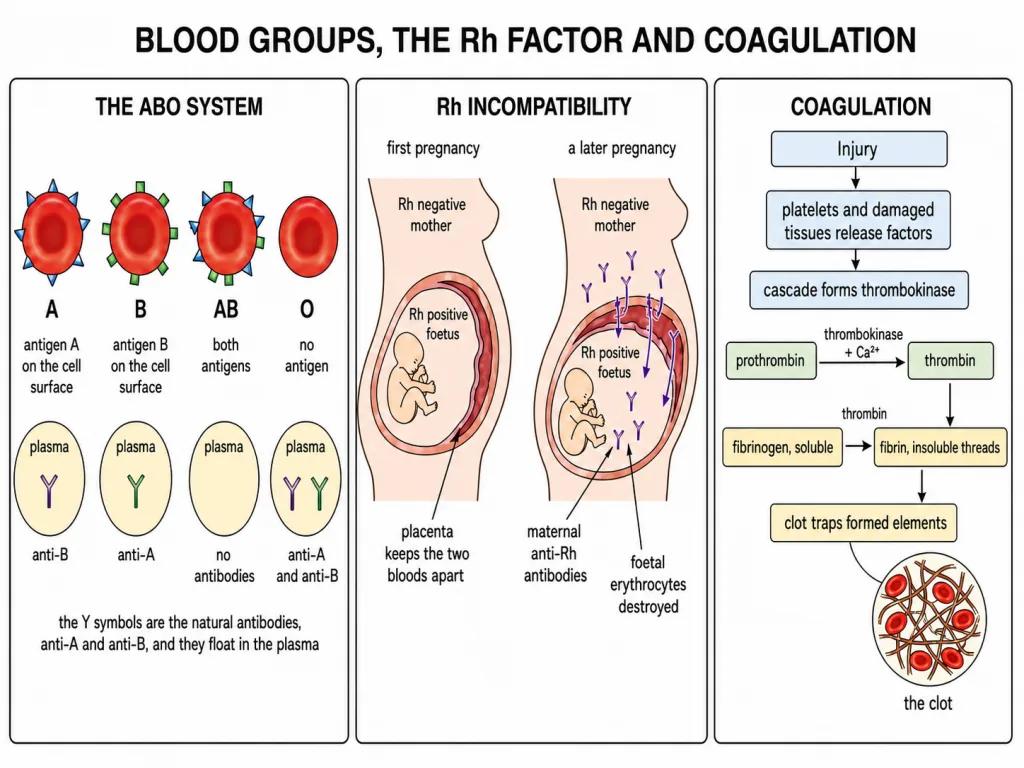
ABO grouping depends on surface antigens A and B on RBCs and the natural antibodies anti-A and anti-B in plasma. In this context, natural means that the antibodies occur without a prior mismatched transfusion; it does not mean they are already present at birth.
| Group | Antigen on RBCs | Antibody in plasma | Compatible donor groups in the NCERT table |
|---|---|---|---|
| A | A | anti-B | A, O |
| B | B | anti-A | B, O |
| AB | A and B | none | AB, A, B, O |
| O | none | anti-A and anti-B | O |
Within this ABO table, group O is called the universal donor and group AB the universal recipient. Donor and recipient blood must still be carefully matched before transfusion to prevent clumping and destruction of RBCs.
Rh grouping and erythroblastosis foetalis
The Rh antigen, similar to one present in rhesus monkeys, occurs on the RBCs of nearly 80% of humans. Individuals with the antigen are Rh positive; those without it are Rh negative. Exposure of an Rh-negative person to Rh-positive blood can induce formation of specific anti-Rh antibodies, so Rh status must also be matched before transfusion.
In an Rh-negative mother carrying an Rh-positive foetus, the two bloods are normally separated by the placenta during the first pregnancy. During delivery, small amounts of foetal Rh-positive blood may enter the maternal circulation and sensitise the mother. In a subsequent Rh-positive pregnancy, maternal anti-Rh antibodies can enter the foetal blood and destroy foetal RBCs, causing erythroblastosis foetalis, severe anaemia and jaundice, and possibly foetal death.
The condition can be prevented by administering anti-Rh antibodies to the mother immediately after the delivery of the first Rh-positive child.
Coagulation of blood
A clot is formed mainly from a network of insoluble fibrin threads that traps dead and damaged formed elements. The sequence is:
- Injury stimulates platelets to release factors; factors from damaged tissue can also initiate coagulation.
- A cascade involving inactive plasma factors forms the enzyme complex thrombokinase.
- With an important role for , thrombokinase helps convert inactive prothrombin into thrombin.
- Thrombin converts soluble fibrinogen into insoluble fibrin threads.
[NEET Important] Platelets and damaged tissue release or provide initiating factors; the cascade forms thrombokinase. Do not treat thrombokinase as a ready-made substance directly released by both.
Tissue fluid and lymph
As blood passes through tissue capillaries, some water and small water-soluble substances enter the spaces between cells. Larger proteins and most formed elements remain within the blood vessels. The released fluid is interstitial fluid or tissue fluid, and exchanges between blood and cells occur through it. It has the same mineral distribution as plasma but is poorer in large proteins.
Lymphatic vessels collect tissue fluid and return it to the major veins. Once this fluid enters the lymphatic system, it is called lymph. Lymph is colourless and contains specialised lymphocytes involved in immune responses. It also transports nutrients and hormones. Fats are absorbed into the lacteals of intestinal villi and carried through lymph.
[NEET Important] Tissue fluid in intercellular spaces and lymph inside lymphatic vessels are related, but the terms are not interchangeable at every location.