
Respiratory organs in animals and the human respiratory system
Respiration happens in five linked steps
NCERT organises respiration in humans into a fixed sequence:
- Pulmonary ventilation: atmospheric air is drawn in and carbon dioxide-rich alveolar air is released.
- Alveolar diffusion: oxygen and carbon dioxide diffuse across the alveolar membrane.
- Transport by blood: blood carries the respiratory gases.
- Tissue diffusion: oxygen and carbon dioxide diffuse between blood and tissues.
- Cellular respiration: cells utilise oxygen for catabolic reactions and release carbon dioxide.
[NEET Important] Keep breathing, gas exchange, gas transport and cellular respiration distinct. A sequence question can change one step while leaving the other four correct.
Respiratory organs across animals
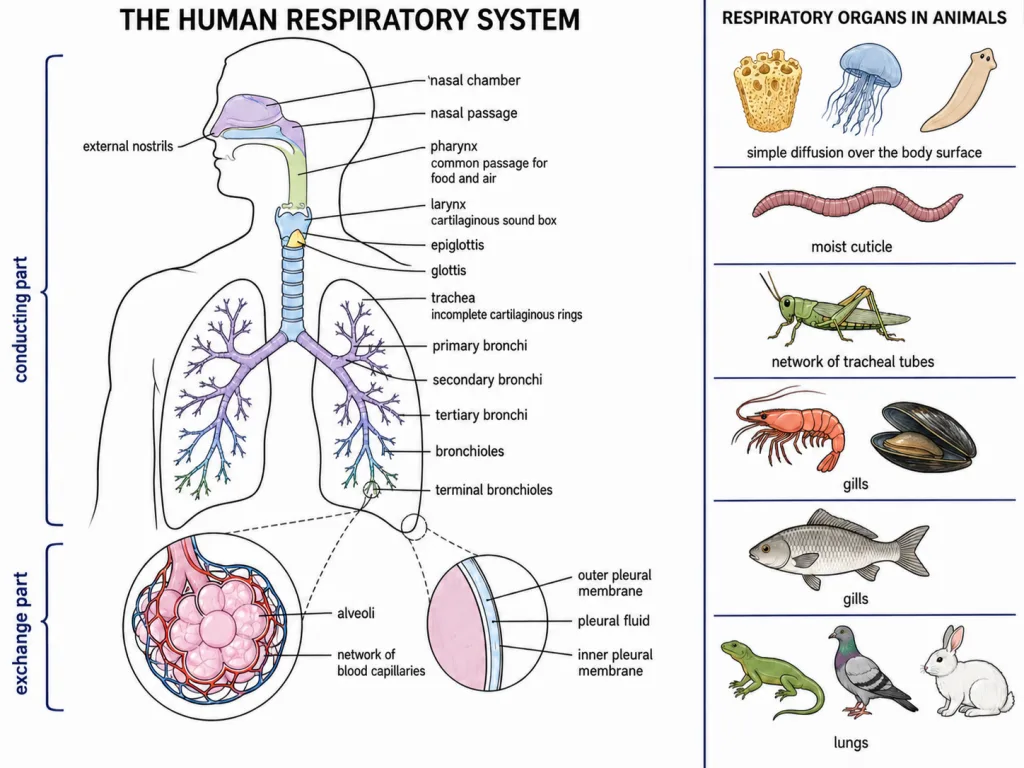
Mechanisms of breathing vary mainly with habitat and level of organisation. Sponges, coelenterates and flatworms exchange oxygen and carbon dioxide by simple diffusion over the entire body surface. Earthworms use their moist cuticle, while insects use a network of tracheal tubes to transport atmospheric air within the body.
Most aquatic arthropods and molluscs use vascularised gills for branchial respiration. Vascularised bags called lungs are used for pulmonary respiration in terrestrial forms. In NCERT's vertebrate comparison, fishes use gills, while amphibians, reptiles, birds and mammals respire through lungs; amphibians such as frogs can also use their moist skin for cutaneous respiration.
The human air passage
Learn the route as an ordered sequence: external nostrils → nasal passage → nasal chamber → pharynx → larynx → trachea. The external nostrils open above the upper lips. A portion of the pharynx is the common passage for food and air. The larynx is a cartilaginous sound box. During swallowing, the thin elastic cartilaginous epiglottis can cover the glottis and help prevent food from entering the larynx.
Trachea, bronchial tree and alveoli
The trachea extends to the mid-thoracic cavity and divides at the level of the fifth thoracic vertebra into right and left primary bronchi. The branching order is primary bronchi → secondary bronchi → tertiary bronchi → bronchioles → terminal bronchioles.
NCERT specifically states that the trachea, primary, secondary and tertiary bronchi, and initial bronchioles are supported by incomplete cartilaginous rings. Each terminal bronchiole gives rise to a number of thin, irregular-walled, vascularised, bag-like alveoli. The branching network of bronchi, bronchioles and alveoli comprises the lungs.
Pleura and the thoracic chamber
Each lung is covered by a double-layered pleura with pleural fluid between the layers. The outer pleural membrane is in close contact with the thoracic lining, while the inner membrane is in contact with the lung surface. Pleural fluid reduces friction on the lung surface. The lungs lie in the anatomically air-tight thoracic chamber.
Conducting part and exchange part
- The conducting part extends from the external nostrils to the terminal bronchioles. It transports air to the alveoli, clears foreign particles, humidifies the air and brings it to body temperature.
- The respiratory or exchange part consists of the alveoli and their ducts. It is the site of actual diffusion of oxygen and carbon dioxide between blood and air in the alveoli.
[NEET Important] Terminal bronchioles mark the end of the conducting part; alveoli and their ducts belong to the exchange part.