
Partial pressure, and why it decides everything
Air is a mixture of gases, and in a mixture each gas contributes its own share of the total pressure. That share is the partial pressure of that gas. Oxygen's share is written pO2 and carbon dioxide's is written pCO2, and every number in this section is one of those two. Keep the notation exactly like that in your answers.
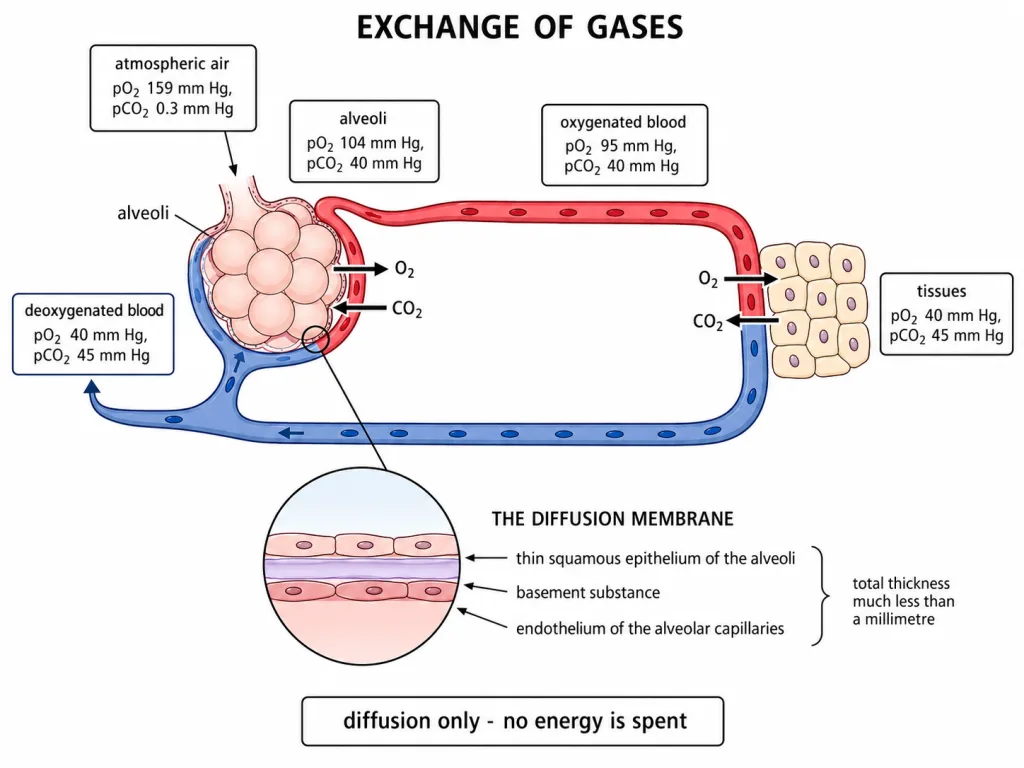
Across an exchange surface, each gas diffuses from a region of higher partial pressure to one of lower partial pressure. Ventilation and blood flow maintain these gradients, and the gradient for each gas determines the direction of its diffusion.
The numbers to know cold
| Site | pO2 (mm Hg) | pCO2 (mm Hg) |
|---|---|---|
| Atmospheric air | 159 | 0.3 |
| Alveoli | 104 | 40 |
| Oxygenated blood | 95 | 40 |
| Deoxygenated blood | 40 | 45 |
| Tissues | 40 | 45 |
Two traps sit in that table. The first is atmospheric pCO2: it is 0.3 mm Hg, a small decimal, not 3 and not 30. The second is the one that costs the most marks. Alveolar pO2 is 104 mm Hg, but oxygenated blood pO2 is 95 mm Hg - different values, different rows. If a question names the alveoli, answer 104; if it names oxygenated blood, answer 95. Never swap them.
Read the table downwards and the gradients appear. pO2 falls from 159 to 104 to 95, then drops to 40 in deoxygenated blood and in the tissues, which share the same pair of readings. pCO2 runs the other way, sitting at 40 in the alveoli and in oxygenated blood and rising to 45 in deoxygenated blood and tissues. Notice the asymmetry: oxygen crosses the alveolar wall down a gradient of 104 against 40, while carbon dioxide crosses on a gradient of just 45 against 40.
Where exchange happens, and where it does not
The alveoli are the primary sites of gas exchange. A second exchange happens deeper in the body, between the blood and the tissues. The conducting part extends from the external nostrils through the terminal bronchioles and transports air but is not the gas-exchange surface. The alveoli and their ducts form the respiratory or exchange part, where gases diffuse between alveolar air and blood. So if you are asked whether exchange occurs in the bronchi, the answer is simply no.
The diffusion membrane
To get between alveolar air and blood, a gas crosses the diffusion membrane, which has exactly three components:
- the thin squamous epithelium of the alveoli
- the endothelium of the alveolar capillaries
- the basement substance lying between those two
Commit all three components to memory. Their total thickness is much less than a millimetre, so the short diffusion distance favours rapid gas exchange.
Direction, mechanism, and rate
At the alveoli, oxygen diffuses from alveolar air into the blood while carbon dioxide diffuses from the blood into alveolar air. At the tissues the arrows reverse: oxygen leaves the blood and enters the tissues, and carbon dioxide leaves the tissues and enters the blood. Both movements are simple diffusion along the pressure and concentration gradient. No carrier molecule is involved and no energy is spent - the gradients in the table do all the work, which is why those numbers matter so much.
Three factors set how fast this goes. One is solubility: carbon dioxide's solubility is 20-25 times that of oxygen, so for the same pressure difference far more CO2 crosses the membrane than O2 does. That is exactly why carbon dioxide manages on a gradient of only about 5 mm Hg while oxygen needs a much steeper one. Another factor is the thickness of the diffusion membrane - thinner means faster, and a membrane much less than a millimetre thick is what makes the whole arrangement workable. The third is the partial pressure gradient itself: the steeper the difference between the two sides, the faster the gas moves across.
Put those three together and you have the section in one picture. Favourable gradients at both the alveoli and the tissues, a very thin three-layered membrane, and gases that dissolve readily - the arrangement is such that diffusion alone, with nothing spent to drive it, moves the volumes your body needs every minute.