
Respiratory volumes and capacities, and disorders of respiration
Why we measure the air you move
When you breathe quietly right now, you are not filling your lungs from empty - you are topping up a system that is already mostly full. Tidal volume is the volume of air inspired or expired during a normal respiration, and it is approximately 500 mL. That sounds modest for a single breath, but stretched across a minute of quiet breathing it adds up: a healthy man can inspire or expire approximately 6000 to 8000 mL of air per minute. Keep those two figures in separate drawers in your head. The 500 mL belongs to one breath; the 6000 to 8000 mL is the per-minute total, and questions love to swap them.
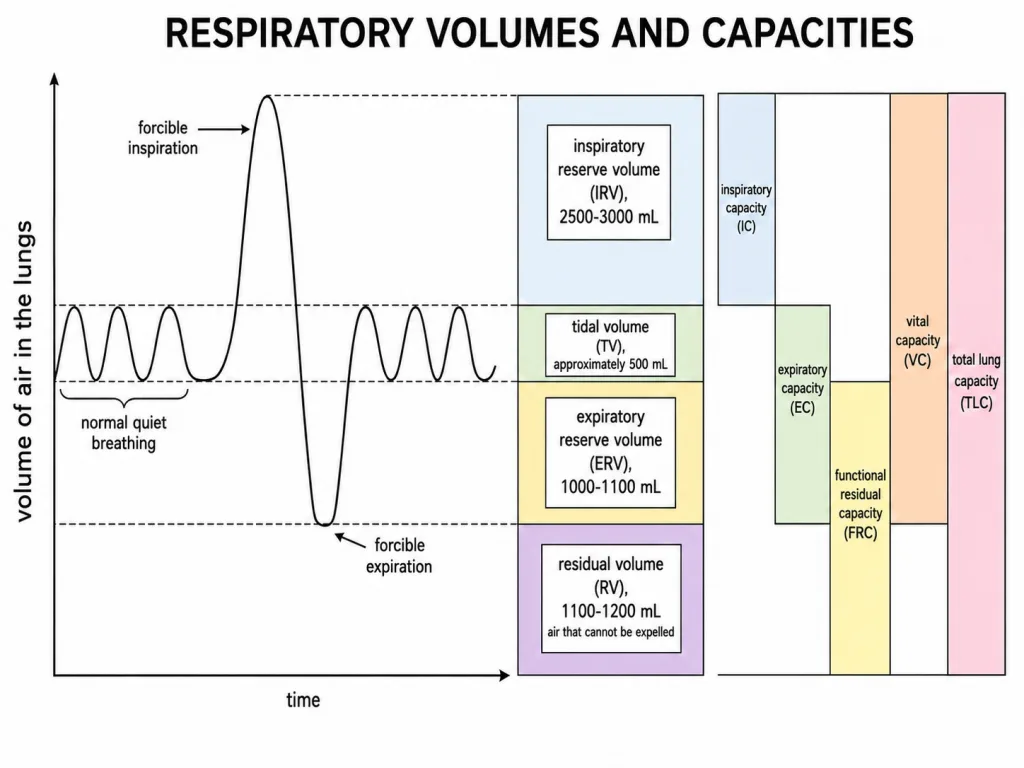
Two cautions before you memorise anything else. First, keep every range as a range - bodies differ, so most of these volumes are given as a span rather than a single number, and collapsing a span to one value is marked wrong. Second, the ranges you are asked to remember are attached to the four volumes, not to the capacities. A capacity is defined as a sum of volumes, so what you reproduce in an answer is that sum.
The four primary volumes
| Volume | What it is | Value |
|---|---|---|
| Tidal volume (TV) | Air inspired or expired during normal respiration | approximately 500 mL |
| Inspiratory reserve volume (IRV) | Extra air inspired by a forcible inspiration | 2500-3000 mL |
| Expiratory reserve volume (ERV) | Extra air expired by a forcible expiration | 1000-1100 mL |
| Residual volume (RV) | Air remaining in the lungs after a forcible expiration | 1100-1200 mL |
Inspiratory reserve volume is the additional air you can draw in when you inhale as hard as you can, over and above a normal breath - the largest of the four, at 2500-3000 mL. Expiratory reserve volume is its mirror image on the way out, the extra air you can force out after a normal expiration, at 1000-1100 mL. Residual volume is the air you simply cannot expel however hard you push, 1100-1200 mL, and it is the reason your lungs never fully deflate.
Capacities are volumes added together
A capacity is nothing more than two or more of those volumes stacked. Learn the sums and you never need a number:
- Inspiratory capacity - the total air a person can inspire after a normal expiration: tidal volume + inspiratory reserve volume.
- Expiratory capacity - the total air a person can expire after a normal inspiration: tidal volume + expiratory reserve volume.
- Functional residual capacity - the air that remains in the lungs after a normal expiration: expiratory reserve volume + residual volume.
- Vital capacity - the maximum volume of air a person can breathe in after a forced expiration, or breathe out after a forced inspiration: expiratory reserve volume + tidal volume + inspiratory reserve volume.
- Total lung capacity - the total air in the lungs at the end of a forced inspiration: residual volume + expiratory reserve volume + tidal volume + inspiratory reserve volume.
Here is the distinction worth more marks than any other in this section: vital capacity excludes residual volume. It is the air you can actually move by your own maximal effort, and since residual volume can never be expelled, it can never be part of vital capacity. Total lung capacity, by contrast, includes all four volumes. Say that plainly in an answer and you have the whole comparison. Functional residual capacity is the other one students misplace - it is what stays behind after an ordinary, unforced expiration, so it combines the air you could still push out with the air you never can.
Disorders of the respiratory system
Asthma is a difficulty in breathing that causes wheezing, and it arises from inflammation of the bronchi and bronchioles. Inflammation narrows the airways and obstructs airflow, making breathing laboured.
Emphysema is a chronic disorder in which the alveolar walls are damaged, and that damage decreases the respiratory surface available for exchange. Cigarette smoking is one of the major causes of emphysema - a link worth remembering, because it is the standard one-line question on this disorder.
Occupational hazards
Some lung damage is earned at work rather than inherited. In industries such as grinding or stone-breaking, the amount of dust produced exceeds the capacity of the body's defence mechanism to clear it. Long exposure to that dust causes inflammation, which leads to fibrosis and serious lung damage. The remedy the chapter prescribes is practical rather than medical: workers in such industries should wear protective masks while they work.