
Is Democratic Government Efficient?
Before we ask whether democracy produces a good government, we face a common objection: Is democratic government efficient? Is it effective? Some people think that democracy produces a less effective government.
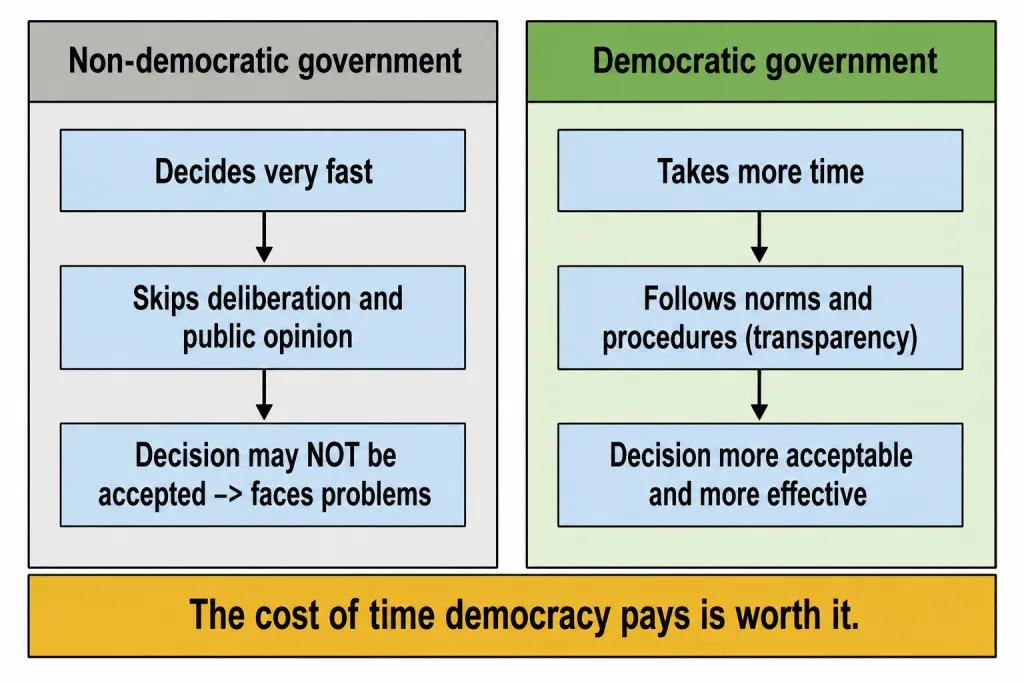
It is true that non-democratic rulers do not have to bother about deliberation in assemblies or worry about majorities and public opinion. So they can be very quick and efficient in decision-making and implementation. Democracy, on the other hand, is based on the idea of deliberation and negotiation. So some delay is bound to take place.
But does this delay make democratic government inefficient? Let us think in terms of costs. Imagine a government that takes decisions very fast, but takes decisions that are not accepted by the people and therefore face problems. In contrast, the democratic government will take more time to follow procedures - but because it has followed procedures, its decisions may be both more acceptable to the people and more effective. So the cost of time that democracy pays is perhaps worth it.
Transparency: The Right to Examine Decisions
Now look at the other side. Democracy ensures that decision-making will be based on norms and procedures. So a citizen who wants to know whether a decision was taken through the correct procedures can find this out. She has the right and the means to examine the process of decision-making. This is known as transparency.
This factor of transparency is often missing from a non-democratic government. Therefore, when we assess the outcomes of democracy, it is right to expect democracy to produce a government that follows procedures and is accountable to the people.
We can also expect that a democratic government develops:
- Mechanisms for citizens to hold the government accountable, and
- Mechanisms for citizens to take part in decision-making whenever they think fit.
A good example of transparency at work is the Right to Information (RTI) Act, which allows citizens to demand information about how the government has acted on their applications and decisions.
Accountable and Responsive Government
There are some things that democracy must provide. In a democracy, we are most concerned with ensuring that people will have the right to choose their rulers and will have control over the rulers. Whenever possible and necessary, citizens should be able to participate in decision-making that affects them all.
Therefore, the most basic outcome of democracy should be that it produces a government that is:
- Accountable to the citizens - it must answer for its decisions and can be questioned and held responsible; and
- Responsive to the needs and expectations of the citizens - it must attend to what the people want.
To measure democracies on this expected outcome, you would look for the following practices and institutions: regular, free and fair elections; open public debate on major policies and legislations; and citizens' right to information about the government and its functioning. These are the tools through which a government is kept accountable and responsive.
Questions and Answers
Q1. Some people say democracy is less efficient than dictatorship because it is slow. How does the chapter respond to this?
Answer: The chapter accepts that democracy involves deliberation and negotiation, so some delay is unavoidable, while non-democratic rulers can decide quickly. But it argues that speed alone is not the right test. A fast decision that people do not accept creates problems, whereas a democratic decision that follows procedures is more acceptable and effective. Thus the cost of time democracy pays is worth it, because it buys acceptability and legitimacy.
Q2. What is transparency? Why is it an important outcome of democracy?
Answer: Transparency means that a citizen has the right and the means to examine the process by which decisions are taken - she can find out whether the correct norms and procedures were followed. It is important because it lets citizens hold the government accountable and check misuse of power. Tools like the Right to Information Act make transparency real. This factor is usually missing in non-democratic governments, which is why democracy is superior in this respect.
Q3. Distinguish between an accountable government and a responsive government.
Answer:
- An accountable government is one that must answer for its decisions to the people; citizens have mechanisms (elections, public debate, RTI) to hold it responsible and question how it acted.
- A responsive government is one that is attentive and sensitive to the needs, demands and expectations of the citizens, and tries to meet them.
A democracy is expected to be both: it should follow correct procedures (accountability) and also serve the people's real needs (responsiveness).