
The Passion for Respect and Freedom
Democracy stands much superior to any other form of government in promoting the dignity and freedom of the individual. Every individual wants to receive respect from fellow beings. Often conflicts arise among individuals precisely because some feel that they are not treated with due respect.
The passion for respect and freedom is the very basis of democracy. Democracies throughout the world have recognised this, at least in principle. This recognition has been achieved in various degrees in various democracies. For societies that have long been built on the basis of subordination and domination, it is not a simple matter to accept that all individuals are equal - but democracy plants that principle firmly, giving it legal and moral force.
The Dignity of Women
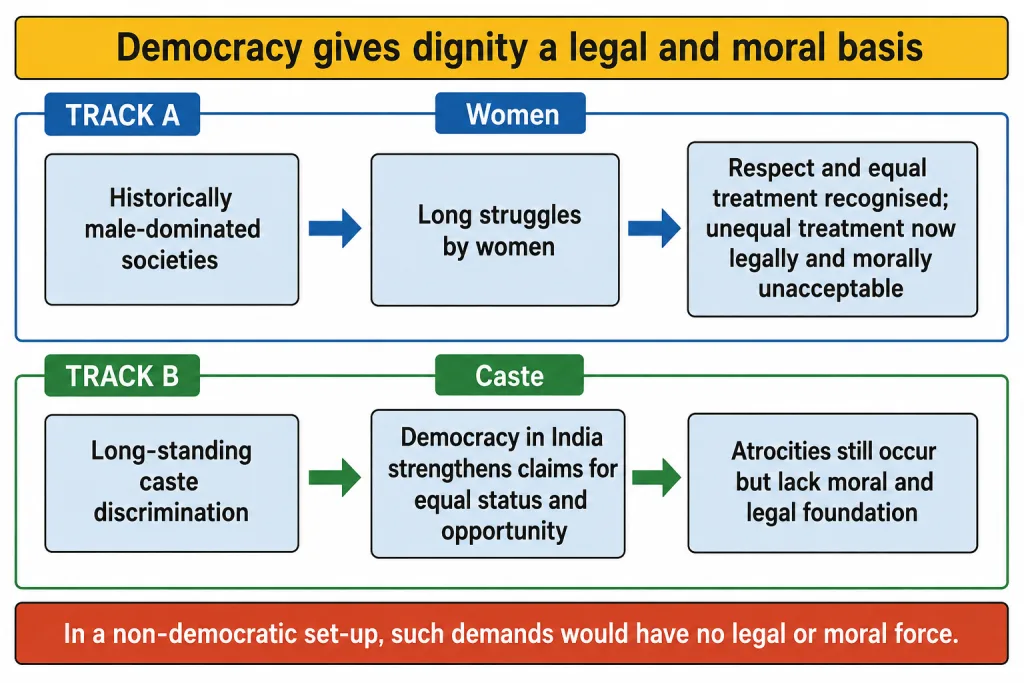
Take the case of the dignity of women. Most societies across the world were historically male-dominated societies. Long struggles by women have created some sensitivity today that respect for and equal treatment of women are necessary ingredients of a democratic society.
This does not mean that women are always actually treated with respect. But once the principle is recognised, it becomes easier for women to wage a struggle against treatment that is now unacceptable, legally and morally.
Here lies the crucial difference. In a non-democratic set-up, this unacceptability would have no legal basis, because the principle of individual freedom and dignity would not carry legal and moral force there. Democracy gives women's demand for equality a firm foundation to stand on.
Caste and the Value of Democratic Rights
The same is true of caste inequalities. Democracy in India has strengthened the claims of the disadvantaged and discriminated castes for equal status and equal opportunity.
There are, of course, still instances of caste-based inequalities and even atrocities. But - and this is the key point - these practices now lack any moral and legal foundation. What was once accepted is now legally and morally condemned. Perhaps it is exactly this recognition - that every citizen has equal rights - that makes ordinary citizens value their democratic rights so deeply.
The great achievement of democracy in the matter of dignity is not that discrimination has vanished, but that discrimination has been stripped of legitimacy. The oppressed can now fight on the strength of the Constitution and the law, and this transforms a person from a helpless subject into a rights-bearing citizen.
Questions and Answers
Q1. Why is democracy considered superior to other forms of government in promoting the dignity and freedom of the individual?
Answer: Every individual craves respect and freedom, and this passion is the basis of democracy. Democracies recognise, at least in principle, that all individuals are equal in dignity and freedom, and they give this principle legal and moral force. Even in societies long built on domination and subordination, democracy establishes equality as a binding principle. No other form of government secures individual dignity and freedom so firmly - which is why democracy is superior in this respect.
Q2. How has democracy helped the struggle of women for dignity and equal treatment?
Answer: Historically most societies were male-dominated. Through long struggles, women have made respect and equal treatment recognised as necessary ingredients of a democratic society. This does not mean women are always treated well, but once the principle is recognised, unequal treatment becomes legally and morally unacceptable, giving women a firm basis to wage their struggle. In a non-democratic set-up such unacceptability would have no legal force - so democracy gives women's cause its foundation.
Q3. 'Caste-based atrocities still occur, yet democracy has still made a difference.' Explain.
Answer: It is true that caste-based inequalities and atrocities still occur. But democracy in India has strengthened the claims of disadvantaged castes for equal status and equal opportunity, so that such practices now lack any moral and legal foundation. Discrimination is no longer legitimate - the oppressed can fight it using the Constitution and law. This recognition of equal rights is what makes ordinary citizens value their democratic rights, turning them from subjects into citizens.