
How Do We Assess Democracy's Outcomes?
As we wind up our study of democracy, it is time to move beyond specific themes and ask a general set of questions: What does democracy do? What outcomes can we reasonably expect of democracy? And does democracy actually fulfil these expectations in real life?
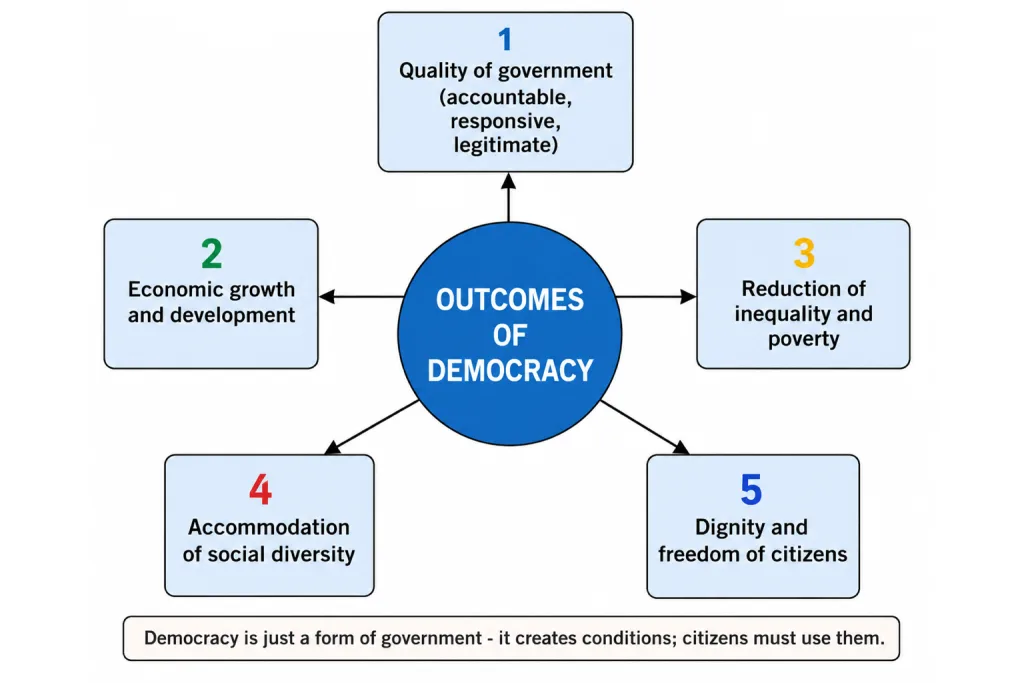
Before we look at the record of democracy, we must first get clarity on how to think about this subject. Only then can we examine the expected and actual outcomes of democracy in various respects - the quality of government, economic well-being, inequality, social differences and conflict, and finally freedom and dignity.
When we talk to people around us, most of them support democracy against other alternatives such as rule by a monarch, the military, or religious leaders. But not so many of them are satisfied with democracy in practice. So we face a dilemma: democracy is seen to be good in principle, but felt to be not so good in its practice. This dilemma invites us to think hard about the outcomes of democracy.
Moral Reasons and Prudential Reasons
The dilemma above raises an important question. Do we prefer democracy only for moral reasons - because it is the right and just form of government? Or are there also some prudential reasons to support democracy - that is, practical reasons of self-interest and good results?
Our fascination for democracy often pushes us into taking the position that democracy can solve all our socio-economic and political problems. When some of our expectations are not met, we begin blaming the idea of democracy, or we start doubting whether we are living in a democracy at all.
The first step towards thinking carefully about the outcomes of democracy is to recognise that democracy is just a form of government. It can only create conditions for achieving something. The citizens have to take advantage of those conditions and achieve those goals. Democracy is not a magic wand; it opens doors, but people must walk through them.
Over a Hundred Democracies - All Different
Over a hundred countries of the world today claim and practise some kind of democratic politics. They have formal constitutions, they hold elections, they have political parties, and they guarantee rights to their citizens. While these features are common to most of them, these democracies are very different from one another in terms of their social situations, their economic achievements, and their cultures.
Clearly, what is achieved or not achieved under each of these democracies will be very different. But this raises a sharp question: is there something that we can expect from every democracy, just because it is a democracy?
Recall the debate in Madam Lyngdoh's class from the Class IX textbook. It emerged there that democracy is a better form of government than dictatorship because it:
- Promotes equality among citizens;
- Enhances the dignity of the individual;
- Improves the quality of decision-making;
- Provides a method to resolve conflicts; and
- Allows room to correct mistakes.
These are the reasonable expectations against which we will now test the record of democracy.
Questions and Answers
Q1. What is meant by saying that democracy is 'good in principle but not so good in its practice'?
Answer: When asked in the abstract, most people support the idea of democracy over rule by kings, the army, or religious leaders - so democracy is seen as good in principle. Yet many of these same people are dissatisfied with the actual working of their democracy, complaining about corruption, delay, or unmet needs - so it is felt to be not so good in practice. This gap between the ideal and the reality is the very dilemma that pushes us to examine the outcomes of democracy carefully.
Q2. Explain the difference between moral reasons and prudential reasons for supporting democracy.
Answer:
- Moral reasons support democracy because it is right and just in itself - it respects the equality and dignity of every citizen.
- Prudential reasons support democracy for its practical, useful results - such as better and more acceptable decisions, peaceful conflict resolution, and the ability to correct mistakes.
Both kinds of reasons matter. Democracy is valued not only because it is a good idea, but also because it tends to produce good outcomes.
Q3. 'Democracy is just a form of government.' Why is recognising this the first step in assessing democracy's outcomes?
Answer: Recognising that democracy is just a form of government reminds us that it can only create conditions for achieving goals; it does not automatically deliver them. The citizens must take advantage of those conditions to achieve development, equality, and justice. If we expect democracy to magically solve every problem, we will unfairly blame the idea whenever an expectation is not met. Judging it fairly means asking what it is reasonable to expect, and then checking the record.