
Can Democracy Produce Harmony?
Do democracies lead to a peaceful and harmonious life among citizens? It is a fair expectation that democracy should produce a harmonious social life.
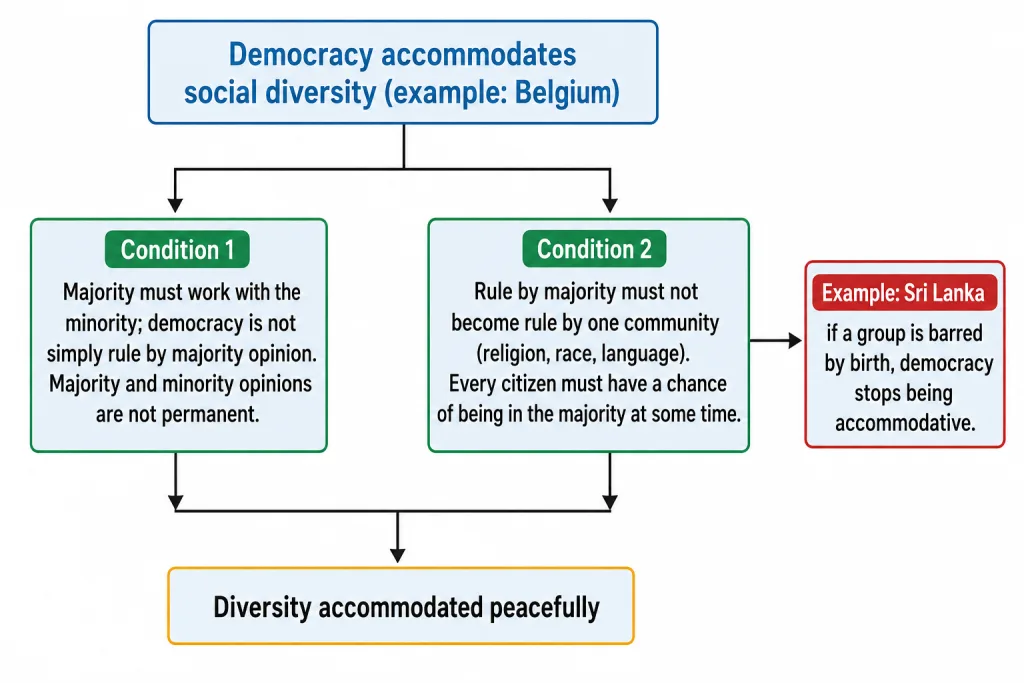
We have already seen in earlier chapters how democracies accommodate various social divisions. In the first chapter we saw how Belgium successfully negotiated the differences among its ethnic populations through power-sharing arrangements. Democracies usually develop a procedure to conduct their competition, and this reduces the possibility of tensions becoming explosive or violent.
No society can fully and permanently resolve conflicts among different groups. But in a democracy we can learn to respect these differences, and we can evolve mechanisms to negotiate them. Democracy is best suited to produce this outcome. Non-democratic regimes, by contrast, often turn a blind eye to or suppress internal social differences. The ability to handle social differences, divisions and conflicts is thus a definite plus point of democratic regimes.
Two Conditions: The Lesson of Sri Lanka
The example of Sri Lanka reminds us that a democracy must fulfil two conditions in order to accommodate social diversity successfully:
Condition 1: Majority must work with minority. It is necessary to understand that democracy is not simply the rule of majority opinion. The majority always needs to work with the minority so that the government functions to represent the general view. Majority and minority opinions are not permanent - they can shift from issue to issue.
Condition 2: Rule by majority must not become rule by a majority community. Rule by the majority must not turn into the permanent rule of one religious, racial or linguistic community. Rule by majority means that, in every decision or every election, different persons and groups may form the majority. Democracy remains democracy only as long as every citizen has a chance of being in the majority at some point of time. If someone is barred from being in the majority on the basis of birth, then the democratic rule ceases to be accommodative for that person or group.
Why This Outcome Matters
The accommodation of social diversity is one of democracy's strongest and most valuable outcomes. Societies are almost never made of a single, uniform group; they contain many religions, languages, races and regions. If these differences are allowed to harden into permanent hostility, they lead to civil war and breakdown, as parts of Sri Lanka's history sadly show.
Democracy offers the best tools to manage this diversity peacefully:
- It provides procedures for competition so that groups compete through votes and negotiation, not violence.
- It teaches groups to respect differences and to see majority and minority as temporary and shifting.
- It keeps the door of the majority open to everyone, so no group feels permanently excluded.
Where these tools are used well - as in Belgium - diverse societies hold together. Where they are ignored, even a democracy can slide into conflict. That is why the two conditions above are so important.
Questions and Answers
Q1. How does democracy help in the accommodation of social diversity?
Answer: Democracy helps by developing a procedure to conduct competition among groups, which reduces the chance of tensions turning violent. Though no society can permanently resolve all conflicts, democracy lets people respect differences and evolve mechanisms to negotiate them - as Belgium did among its ethnic groups. Non-democratic regimes instead ignore or suppress such differences. This ability to handle divisions peacefully is a definite plus point of democracy.
Q2. What are the two conditions a democracy must fulfil to accommodate social diversity? (from the example of Sri Lanka)
Answer:
- First, democracy is not simply the rule of majority opinion; the majority must work with the minority so the government represents the general view, since majority and minority opinions are not permanent.
- Second, rule by the majority must not become the rule of one majority community by religion, race or language. Every citizen must have a chance of being in the majority at some time. If a person is barred by birth from ever being in the majority, democracy stops being accommodative for them.
Q3. 'Democracy remains democracy only as long as every citizen has a chance of being in the majority at some point of time.' Explain this statement.
Answer: In a healthy democracy, majorities are formed afresh on each issue and each election, so different persons and groups can be in the majority at different times. This keeps everyone included and hopeful of influencing decisions. But if a group is permanently excluded from the majority because of birth - their religion, race or language - then power becomes the fixed monopoly of one community. Such a system loses its accommodative character and, in that respect, ceases to be a true democracy.