
A Mixed Record on Accountability
Having said what we can expect from democracy, we must honestly ask what democracy actually delivers. The performance of democracies shows a mixed record.
Democracies have had greater success in setting up regular and free elections and in creating conditions for open public debate. But most democracies fall short of elections that give a fair chance to everyone, and they do not subject every decision to public debate. Democratic governments also do not have a very good record when it comes to sharing information with citizens.
All that can be said in their favour is that democratic regimes are much better than any non-democratic regime in these respects. In substantive terms, it may be reasonable to expect from democracy a government that is attentive to the needs and demands of the people and is largely free of corruption.
Corruption and Responsiveness: A Weak Record
The record of democracies is not impressive on these two counts. Democracies often frustrate the needs of the people and often ignore the demands of a majority of their population. The routine tales of corruption are enough to convince us that democracy is not free of this evil.
At the same time, there is nothing to show that non-democracies are less corrupt or more sensitive to the people. So corruption and unresponsiveness are not unique failings of democracy; other forms of government are no better, and are usually worse, because they lack even the tools to expose such failings.
This honesty is important. Judging democracy fairly means admitting its shortcomings while still comparing it with the real alternatives, not with an imaginary perfect government.
The Great Strength: Legitimate Government
There is one respect in which democratic government is certainly better than all its alternatives: democracy produces a legitimate government.
A democratic government may be slow, less efficient, not always very responsive or clean. But it is the people's own government. That is why there is overwhelming support for the idea of democracy all over the world. As evidence from South Asia shows, this support exists in countries with democratic regimes as well as in countries without democratic regimes:
- People wish to be ruled by representatives elected by them.
- They also believe that democracy is suitable for their country.
Democracy's ability to generate its own support is itself an outcome that cannot be ignored. Very few people doubt the suitability of democracy for their own country.
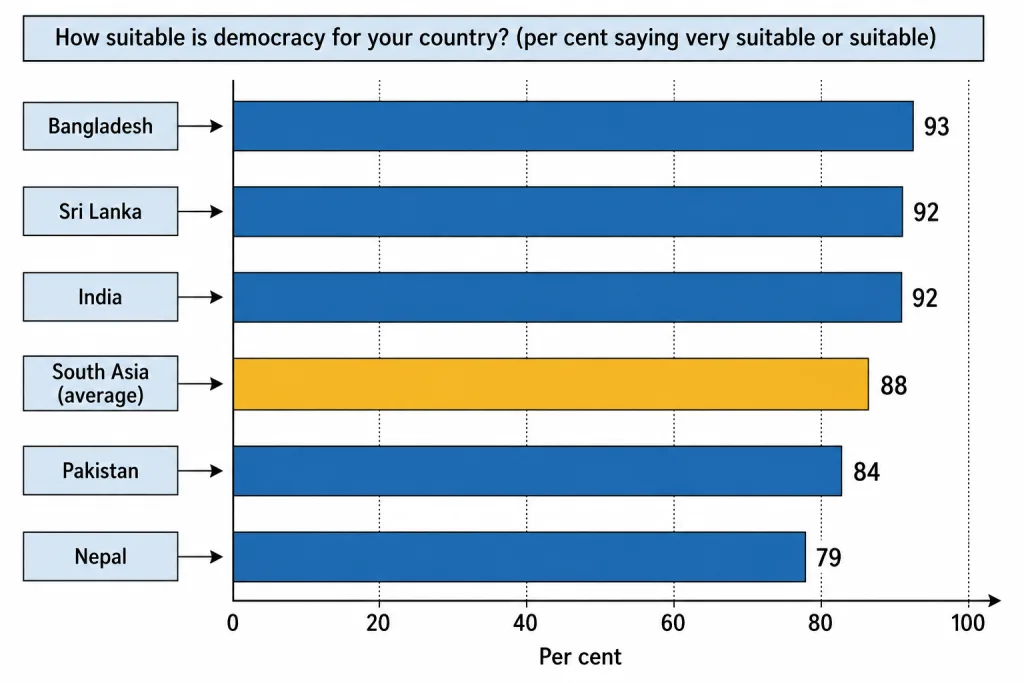
The survey figures for the question 'How suitable is democracy for your country?' (those saying very suitable or suitable) were: South Asia 88, Bangladesh 93, Sri Lanka 92, India 92, Pakistan 84, and Nepal 79.
Questions and Answers
Q1. Describe the mixed record of democracies in producing accountable and responsive government.
Answer: Democracies do well in holding regular and free elections and in allowing open public debate. But they often fall short in giving every candidate a fair chance, in subjecting every decision to debate, and in sharing information with citizens. They also often frustrate people's needs and are not free of corruption. The saving point is that democracies are still much better than any non-democratic regime, which is neither less corrupt nor more sensitive to the people.
Q2. What is a legitimate government? Why is legitimacy called democracy's greatest strength?
Answer: A legitimate government is one that is the people's own government - chosen by them and accepted as rightful. It is called democracy's greatest strength because, even when a democracy is slow, inefficient or imperfect, it enjoys the people's consent and support. Surveys across South Asia show overwhelming support for democracy even in countries without democratic regimes. This ability of democracy to generate its own support sets it apart from every other form of government.
Q3. 'There is nothing to show that non-democracies are less corrupt.' Why is this point important when judging democracy?
Answer: It is important because it reminds us to compare democracy with the real alternatives, not with a perfect ideal. Democracy has a poor record on corruption, but so do dictatorships and other regimes - and they usually lack the elections, free press and right to information needed to even expose corruption. So corruption is a failing of governments in general, not of democracy alone; democracy at least provides the means to fight it.