
Does Democracy Deliver Economic Development?
If democracies are expected to produce good governments, then is it not fair to expect that they would also produce development? Unfortunately, the evidence shows that in practice, many democracies did not fulfil this expectation.
Debates about democracy tend to be very passionate, and rightly so, because democracy appeals to some of our deep values. Such debates cannot always be resolved simply. But some debates can and should be settled by referring to facts and figures. The debate about the economic outcomes of democracy is one such debate. Over the years, students of democracy have gathered careful evidence on the relationship of democracy with economic growth and economic inequality.
The Evidence: Growth Rates, 1950-2000
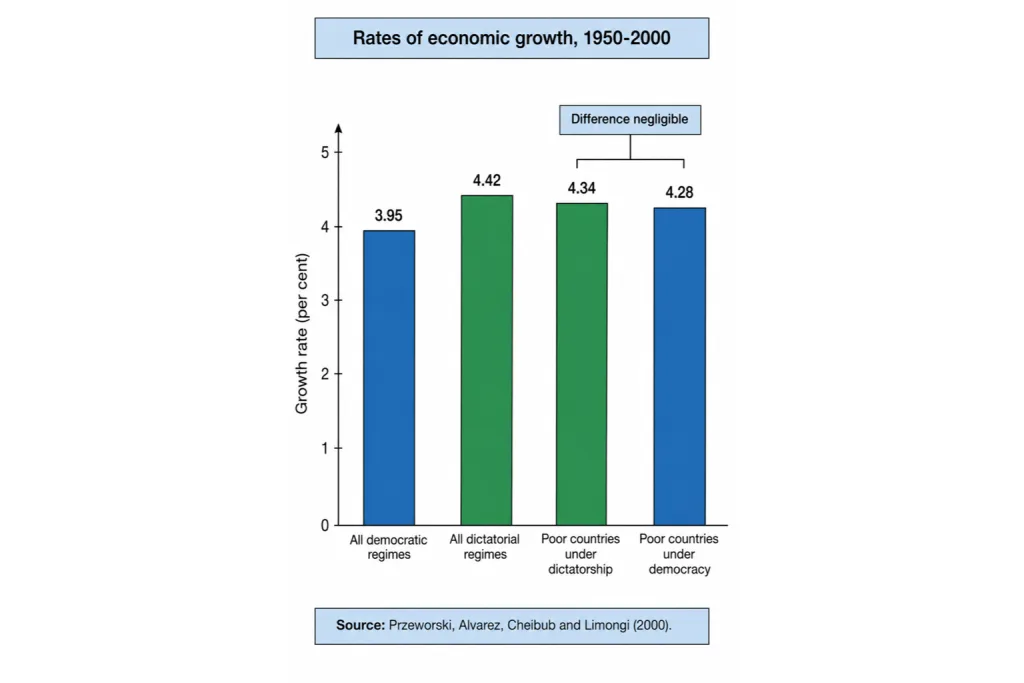
Consider all democracies and all dictatorships for the fifty years between 1950 and 2000. The evidence (from Przeworski and others) is summarised below:
- All democratic regimes: growth rate 3.95
- All dictatorial regimes: growth rate 4.42
- Poor countries under dictatorship: growth rate 4.34
- Poor countries under democracy: growth rate 4.28
On average, dictatorial regimes have had a slightly higher rate of economic growth. The inability of democracy to achieve higher economic development worries us.
But look carefully at the last two figures. When we compare the record only in poor (less developed) countries, the difference between dictatorships (4.34) and democracies (4.28) is negligible - virtually no difference at all.
What the Evidence Really Tells Us
The lesson from the data is balanced. We cannot say that democracy is a guarantee of economic development. But we can expect that democracy will not lag behind dictatorships in this respect, especially among the poor countries where the difference is negligible.
Also, economic development depends on several factors besides the form of government, as you have already studied in economics:
- the country's population size,
- the global situation,
- cooperation from other countries, and
- the economic priorities adopted by the country.
So it is unfair to blame democracy alone for slower growth. When the difference in growth rates is so small, and democracy has several other positive outcomes - legitimacy, dignity, accountability, peaceful conflict resolution - it is better to prefer democracy. We should not reject a form of government that respects our freedom merely for a tiny difference in growth figures.
Questions and Answers
Q1. What does the evidence on economic growth rates between 1950 and 2000 show about democracies and dictatorships?
Answer: For the fifty years 1950-2000, all dictatorial regimes grew slightly faster (4.42) than all democratic regimes (3.95). This slightly lower growth under democracy is a matter of concern. However, when the comparison is limited to poor countries, the growth rate under dictatorship (4.34) and under democracy (4.28) is almost the same - the difference is negligible. So democracy does not clearly lag behind in the countries that matter most for this question.
Q2. 'Democracy is not a guarantee of economic development, but that is not a reason to reject it.' Explain.
Answer: The evidence shows democracy cannot guarantee faster economic development. But economic growth depends on many factors - population size, the global situation, cooperation from other countries, and a country's own economic priorities - not just its form of government. Since the difference in growth is very small (and negligible among poor countries), and since democracy delivers many other positive outcomes such as legitimacy, dignity and accountability, it is better to prefer democracy.
Q3. List the factors, other than the form of government, on which economic development depends.
Answer: As studied in economics, economic development depends on several factors besides whether a country is a democracy or a dictatorship:
- the size of the country's population,
- the global (international) situation,
- the extent of cooperation received from other countries, and
- the economic priorities adopted by the country.
Because so many factors are involved, the form of government alone cannot be blamed for slower growth.