
Political Equality Alongside Economic Inequality
Perhaps more than development, it is reasonable to expect democracies to reduce economic disparities. Even when a country achieves economic growth, we may ask: will the wealth be distributed so that all citizens have a share and lead a better life? Or is economic growth in democracies accompanied by increased inequalities?
Democracies are based on political equality. All individuals have equal weight in electing representatives - one person, one vote, one value. But running parallel to this process of bringing everyone into the political arena on an equal footing, we find growing economic inequalities.
A small number of ultra-rich enjoy a highly disproportionate share of wealth and incomes. Not only that, their share in the total income of the country has been increasing. Meanwhile, those at the bottom of society have very little to depend upon, and their incomes have been declining. Sometimes they find it difficult to meet their basic needs - food, clothing, house, education and health. This is the paradox of democracy: political equality above, economic inequality below.
The Evidence: Inequality of Income
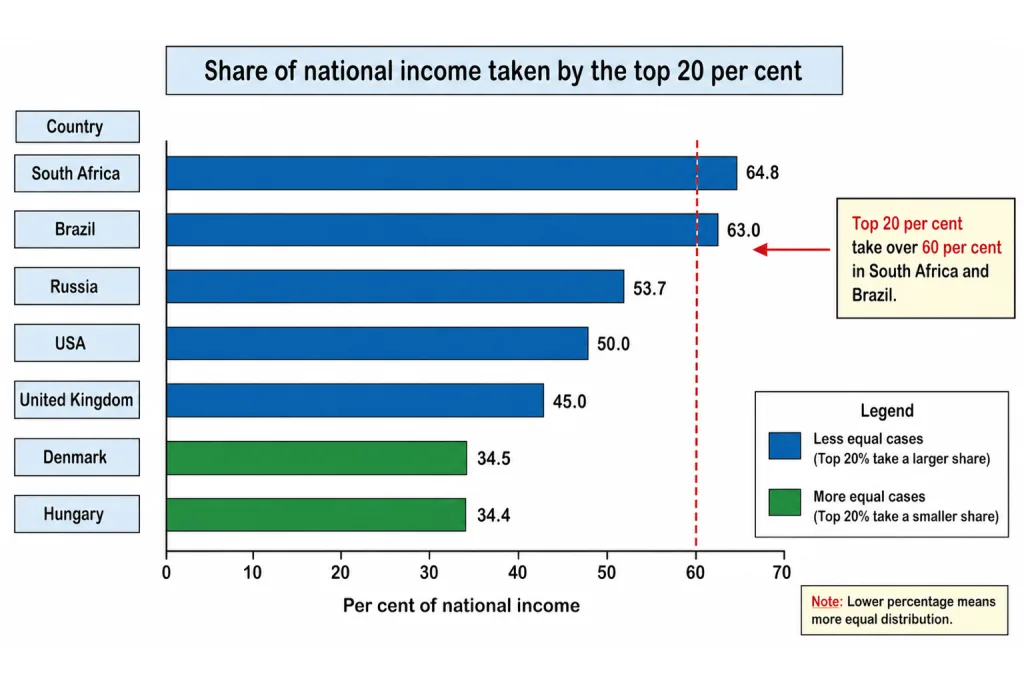
Within democracies there can be a very high degree of inequality. The table below shows the share of national income taken by the top 20 per cent and left to the bottom 20 per cent in selected countries:
| Country | Top 20 per cent | Bottom 20 per cent |
|---|---|---|
| South Africa | 64.8 | 2.9 |
| Brazil | 63.0 | 2.6 |
| Russia | 53.7 | 4.4 |
| USA | 50.0 | 4.0 |
| United Kingdom | 45.0 | 6.0 |
| Denmark | 34.5 | 9.6 |
| Hungary | 34.4 | 10.0 |
In democracies like South Africa and Brazil, the top 20 per cent take away more than 60 per cent of the national income, leaving less than 3 per cent for the bottom 20 per cent. Countries like Denmark and Hungary are much better in this respect. So democracy by itself does not automatically produce equal distribution.
The Puzzle: Why the Poor Stay Poor
There is a puzzle here. Democracy is a rule of the majority. The poor are in a majority. So democracy ought to be a rule of the poor - yet it often is not. Why?
In actual life, democracies do not appear to be very successful in reducing economic inequalities. The poor constitute a large proportion of voters, and no party will like to lose their votes. Yet democratically elected governments do not appear to be as keen to address the question of poverty as one would expect.
The situation is much worse in some other countries. In Bangladesh, more than half the population lives in poverty. People in several poor countries are now dependent on the rich countries even for their food supplies.
The honest conclusion is that democracy has succeeded in giving political equality but has been far less successful in reducing economic inequality and poverty. This remains one of the biggest challenges for democracies.
Questions and Answers
Q1. Explain the paradox of political equality and economic inequality in a democracy.
Answer: Democracy rests on political equality: every citizen has an equal vote, regardless of wealth. But running parallel to this, economic inequalities keep growing. A small group of ultra-rich hold a disproportionate and rising share of income, while those at the bottom see their incomes decline and struggle to meet basic needs. Thus equality in the political arena coexists with deep inequality in the economic arena - the central paradox of modern democracy.
Q2. 'The poor are in a majority, so democracy should be a rule of the poor.' Why does this often not happen?
Answer: Although the poor form a large share of voters and no party wishes to lose their votes, elected governments often do not appear keen to tackle poverty effectively. Wealth and influence shape policy, and short-term politics may sideline the poor's real needs. So even though the poor are numerically a majority, democracies have not been very successful in reducing economic inequality - showing a gap between the promise and the practice of democracy.
Q3. What does the income-inequality table tell us about democracies like South Africa and Brazil compared with Denmark and Hungary?
Answer: The table shows that inequality varies greatly among democracies. In South Africa (64.8) and Brazil (63.0), the top 20 per cent take more than 60 per cent of national income, leaving the bottom 20 per cent with less than 3 per cent. In contrast, Denmark (34.5) and Hungary (34.4) are far more equal, with the bottom 20 per cent getting around 10 per cent. This proves democracy does not automatically ensure fair distribution; outcomes depend on each country's policies.