
Expectations as Criteria for Judgement
We have now examined what we can reasonably expect from democracy - accountable and legitimate government, economic well-being, reduction of inequality, accommodation of diversity, and dignity and freedom. These expectations from democracy also serve as the criteria for judging any democratic country.
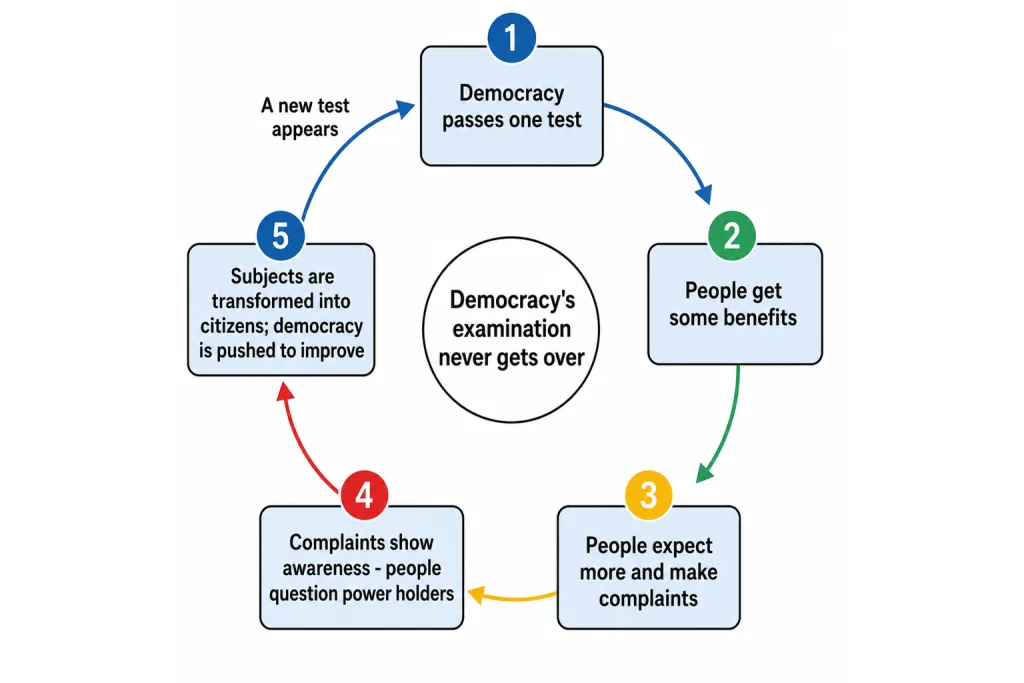
This gives democracy a very special character. What is most distinctive about democracy is that its examination never gets over. As democracy passes one test, it produces another test. As people get some benefits of democracy, they ask for more and want to make democracy even better.
That is why, when we ask people about the way democracy functions, they will always come up with more expectations, and many complaints. Far from being a sign of failure, this endless list of demands is a sign of health - it means citizens are alert, aware, and hopeful of improvement.
Complaints as a Testimony to Success
Here lies one of the most striking ideas of the chapter. The very fact that people are complaining is itself a testimony to the success of democracy.
Complaints show that people have developed the awareness and the ability to expect things from those in power - and to look critically at power holders, at "the high and the mighty". In a dictatorship, people cannot openly complain; the absence of complaints there is a sign of fear, not satisfaction.
A public expression of dissatisfaction with democracy therefore shows the success of the democratic project. It transforms people from the status of a subject into that of a citizen:
- A subject merely obeys and has no voice.
- A citizen has rights, expectations, and the confidence to demand accountability.
This transformation - from subject to citizen - is one of democracy's deepest and most valuable outcomes.
The Belief in the Vote
Finally, most individuals today believe that their vote makes a difference - to the way the government is run and to their own self-interest. Survey evidence from South Asia captures this: to the question 'Does your vote make a difference?', the shares answering yes were South Asia 65, Bangladesh 66, India 67, Nepal 75, Pakistan 50, and Sri Lanka 65.
This belief in the efficacy of the vote is placed above the mere calculation of utility. People value their vote not only for what it might immediately gain them, but because it makes them active participants in their own governance.
In sum, democracy's outcomes are uneven. It is not a guarantee of fast growth or of equal wealth, and its record on corruption and responsiveness is mixed. But it is clearly superior in producing a legitimate government and in securing the dignity and freedom of citizens. Above all, democracy keeps improving itself, because it turns silent subjects into demanding, participating citizens whose expectations never stop pushing it to be better.
Questions and Answers
Q1. What is meant by saying that in a democracy 'the examination never gets over'?
Answer: It means democracy is never finished improving. As it passes one test, it faces a new one: once people receive some benefits, they expect more and demand that democracy become even better. So citizens always voice fresh expectations and complaints. This continuous testing is distinctive to democracy and is a sign of its health, because it shows people are engaged and hopeful of improvement rather than resigned.
Q2. 'The fact that people are complaining is itself a testimony to the success of democracy.' Explain.
Answer: Complaints show that people have gained the awareness and confidence to expect things from their government and to question power holders critically. Such open criticism is possible only in a democracy; in a dictatorship, silence reflects fear, not contentment. A public expression of dissatisfaction therefore reflects democracy's success: it has transformed people from subjects who merely obey into citizens who hold power to account.
Q3. Explain how democracy transforms a 'subject' into a 'citizen'.
Answer: A subject simply obeys authority and has no voice or rights in how they are governed. A citizen has rights, expectations and the confidence to question rulers and demand accountability. By giving people dignity, freedom, the vote and the right to complain, democracy raises them from passive subjects into active citizens. Most people today believe their vote makes a difference, and this sense of participation - valued above mere personal gain - marks the shift from subject to citizen.