
Four Challenges to Political Parties
We have seen how crucial political parties are for the working of democracy. Since parties are the most visible face of democracy, it is natural that people blame parties for whatever is wrong with democracy. All over the world, people express strong dissatisfaction with the failure of parties to perform their functions well - and this is true in our country too. Popular criticism has focused on four problem areas. Parties must face and overcome these challenges to remain effective instruments of democracy.
Lack of Internal Democracy and Dynastic Succession
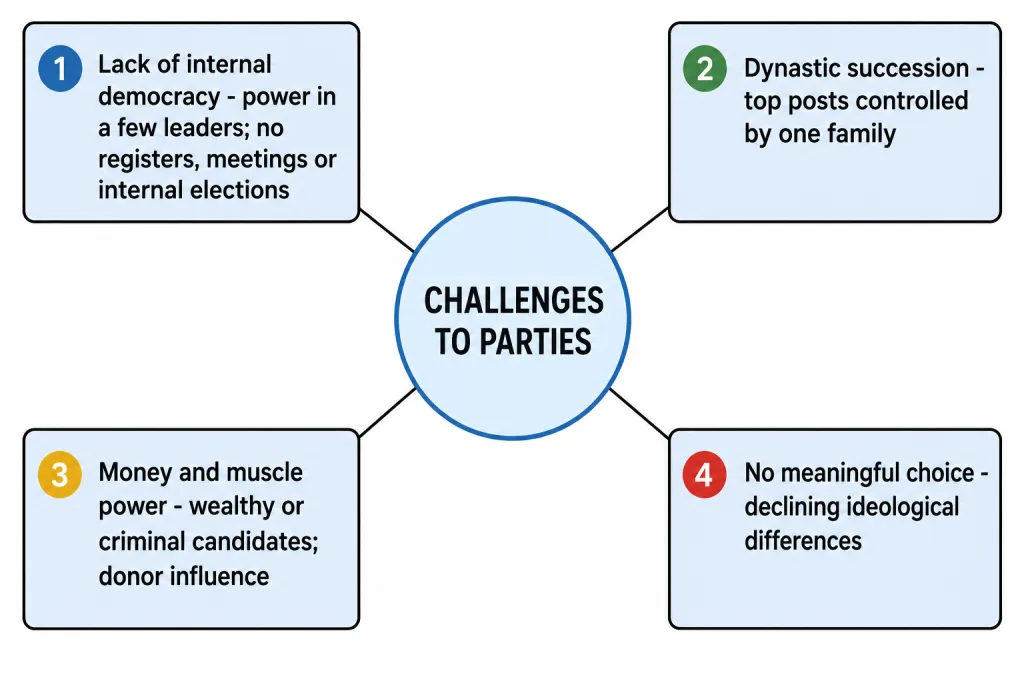
1. Lack of internal democracy. All over the world there is a tendency in parties towards the concentration of power in one or a few leaders at the top. Parties often do not keep membership registers, do not hold organisational meetings, and do not conduct internal elections regularly. Ordinary members do not get enough information or the means to influence decisions. As a result, leaders assume great power, and those who disagree find it difficult to continue. Personal loyalty to the leader becomes more important than loyalty to party principles.
2. Dynastic succession. This is linked to the first challenge. Because most parties do not follow open and transparent procedures, there are few ways for an ordinary worker to rise to the top. Leaders in a position of unfair advantage favour people close to them, often their family members. In many parties the top positions are controlled by one family. This is unfair to other members, and bad for democracy, because people without adequate experience or support come to occupy positions of power. The tendency exists even in some older democracies.
Money and Muscle Power, and No Meaningful Choice
3. Money and muscle power. This challenge concerns the growing role of money and muscle power in parties, especially during elections. Since parties focus only on winning elections, they use short-cuts. They tend to nominate candidates who have or can raise a lot of money. Rich people and companies that fund parties gain influence over their policies and decisions. In some cases, parties even support criminals who can win. Democrats everywhere are worried about the rising role of rich people and big companies in politics.
4. No meaningful choice. Very often parties do not offer a meaningful choice to voters. To offer a real choice, parties must be significantly different. But in recent years the ideological differences among parties have declined in most parts of the world. For example, the difference between the Labour Party and the Conservative Party in Britain is very small. In India too, the differences among major parties on economic policies have narrowed. Those who want genuinely different policies have no option, and voters often cannot even elect very different leaders because the same leaders keep shifting from one party to another.
Questions and Answers
Q1. What are the four challenges faced by political parties?
Answer: The four challenges are:
- Lack of internal democracy (concentration of power in a few leaders).
- Dynastic succession (top posts controlled by one family).
- Growing role of money and muscle power, especially in elections.
- Parties often not offering a meaningful choice to voters.
Q2. Explain the challenge of 'lack of internal democracy' in political parties.
Answer: Lack of internal democracy means power is concentrated in one or a few top leaders. Parties often keep no membership registers, hold no organisational meetings, and do not conduct internal elections. Ordinary members lack information and influence, so personal loyalty to the leader matters more than principles, and those who disagree find it hard to remain in the party.
Q3. How is dynastic succession bad for democracy?
Answer: In dynastic succession, leaders use their unfair advantage to favour their family members, so top posts stay within one family. This is unfair to other members and harmful to democracy because people without adequate experience or popular support come to hold power simply by belonging to the ruling family.
Q4. Why do parties often fail to offer a meaningful choice to voters?
Answer: To offer a meaningful choice, parties must be significantly different. But ideological differences among parties have declined - for example, the Labour and Conservative parties in Britain differ little, and in India the major parties' economic policies have converged. Moreover, the same leaders keep shifting between parties, so voters cannot even elect very different leaders.