
How Many Parties Should We Have?
In a democracy, any group of citizens is free to form a political party. In this formal sense there are a very large number of parties - more than 750 parties are registered with the Election Commission of India. But not all of them are serious contenders in elections. Usually only a handful of parties are effectively in the race to win elections and form the government. So the real question is: how many major or effective parties are good for a democracy?
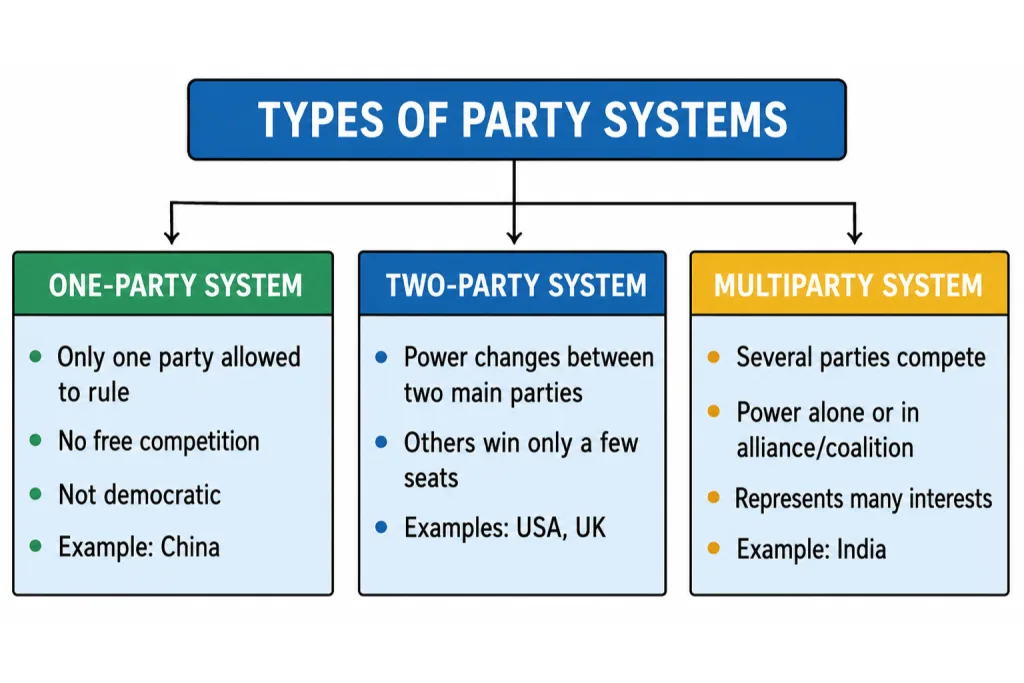
The number of major parties in a country gives us its party system. There are three broad types: the one-party system, the two-party system and the multiparty system.
One-Party and Two-Party Systems
One-party system. In some countries, only one party is allowed to control and run the government. In China, for example, only the Communist Party is allowed to rule. Although people are legally free to form parties, this does not really happen because the electoral system does not permit free competition for power. A one-party system is not a good option because it is not democratic. Any democratic system must allow at least two parties to compete in elections and give competing parties a fair chance to come to power.
Two-party system. In some countries, power usually changes between two main parties. Several other parties may exist, contest elections and win a few seats, but only the two main parties have a serious chance of winning a majority and forming the government. The United States of America and the United Kingdom are examples of a two-party system.
The Multiparty System
If several parties compete for power, and more than two parties have a reasonable chance of coming to power either on their own or in alliance with others, we call it a multiparty system. India has a multiparty system.
In such a system, the government is often formed by various parties coming together in a coalition. When several parties join hands to contest elections and win power, it is called an alliance or a front. For example, in the 2004 parliamentary elections there were three major alliances in India - the National Democratic Alliance (NDA), the United Progressive Alliance (UPA) and the Left Front.
The multiparty system often appears very messy and can lead to political instability. At the same time, it allows a variety of interests and opinions to enjoy political representation.
Which System Is Best?
So which of these systems is better? Perhaps the best answer is that this is not a very good question. A party system is not something a country can choose. It evolves over a long time, depending on the nature of the society, its social and regional divisions, its history of politics and its system of elections. These things cannot be changed quickly.
Each country develops a party system conditioned by its special circumstances. For example, India evolved a multiparty system because the enormous social and geographical diversity of such a large country cannot be easily absorbed by two or even three parties. No system is ideal for all countries and all situations.
Questions and Answers
Q1. What is a one-party system? Why is it not considered a good democratic option?
Answer: In a one-party system, only one party is allowed to control and run the government, as with the Communist Party in China. It is not a good democratic option because the electoral system does not permit free competition for power. A democracy must allow at least two parties to compete and give them a fair chance of coming to power.
Q2. Distinguish between a two-party system and a multiparty system.
Answer: In a two-party system, power usually changes between two main parties, and only these two have a serious chance of winning a majority (e.g., the USA and the UK). In a multiparty system, several parties compete, and more than two have a reasonable chance of coming to power on their own or in alliance (e.g., India). The multiparty system may be messier but represents more interests.
Q3. What is an alliance or a front? Give an Indian example.
Answer: When several parties in a multiparty system join hands to contest elections and win power, it is called an alliance or a front. In India's 2004 parliamentary elections there were three major alliances - the National Democratic Alliance (NDA), the United Progressive Alliance (UPA) and the Left Front.
Q4. Why did India develop a multiparty system?
Answer: A party system is not chosen but evolves according to a country's society, divisions, history and electoral system. India developed a multiparty system because its huge social and geographical diversity could not be absorbed by just two or three parties. Many groups and regions needed representation, which produced a large number of parties.