
What Does a Political Party Do?
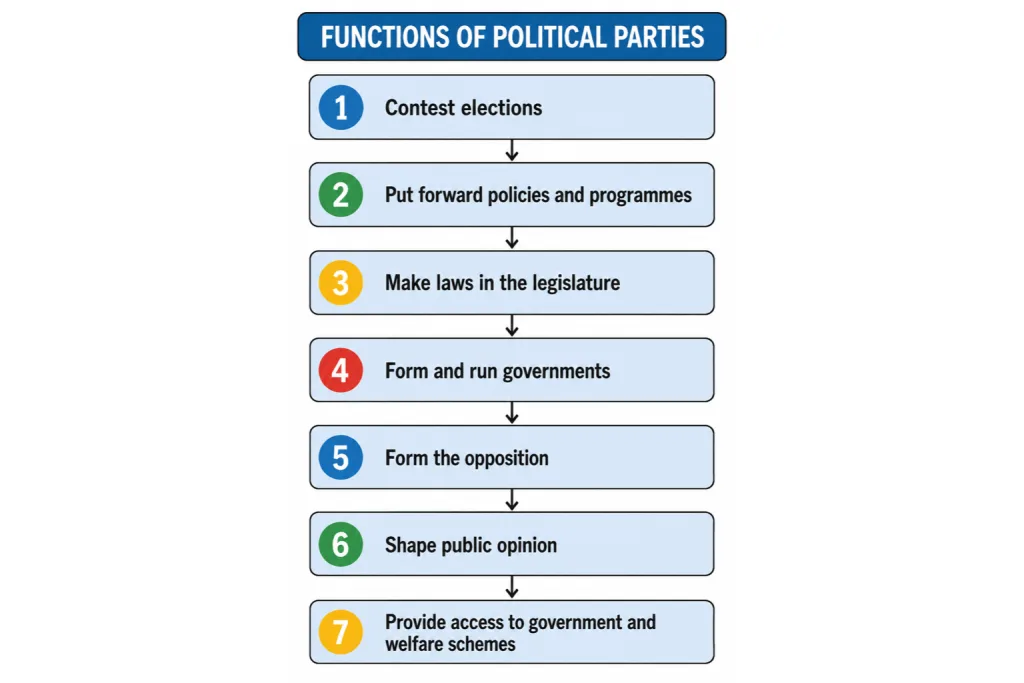
Basically, political parties fill political offices and exercise political power. They do this by performing a whole series of functions in a democracy. The chapter lists seven main functions of political parties. Read them carefully, because 'functions of political parties' is one of the most frequently asked Board questions.
Parties link the ordinary citizen with the government. Without them, the vast variety of opinions in a large society could never be gathered, sorted and turned into policies and laws.
Contesting Elections and Offering Policies
1. Parties contest elections. In most democracies, elections are fought mainly among candidates put up by political parties. Parties select their candidates in different ways. In some countries such as the USA, members and supporters of a party choose its candidates. In other countries like India, the top party leaders choose candidates for contesting elections.
2. Parties put forward different policies and programmes, and voters choose from them. Each of us may have different opinions on what policies are suitable for society, but no government can handle such a large variety of views. In a democracy, a large number of similar opinions have to be grouped together to give a direction in which the government can frame policies. A party thus reduces a vast multitude of opinions into a few basic positions which it supports. A government is expected to base its policies on the line taken by the ruling party - the party that runs the government.
Making Laws, Forming Governments and Opposition
3. Parties play a decisive role in making laws. Formally, laws are debated and passed in the legislature. But since most members belong to a party, they go by the direction of the party leadership, irrespective of their personal opinions.
4. Parties form and run governments. The big policy decisions are taken by the political executive, which comes from the political parties. Parties recruit leaders, train them and then make them ministers to run the government the way they want.
5. Losing parties form the opposition. Parties that lose the elections play the role of opposition to the parties in power. They voice different views, criticise the government for its failures or wrong policies, and mobilise opposition to the government.
Shaping Opinion and Providing Access
6. Parties shape public opinion. They raise and highlight issues. Parties have lakhs of members and activists spread all over the country. Many pressure groups are extensions of political parties among different sections of society. Parties sometimes launch movements to resolve problems faced by people, and opinions in society often crystallise along the lines that parties take.
7. Parties provide people access to government machinery and welfare schemes. For an ordinary citizen it is far easier to approach a local party leader than a government officer. That is why people feel close to parties even when they do not fully trust them. Parties therefore have to be responsive to people's needs and demands - otherwise people can reject them in the next elections.
Questions and Answers
Q1. State any four functions that political parties perform in a democracy.
Answer: Political parties perform many functions. Four important ones are:
- Contesting elections by putting up candidates.
- Putting forward policies and programmes from which voters choose.
- Forming and running governments by supplying the political executive.
- Acting as the opposition when they lose, by criticising the government.
Q2. How do parties help in making laws for a country?
Answer: Laws are formally debated and passed in the legislature. But most members of the legislature belong to some party, and they vote according to the direction of the party leadership rather than their personal opinions. In this way, parties play a decisive role in making laws.
Q3. Why do people often feel close to political parties even when they do not fully trust them?
Answer: Parties provide ordinary people access to government machinery and to welfare schemes. It is much easier for a citizen to approach a local party leader than a government officer to get work done. This everyday usefulness makes people feel close to parties even when they do not fully trust them.
Q4. What is the role of a ruling party and of the opposition?
Answer: The ruling party is the party that runs the government; the government bases its policies on the line taken by this party. The opposition is made up of the parties that lost the election. The opposition voices different views, criticises the government for its failures and wrong policies, and mobilises public opposition - keeping the government accountable.