
Can Parties Be Reformed?
To face these challenges, political parties need to be reformed. But the question is difficult: are parties willing to reform? In a democracy, the final decision is made by leaders who represent parties. People can replace them, but only with another set of party leaders. If none of them wishes to reform, how can anyone force them to change? Citizens all over the world face this puzzle.
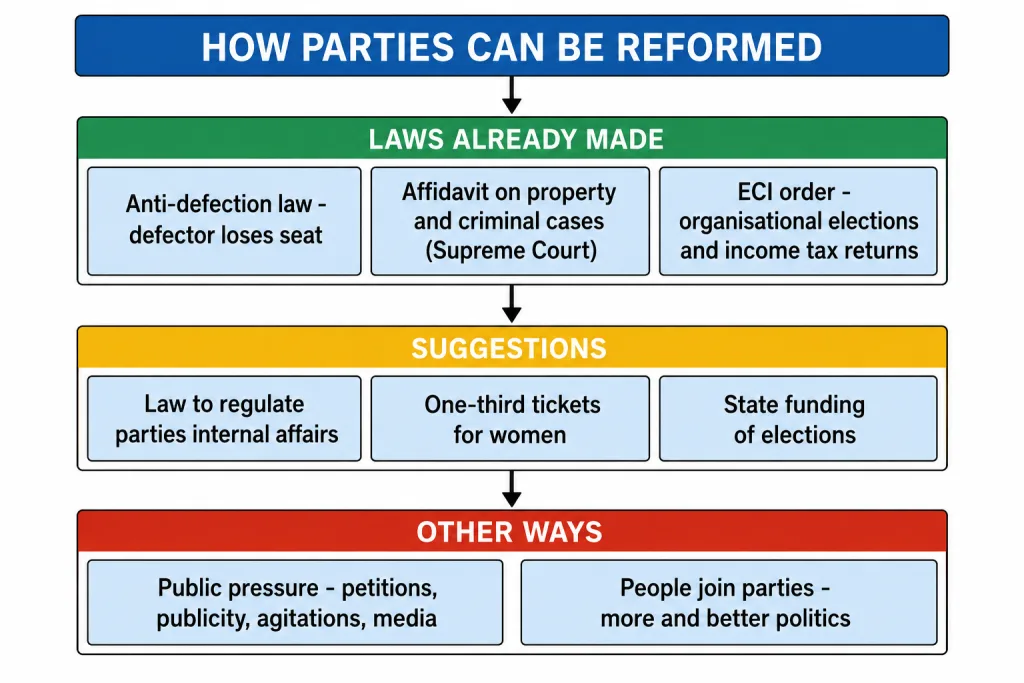
Even so, several recent efforts and suggestions in our country aim to reform political parties and their leaders. Some are already laws, while others are proposals yet to be accepted.
Recent Legal Efforts
1. The Anti-Defection Law. The Constitution was amended to prevent elected MLAs and MPs from changing parties. This was done because many representatives were defecting (changing party allegiance) to become ministers or for cash rewards. Now, if an MLA or MP changes parties, he or she loses the seat in the legislature. This has helped bring defection down. But it has also made dissent more difficult, as MPs and MLAs must accept whatever the party leaders decide.
2. Affidavit disclosure (Supreme Court order). The Supreme Court passed an order to reduce the influence of money and criminals. Now every candidate must file an affidavit - a signed, sworn statement - giving details of property and criminal cases pending against them. This has made a lot of information public, but there is no system to check whether it is true.
3. Election Commission order. The Election Commission made it necessary for parties to hold their organisational elections and file their income tax returns. Parties have started doing this, but sometimes it is a mere formality, so it is unclear if it has increased internal democracy.
Suggestions for Further Reform
Besides these efforts, many suggestions are often made to reform parties:
- A law to regulate the internal affairs of parties: making it compulsory to maintain a register of members, follow the party's own constitution, have an independent authority to act as a judge in party disputes, and hold open elections to the highest posts.
- Making it mandatory for parties to give a minimum number of tickets, about one-third, to women candidates, and to have a quota for women in the party's decision-making bodies.
- State funding of elections: the government could give parties money to meet election expenses - in kind (petrol, paper, telephone) or in cash based on the votes secured in the last election.
These suggestions have not yet been accepted by parties. We must also be careful about legal solutions to political problems, because over-regulation can be counter-productive and force parties to find ways to cheat the law.
Two Other Ways to Reform
Apart from laws and suggestions, there are two other ways in which parties can be reformed:
- People can put pressure on political parties. This can be done through petitions, publicity and agitations. Ordinary citizens, pressure groups, movements and the media can play an important role. If parties feel they would lose public support by not reforming, they would take reform more seriously.
- People can join parties. Political parties can improve if those who want reform join them. The quality of democracy depends on the degree of public participation. It is difficult to reform politics if ordinary citizens stay outside and only criticise from the sidelines.
In short, the problem of bad politics can be solved by more and better politics - by informed, active citizens taking part rather than merely complaining.
Questions and Answers
Q1. What is the anti-defection law, and what have been its effects?
Answer: The Constitution was amended to stop elected MLAs and MPs from changing parties; anyone who defects now loses the seat in the legislature. It was passed because members defected to become ministers or for cash. It has reduced defection, but it has also made dissent difficult, since members must obey the party leaders' decisions.
Q2. How does the affidavit requirement help reduce the influence of money and criminals? What is its weakness?
Answer: By order of the Supreme Court, every candidate must file an affidavit disclosing property and pending criminal cases. This makes a lot of information public, helping voters judge candidates. Its weakness is that there is no system to verify whether the information given is true, so its impact on curbing money and crime is uncertain.
Q3. Suggest any three reforms to strengthen political parties.
Answer: Three suggested reforms are:
- A law to regulate parties' internal affairs - membership registers, own constitution, an independent authority for disputes, and open elections to top posts.
- A mandatory one-third quota of tickets for women and a quota for women in decision-making bodies.
- State funding of elections, given in kind (petrol, paper, telephone) or in cash based on past votes.
Q4. Apart from laws, what two other ways can reform political parties?
Answer: First, people can pressure parties through petitions, publicity and agitations, with citizens, pressure groups, movements and the media playing a role - parties reform if they fear losing public support. Second, people can join parties, since the quality of democracy depends on public participation. In short, the problem of bad politics can be solved by more and better politics.