
State (Regional) Parties
Other than the recognised national parties, most of the major parties of the country are classified by the Election Commission as State parties. These are commonly referred to as regional parties - but the label can be misleading. These parties need not be regional in their ideology or outlook.
Some of them are, in fact, all-India parties that happen to have succeeded only in some states. For example, parties like the Samajwadi Party and the Rashtriya Janata Dal have a national-level political organisation with units in several states. Others, like the Biju Janata Dal, the Sikkim Democratic Front, the Mizo National Front and the Telangana Rashtra Samithi, are consciously proud of their State identity.
Growth of State Parties and Federalism
Over the last three decades, the number and strength of State parties has expanded. This has made the Parliament of India politically more and more diverse. Until 2014, no single national party was able to secure a majority in the Lok Sabha on its own.
As a result, the national parties were compelled to form alliances with State parties. Since 1996, nearly every one of the State parties has had an opportunity to be part of one or another national-level coalition government.
This development has been good for the country. It has strengthened federalism and democracy in India, because regional aspirations now find a place in national decision-making, and no single party can ignore the diversity of the country.
Why the Distinction Matters
The distinction between national and State parties is not about quality or importance - a State party can be very powerful within its region and can even decide who forms the government at the Centre. The distinction is purely about the spread of a party's support, measured by the Election Commission's criteria of votes and seats.
A healthy respect for State parties is really a respect for India's diversity. When national parties must work with regional partners in a coalition, the interests of different regions, languages and communities get represented at the national level. This is why the growing role of State parties has been described as a strengthening - not a weakening - of Indian democracy.
Questions and Answers
Q1. What is a State party? Why is the term 'regional party' sometimes misleading?
Answer: A State party is a party recognised by the Election Commission within a particular State (at least six per cent of Assembly votes and two seats). They are commonly called regional parties, but this can mislead, because many of them are not regional in ideology - some, like the Samajwadi Party and Rashtriya Janata Dal, are all-India in outlook and organisation, though successful only in some states.
Q2. How has the growth of State parties strengthened federalism in India?
Answer: Over three decades the number and strength of State parties has grown, making Parliament more diverse. As no single national party could win a majority alone (until 2014), national parties had to form coalitions with State parties. Since 1996, nearly every State party has shared in a national coalition. This gives regions a voice at the Centre and strengthens federalism and democracy.
Q3. Name any four State parties that are conscious of their State identity.
Answer: Four State parties conscious of their State identity are:
- Biju Janata Dal
- Sikkim Democratic Front
- Mizo National Front
- Telangana Rashtra Samithi
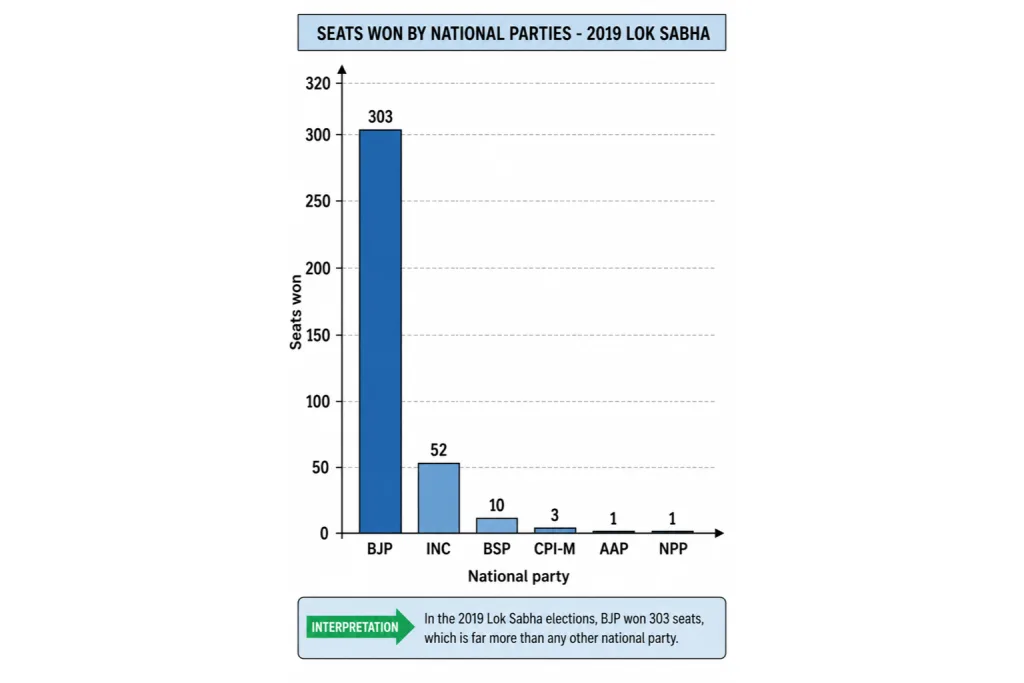
Q4. How did the seats won by parties in the 2019 Lok Sabha election reflect the strength of the BJP?
Answer: In 2019 the BJP emerged as the largest party with 303 seats, far ahead of the INC (52), BSP (10), CPI-M (3), AAP (1) and NPP (1). This showed the BJP's nationwide dominance, while the wide gap and the many seats won by State parties explained why coalition politics continues to matter.