
Why Modern Democracies Cannot Do Without Parties
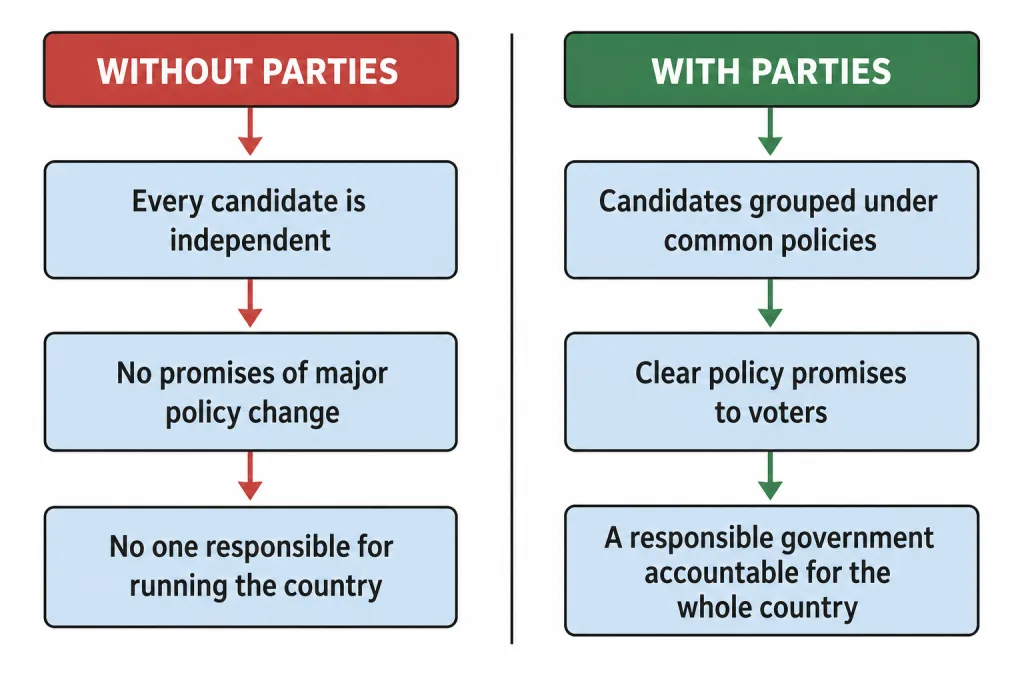
The list of functions in a sense already answers the question 'why do we need parties?' - we need them because they perform all those functions. But we still need to ask why modern democracies cannot exist without political parties. We can understand this by imagining a situation without parties.
If there were no parties, every candidate in the elections would be independent. No one would be able to make promises to the people about any major policy changes. A government might be formed, but its utility would remain uncertain. Elected representatives would be accountable only to their own constituency for local matters - but no one would be responsible for how the country as a whole is run.
The Panchayat Example and the Rise of Parties
We can also see the necessity of parties by looking at non-party-based elections to the panchayat in many states. Although parties do not contest formally, it is generally noticed that the village still gets split into more than one faction, each of which puts up a 'panel' of its candidates. This is exactly what a party does. That is why we find political parties in almost all countries of the world - big or small, old or new, developed or developing.
The rise of political parties is directly linked to the emergence of representative democracies. Large societies need representative democracy. As societies became large and complex, they needed some agency to gather different views on various issues and present them to the government; to bring representatives together so that a responsible government could be formed; and a mechanism to support or restrain the government, make policies and justify or oppose them. Political parties fulfil these needs. We can therefore say that parties are a necessary condition for a democracy.
Popular Participation in Political Parties
It is often said that parties are facing a crisis because they are unpopular and citizens are indifferent to them. The available evidence, based on large sample surveys over several decades, shows this belief is only partly true for India:
- Political parties do not enjoy much trust among people in South Asia. The proportion who say their trust in parties is 'not much' or 'not at all' is larger than those with 'some' or 'great' trust.
- The same is true of most other democracies - parties are among the least trusted institutions all over the world.
- Yet participation in party activities is fairly high. The proportion of people who said they were members of a political party was higher in India than in many advanced countries like Canada, Japan, Spain and South Korea.
- Over the last three decades, membership of parties in India has gone up steadily, and so has the proportion of those who feel 'close to a political party'.
So while trust in parties is low, involvement with them in India is high and rising.
Questions and Answers
Q1. Why can modern democracies not exist without political parties?
Answer: Without parties, every candidate would be independent, so no one could promise any major policy change, and no single group would be responsible for running the country as a whole. Parties gather views, form responsible governments and provide accountability. Hence parties are a necessary condition for a large, representative democracy.
Q2. How does the example of non-party panchayat elections show the necessity of parties?
Answer: Even where parties do not contest formally, such as in some panchayat elections, the village still splits into factions, and each faction puts up its own panel of candidates. This is exactly what a party does. It shows that some party-like grouping arises naturally in any competitive election, proving that parties are indispensable.
Q3. 'Trust in parties is low but participation is high in India.' Explain.
Answer: Surveys show that Indians, like people elsewhere, do not trust parties much - parties are among the least trusted institutions. However, participation is high: more Indians report being members of a party than in many advanced countries, and over three decades both membership and the feeling of being 'close to a party' have risen steadily. So low trust coexists with high and growing involvement.
Q4. The rise of political parties is linked to which development?
Answer: The rise of political parties is directly linked to the emergence of representative democracies. As societies grew large and complex, they needed an agency to gather views, bring representatives together to form a responsible government, and to support or restrain that government. Parties met all these needs, so they rose along with representative democracy.