
Why Do We Need Political Parties?
Political parties are easily one of the most visible institutions in a democracy. For most ordinary citizens, democracy is almost equal to political parties. If you travel to a remote part of the country and speak to less-educated citizens, you may meet people who know little about the Constitution or the nature of our government - but they would almost certainly know something about our political parties.
At the same time, this visibility does not mean popularity. Most people tend to be very critical of political parties. They blame parties for all that is wrong with our democracy and our political life, and parties have become identified with social and political divisions. It is therefore natural to ask: do we need political parties at all?
About a hundred years ago, there were very few countries in the world that had any political party. Today there are very few that do not have parties. To understand why parties became so omnipresent in democracies, we must first answer what political parties are and what they do.
What Is a Political Party?
A political party is a group of people who come together to contest elections and hold power in the government. They agree on some policies and programmes for the society with a view to promote the collective good.
Since there can be different views on what is good for all, parties try to persuade people why their policies are better than those of others. They seek to implement these policies by winning popular support through elections. In short, a party is defined by three things:
- which part of society it stands for,
- which policies it supports, and
- whose interests it upholds.
Thus, parties reflect the fundamental political divisions in a society. Parties are about a part of the society and therefore involve partisanship. A partisan is a person who is strongly committed to a party, group or faction; partisanship is marked by a tendency to take a side and an inability to take a balanced view on an issue.
The Three Components of a Party
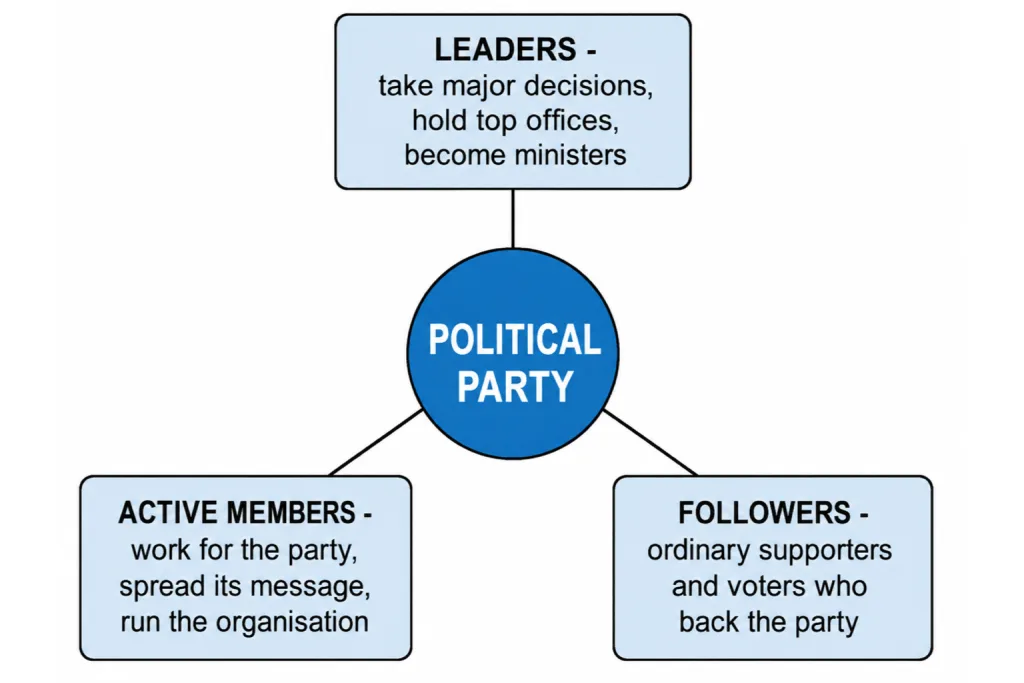
Every political party has three components or parts, and all three are needed for the party to function:
- The leaders - who take the major decisions, contest for the top offices, and become ministers or run the government when the party wins power.
- The active members - who work for the party, spread its message and keep the organisation alive between elections.
- The followers - the large body of ordinary supporters and voters who believe in the party's ideology and vote for it.
Together these three make a party a living organisation that links society with the government. A party is not just its leaders; it is also the activists on the ground and the millions of ordinary followers who feel close to it.
Questions and Answers
Q1. What is a political party?
Answer: A political party is a group of people who come together to contest elections and hold power in the government. Its members agree on certain policies and programmes for the society, which they seek to implement by winning popular support through elections, with the aim of promoting the collective good.
Q2. What are the three components of a political party?
Answer: A political party has three components:
- The leaders, who take major decisions and hold top offices.
- The active members, who work for the party and run its organisation.
- The followers, the ordinary supporters and voters who back the party.
A party needs all three to be an effective, living organisation.
Q3. What is meant by 'partisanship'?
Answer: Partisanship is a strong commitment to a party, group or faction. A partisan takes a firm side and finds it hard to take a balanced view on an issue. Because a political party stands for only a part of society and its interests, parties naturally involve partisanship - a party is known by which part it stands for and whose interests it upholds.
Q4. Why are political parties described as the most visible face of democracy?
Answer: For most ordinary citizens, democracy is almost equal to political parties. Even people who know little about the Constitution or the working of government usually know something about the parties. Parties contest elections, form governments and are constantly in the news, so they are the institution that citizens see and identify with most - which is also why parties get blamed for whatever goes wrong.