
Registration and Recognition of Parties
Democracies that follow a federal system tend to have two kinds of parties: parties present in only one federal unit, and parties present in several or all units of the federation. India is like this too. The country-wide parties are called national parties; they have units in various states, but by and large all these units follow the same policies, programmes and strategy decided at the national level.
Every party in the country has to register with the Election Commission. While the Commission treats all parties equally, it offers some special facilities to large and established parties. These parties are given a unique election symbol - only the official candidates of that party can use that symbol. Parties that get this privilege are said to be 'recognised' by the Election Commission, and are called recognised political parties.
The Recognition Criteria
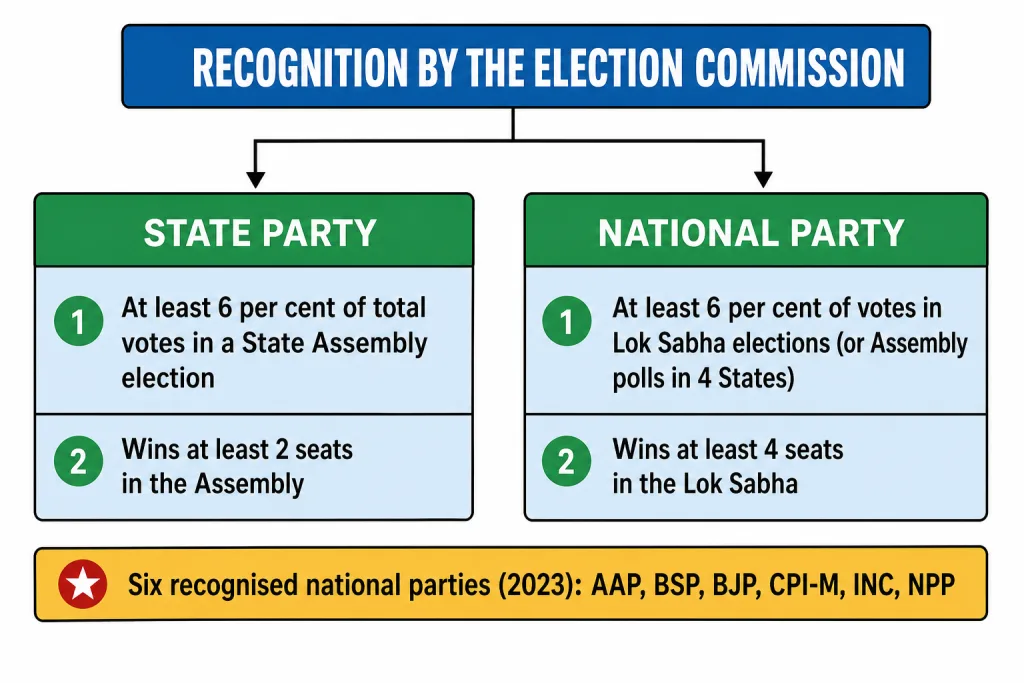
The Election Commission has laid down detailed criteria based on the proportion of votes and seats a party must get to be recognised:
- State party: A party that secures at least six per cent of the total votes in an election to the Legislative Assembly of a State and wins at least two seats is recognised as a State party.
- National party: A party that secures at least six per cent of the total votes in Lok Sabha elections (or Assembly elections in four States) and wins at least four seats in the Lok Sabha is recognised as a national party.
According to this classification, there are six recognised national parties in the country, as per the notification of the Election Commission of India issued in 2023.
The National Parties (Part 1)
Aam Aadmi Party (AAP): Formed on 26 November 2012, following the 2011 anti-corruption movement. Founded on the ideas of accountability, clean administration, transparency and good governance. It has formed governments in Delhi and Punjab. In the 2019 Lok Sabha election it secured one seat.
Bahujan Samaj Party (BSP): Formed in 1984 under the leadership of Kanshi Ram. Seeks to represent and secure power for the bahujan samaj - dalits, adivasis, OBCs and religious minorities. Draws inspiration from Sahu Maharaj, Mahatma Phule, Periyar Ramaswami Naicker and Babasaheb Ambedkar. Its main base is Uttar Pradesh. In 2019 it polled about 3.63 per cent votes and won 10 seats.
Bharatiya Janata Party (BJP): Founded in 1980 by reviving the erstwhile Bharatiya Jana Sangh (formed by Syama Prasad Mukherjee in 1951). Wants to build a strong, modern India inspired by ancient culture and Deendayal Upadhyaya's ideas of integral humanism and Antyodaya. Cultural nationalism (Hindutva) is a key element of its politics. Emerged as the largest party with 303 seats in 2019 and currently leads the ruling NDA at the Centre.
The National Parties (Part 2)
Communist Party of India - Marxist (CPI-M): Founded in 1964. Believes in Marxism-Leninism; supports socialism, secularism and democracy, and opposes imperialism and communalism. Enjoys strong support in West Bengal, Kerala and Tripura. It was in power in West Bengal without a break for 34 years. In 2019 it won about 1.75 per cent votes and 3 seats.
Indian National Congress (INC): Popularly the Congress Party - one of the oldest parties in the world, founded in 1885. Played a dominant role after Independence; under Jawaharlal Nehru it sought to build a modern, secular, democratic republic. A centrist party that espouses secularism and welfare of weaker sections and minorities. Led the UPA government from 2004 to 2014. In 2019 it won 19.5 per cent votes and 52 seats.
National People's Party (NPP): Formed in July 2013 under P.A. Sangma. It is the first party from North East India to attain national-party status. Its core philosophy is education, employment and empowerment for all. It formed a government in Meghalaya and won one seat in 2019.
Questions and Answers
Q1. What is a 'recognised' political party?
Answer: A recognised political party is one that the Election Commission has granted special facilities, above all a unique election symbol reserved for its official candidates. Recognition is granted on the basis of the proportion of votes and seats a party wins, under the Commission's criteria.
Q2. State the criteria for a party to be recognised as a national party.
Answer: A party is recognised as a national party if it secures at least six per cent of the total votes in Lok Sabha elections (or Assembly elections in four States) and wins at least four seats in the Lok Sabha. There are six recognised national parties as per the 2023 notification of the Election Commission.
Q3. Name the six recognised national parties of India.
Answer: The six recognised national parties (2023 notification) are:
- Aam Aadmi Party (AAP)
- Bahujan Samaj Party (BSP)
- Bharatiya Janata Party (BJP)
- Communist Party of India - Marxist (CPI-M)
- Indian National Congress (INC)
- National People's Party (NPP)
Q4. Which national party is the first from North East India, and what is its core philosophy?
Answer: The National People's Party (NPP), formed in July 2013 under P.A. Sangma, is the first party from North East India to attain national-party status. Its core philosophy is education, employment and empowerment for all sections of society; it formed a government in Meghalaya.