
The Belgian Leaders Took a Different Path
While Sri Lanka's majority chose dominance, the Belgian leaders took a very different path. They recognised the existence of regional differences and cultural diversities. Between 1970 and 1993, they amended their constitution four times so as to work out an arrangement that would enable everyone to live together within the same country.
The arrangement they worked out is different from any other country and is very innovative. It is often called accommodation — a way of recognising and adjusting to the interests of different communities so that all can share power. Let us look at the main elements of the Belgian model.
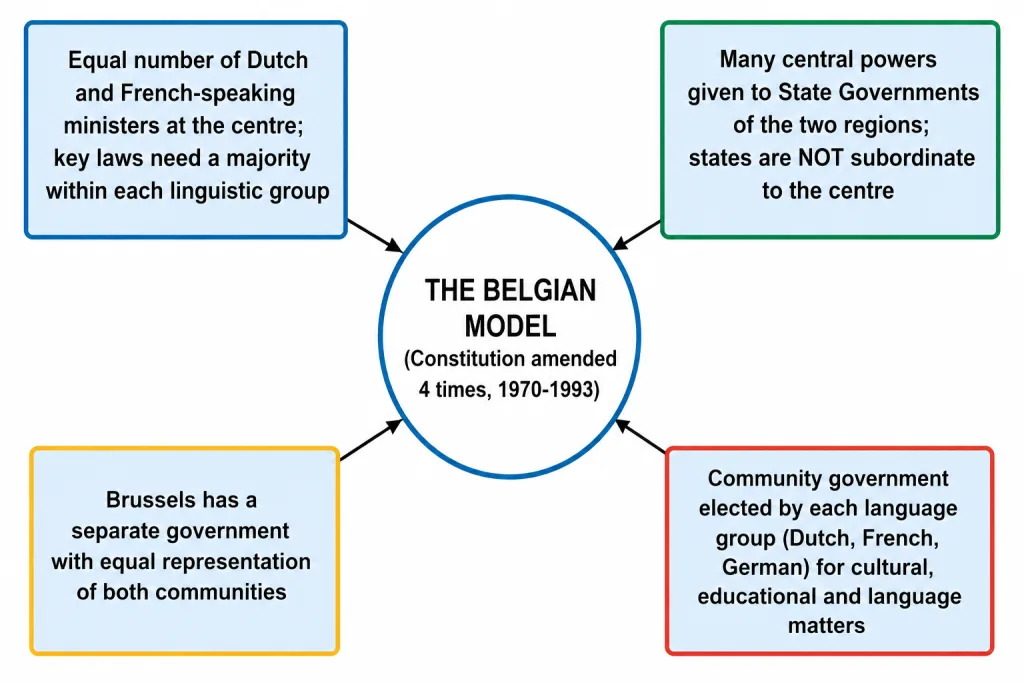
Elements of the Belgian Model — Part 1
1. Equal representation in the central government. The Constitution prescribes that the number of Dutch and French-speaking ministers shall be equal in the central government. Some special laws require the support of a majority of members from each linguistic group. Thus, no single community can make decisions unilaterally.
2. Powers to the state governments. Many powers of the Central Government have been given to the State Governments of the two regions of the country. The State Governments are not subordinate to the Central Government.
These two elements ensure that neither the Dutch majority nor the French minority can force its will on the other. Power is genuinely shared, not just held by the larger group.
Elements of the Belgian Model — Part 2
3. Brussels has a separate government. Brussels has a separate government in which both communities have equal representation. The French-speaking people accepted equal representation in Brussels because the Dutch-speaking community had accepted equal representation in the Central Government. This mutual give-and-take is the heart of accommodation.
4. The community government. Apart from the Central and the State Governments, there is a third kind of government — the 'community government'. This government is elected by people belonging to one language community — Dutch, French and German-speaking — no matter where they live. This government has power over cultural, educational and language-related issues.
Because these arrangements worked so well and kept Belgium united and stable, when many countries of Europe came together to form the European Union, Brussels was chosen as its headquarters.
Why the Belgian Model Matters
You might find the Belgian model very complicated — it indeed is, even for people living in Belgium. But these arrangements have worked well so far. They helped to avoid civic strife between the two major communities and a possible division of the country on linguistic lines.
The Belgian leaders were glad that their Constitution does not force any community to feel like a loser. Instead of asking "what is wrong if the majority rules?", they asked "how can all communities feel that they have a fair share in power?" That single change of question is what makes accommodation so different from majoritarianism.
Questions and Answers
Q1. How did Belgium accommodate its regional and cultural diversities?
Answer: The Belgian leaders recognised regional differences and cultural diversities and, between 1970 and 1993, amended the constitution four times. The key elements were: equal numbers of Dutch and French-speaking ministers in the central government; many central powers given to State Governments that are not subordinate to the centre; a separate government for Brussels with equal representation of both communities; and a community government for cultural, educational and language matters. Together these ensured that no single community could dominate.
Q2. What is the 'community government' in Belgium?
Answer: The community government is a third kind of government in Belgium, apart from the Central and State Governments. It is elected by people belonging to one language community — Dutch, French or German-speaking — regardless of where they live in the country. It has power over cultural, educational and language-related issues. It is a good example of power being shared among different social groups.
Q3. Why did the French-speaking people accept equal representation in Brussels?
Answer: The French-speaking people accepted equal representation in Brussels because the Dutch-speaking community had, in return, accepted equal representation in the Central Government. This was a mutual arrangement based on give-and-take: each community gave up the chance to dominate in one place in exchange for security in another. Such compromise is the essence of accommodation and helped keep the country united.