
Form 2: Power Shared Among Different Levels of Government
Power can be shared among governments at different levels — a general government for the entire country and governments at the provincial or regional level. Such a general government for the entire country is usually called a federal government. In India, we refer to it as the Central or Union Government. The governments at the provincial or regional level are called by different names in different countries; in India we call them State Governments.
This system is not followed in all countries. There are many countries where there are no provincial or state governments. But in countries like ours, where there are different levels of government, the constitution clearly lays down the powers of different levels of government. This is what was done in Belgium, but was refused in Sri Lanka. This is called the federal division of power.
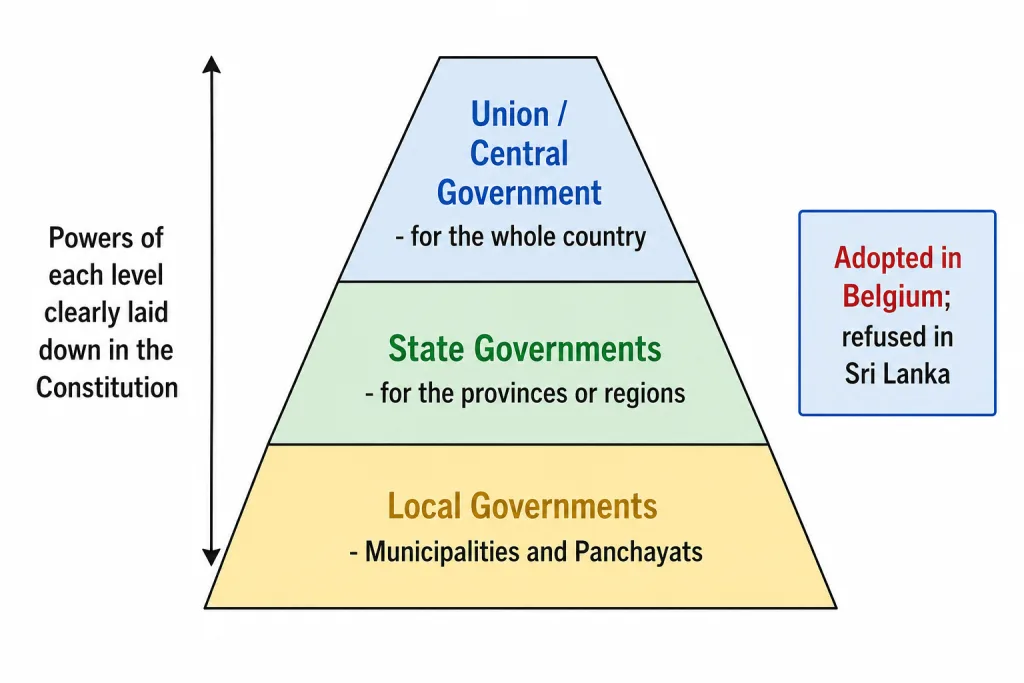
Vertical Division of Power
The same principle can be extended to levels of government lower than the State government, such as the municipality and the panchayat. Let us call the division of powers involving higher and lower levels of government the vertical division of power.
So the picture looks like a ladder of governments:
- the Union (Central) Government for the whole country,
- the State Governments for the provinces or regions, and
- local governments such as municipalities and panchayats at the lowest level.
Because these governments sit at different heights — higher and lower — the sharing is described as vertical. This form of power-sharing will be studied at greater length in the next chapter on federalism.
Form 3: Power Shared Among Different Social Groups
Power may also be shared among different social groups, such as religious and linguistic groups. The 'community government' in Belgium is a good example of this arrangement.
In some countries, there are constitutional and legal arrangements whereby socially weaker sections and women are represented in the legislatures and administration. In our own country, we have the system of 'reserved constituencies' in the assemblies and the parliament.
This type of arrangement is meant to give space in the government and administration to diverse social groups who otherwise would feel alienated from the government. It is a method used to give minority communities a fair share in power. In Unit II, we shall look at various ways of accommodating social diversities.
Questions and Answers
Q1. What is meant by the vertical division of power? Give an example.
Answer: The vertical division of power is the sharing of power among governments at different levels — higher and lower. It includes a general (Union) government for the whole country, State Governments for the regions, and local governments such as municipalities and panchayats. Because the constitution clearly divides powers between these higher and lower levels, it is also called the federal division of power. India is an example, with its Central, State and local governments.
Q2. How is power shared among different social groups? Give examples.
Answer: Power is shared among social groups such as religious and linguistic communities so that diverse groups get a share in government. Examples include the 'community government' in Belgium, which handles the affairs of a language community, and the system of 'reserved constituencies' in India, which ensures that socially weaker sections and women are represented in the legislatures and administration. Such arrangements give minority communities a fair share and prevent them from feeling alienated.
Q3. 'The constitution clearly lays down the powers of different levels of government. This is what they did in Belgium, but was refused in Sri Lanka.' Explain.
Answer: In a federal system, the constitution divides powers between the central and regional (state) governments so that lower levels are not fully controlled by the centre. Belgium adopted this by giving real powers to its State Governments, which are not subordinate to the Central Government. Sri Lanka refused to grant such regional autonomy to the Tamil-majority provinces, denying them a federal share of power. This refusal was one of the causes of the conflict there.