
From Undivided Power to Shared Power
The idea of power-sharing has emerged in opposition to the notions of undivided political power. For a long time, it was believed that all power of a government must reside in one person or group of persons located at one place. It was felt that if the power to decide is dispersed, it would not be possible to take quick decisions and to enforce them.
But these notions have changed with the emergence of democracy. One basic principle of democracy is that people are the source of all political power. In a democracy, people rule themselves through institutions of self-government. In a good democratic government, due respect is given to diverse groups and views that exist in society. Everyone has a voice in the shaping of public policies. Therefore, in a democracy, political power should be distributed among as many citizens as possible.
In modern democracies, power-sharing arrangements can take many forms. This section looks at the first form.
Form 1: Horizontal Distribution of Power
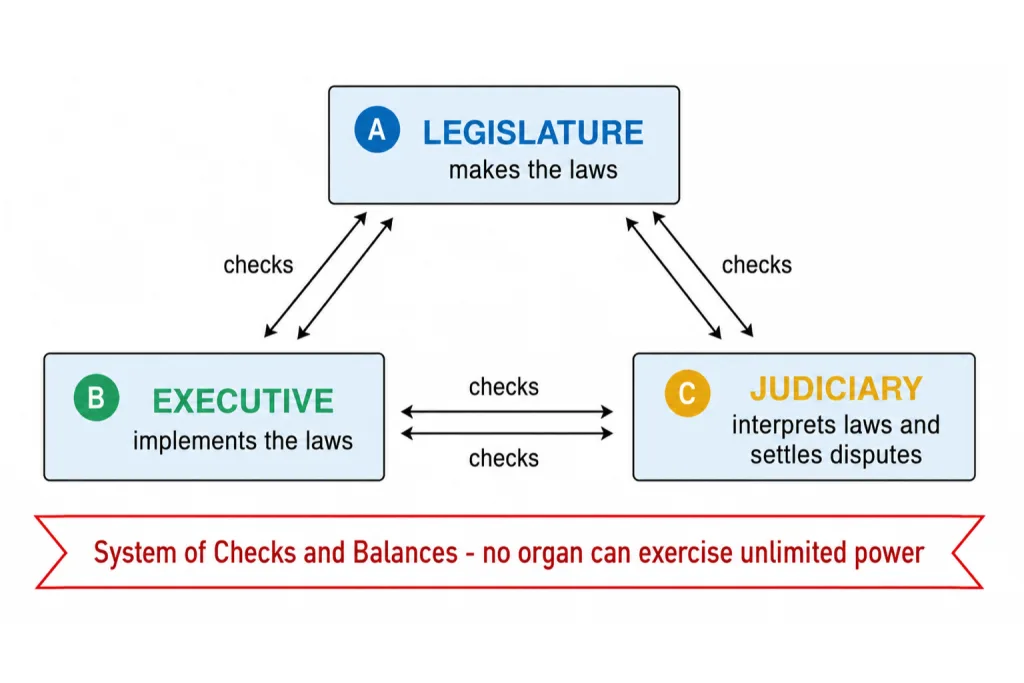
Power is shared among different organs of government, such as the legislature, the executive and the judiciary. Let us call this the horizontal distribution of power, because it allows different organs of government placed at the same level to exercise different powers.
Such a separation ensures that none of the organs can exercise unlimited power. Each organ checks the others. This results in a balance of power among the various institutions.
- Even though ministers and government officials exercise power, they are responsible to the Parliament or State Assemblies.
- Although judges are appointed by the executive, they can check the functioning of the executive or the laws made by the legislature.
This arrangement is called a system of checks and balances.
Why Horizontal Sharing Matters
Under horizontal distribution, the three organs of government stand at the same level and hold separate powers. Because power is spread across them, no single organ can become all-powerful.
- The legislature makes the laws.
- The executive puts the laws into action.
- The judiciary interprets the laws and settles disputes.
Each keeps a watch on the others so that everyone stays within the limits set by the Constitution. This mutual watchfulness is exactly what "checks and balances" means. It protects citizens from the misuse of power and keeps the government answerable, which is why the separation of powers is one of the most important safeguards in a democracy.
Questions and Answers
Q1. What is meant by the horizontal distribution of power? Why is it so called?
Answer: The horizontal distribution of power is the sharing of power among the different organs of government — the legislature, executive and judiciary. It is called 'horizontal' because these organs are placed at the same level and exercise different powers. This separation ensures that no organ can exercise unlimited power, since each organ checks the others, producing a balance of power.
Q2. Explain the system of 'checks and balances' with examples.
Answer: Under the system of checks and balances, each organ of government keeps a watch on the others so that none becomes too powerful. For example, ministers and officials exercise power but are responsible to the Parliament or State Assemblies; and although judges are appointed by the executive, they can check the functioning of the executive and review the laws made by the legislature. In this way each organ checks the others and stays within its limits.
Q3. Why did old notions of undivided power change with the coming of democracy?
Answer: Earlier it was believed that all power must rest in one person or group at one place, because dispersing power was thought to prevent quick decisions. With democracy, this changed. A basic principle of democracy is that people are the source of all political power and rule themselves through institutions of self-government. Since a good democracy respects diverse groups and views and gives everyone a voice, power must be distributed among as many citizens as possible.