
Two Democracies, Two Different Paths
What do we learn from these two stories of Belgium and Sri Lanka? Both are democracies. Yet they dealt with the question of power-sharing very differently.
- In Belgium, the leaders realised that the unity of the country is possible only by respecting the feelings and interests of different communities and regions. This realisation resulted in mutually acceptable arrangements for sharing power.
- Sri Lanka shows the contrasting example. It shows that if a majority community wants to force its dominance over others and refuses to share power, it can undermine the unity of the country.
Both countries faced similar problems of diversity. The difference lay entirely in how they chose to respond.
The Lesson: Sharing Power Strengthens the Nation
At first, sharing power sounds like a way of weakening a country — "Sharing power = dividing power = weakening the country." The two stories show that the opposite is true.
- In Sri Lanka, refusing to share power led to distrust, civil war, deaths, refugees and economic setback. Forcing the majority's will did not make the country stronger; it nearly tore it apart.
- In Belgium, sharing power through a complicated but fair arrangement kept the country united, stable and peaceful, and made Brussels important enough to host the European Union.
So the surprising conclusion is that sharing power actually makes a country more united and stable, not weaker. It sounds odd at first, but the evidence is clear.
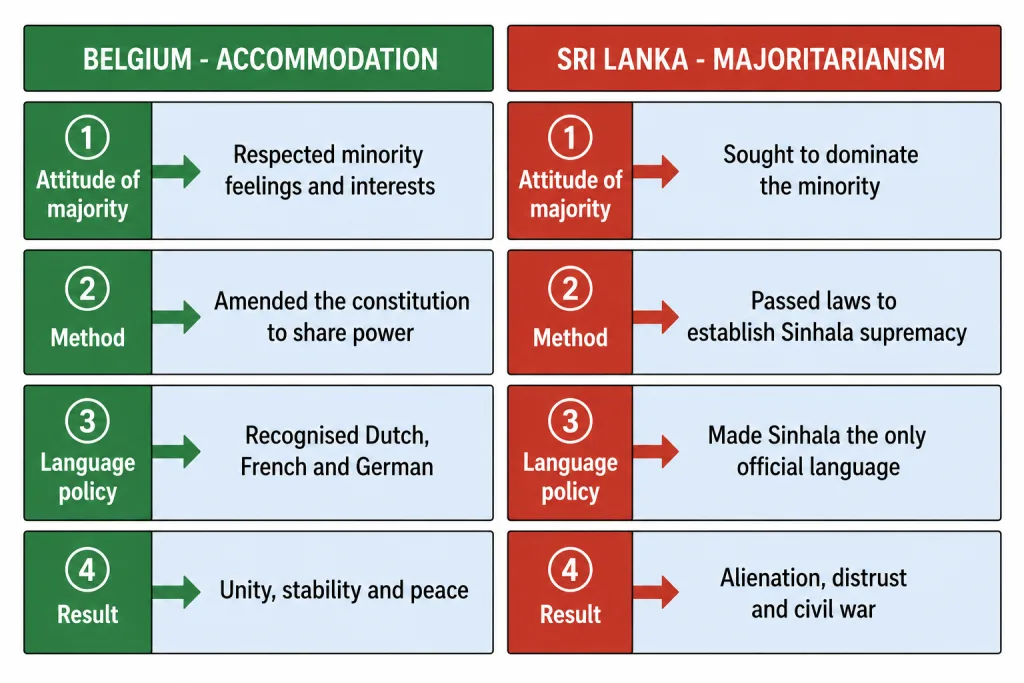
Accommodation vs Majoritarianism — A Comparison
| Basis | Belgium (Accommodation) | Sri Lanka (Majoritarianism) |
|---|---|---|
| Attitude of the majority | Respected the minority's feelings and interests | Sought to dominate the minority |
| Method | Amended the constitution to share power | Passed laws to establish Sinhala supremacy |
| Language policy | Recognised Dutch, French and German | Made Sinhala the only official language |
| Result | Unity, stability and peace | Alienation, distrust and civil war |
This comparison makes the central message of the chapter very clear: respecting diversity and sharing power keeps a country together, while imposing the majority's will drives it apart.
Questions and Answers
Q1. Contrast the ways in which Belgium and Sri Lanka dealt with the question of power sharing.
Answer: Both are democracies, but they responded very differently. Belgium recognised regional and cultural differences and made mutually acceptable arrangements to share power among communities, which kept the country united and stable. Sri Lanka followed majoritarianism: the Sinhala majority tried to force its dominance and refused to share power with the Tamils, which led to alienation, civil war and a terrible setback to national life. Belgium chose accommodation; Sri Lanka chose domination.
Q2. 'Sharing power makes a country stronger, not weaker.' Explain using the two examples.
Answer: In Belgium, sharing power through a fair, complicated arrangement helped avoid civic strife and a division of the country, keeping it united. In Sri Lanka, refusing to share power produced civil war, thousands of deaths, refugees and economic damage, and it undermined the unity of the country. Thus, contrary to the idea that "sharing power weakens a country", the evidence shows that sharing power strengthens national unity, while refusing to share it weakens the nation.
Q3. What is the main lesson of the Belgium and Sri Lanka stories?
Answer: The main lesson is that the unity of a diverse country depends on respecting all its communities and sharing power with them. When a majority accommodates the minority, as in Belgium, the country stays united and peaceful. When a majority imposes its will and refuses to share power, as in Sri Lanka, it breeds distrust, conflict and instability. Power-sharing is therefore essential for the well-being of a democracy.