
Two Sets of Reasons for Power Sharing
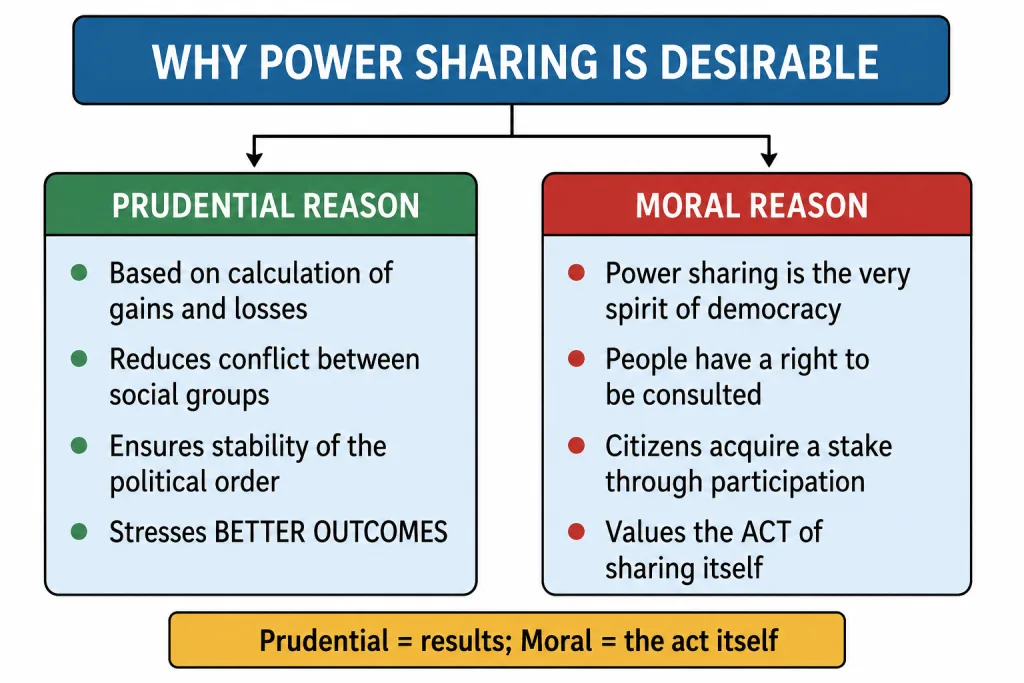
Why is power sharing desirable? Two different sets of reasons can be given in its favour. Let us call the first set prudential and the second moral.
- Prudential reasons are based on prudence, or on careful calculation of gains and losses. Prudential decisions are usually contrasted with decisions based purely on moral considerations. Prudential reasons stress that power sharing will bring out better outcomes.
- Moral reasons emphasise the very act of power sharing as valuable in itself.
Both kinds of reasons matter, and together they make a powerful case for sharing power in a democracy.
The Prudential Reason
Firstly, power sharing is good because it helps to reduce the possibility of conflict between social groups. Since social conflict often leads to violence and political instability, power sharing is a good way to ensure the stability of the political order.
Imposing the will of the majority community over others may look like an attractive option in the short run, but in the long run it undermines the unity of the nation. In fact, the tyranny of the majority is not just oppressive for the minority; it often affects the majority adversely as well.
This is the prudential case: sharing power is a wise, practical calculation. It prevents conflict, keeps the country stable, and protects everyone — including the majority — from the damage that domination eventually brings.
The Moral Reason
There is a second, deeper reason why power sharing is good for democracies. Power sharing is the very spirit of democracy.
A democratic rule involves sharing power with those affected by its exercise, and who have to live with its effects. People have a right to be consulted on how they are to be governed. A legitimate government is one where citizens, through participation, acquire a stake in the system.
This is the moral case: power sharing is valuable in itself, not only because of its good results. Even if it were not useful, sharing power would still be the right and democratic thing to do, because a democracy belongs to all its people.
Prudential and Moral — Two Sides of One Idea
The difference between the two sets of reasons is simple but important.
- Prudential reasons look at the consequences — power sharing brings better outcomes: less conflict, more stability, a stronger nation.
- Moral reasons look at the act itself — power sharing is right because it is the spirit of democracy and gives people a genuine say in how they are governed.
In the Indian context, a prudential reason for power sharing is that it keeps our diverse society peaceful and stable; a moral reason is that it allows every citizen and community to participate in and feel ownership of the government. Together, prudence and morality both point to the same conclusion: share power.
Questions and Answers
Q1. Distinguish between the prudential and moral reasons for power sharing.
Answer: Prudential reasons are based on prudence — a careful calculation of gains and losses. They stress that power sharing brings better outcomes: it reduces conflict between social groups and ensures the stability of the political order. Moral reasons emphasise the very act of power sharing as valuable in itself, because power sharing is the spirit of democracy. In short, prudential reasons value the results of power sharing, while moral reasons value the act of power sharing.
Q2. 'The tyranny of the majority is not just oppressive for the minority; it often affects the majority adversely as well.' Explain.
Answer: When a majority imposes its will on a minority, it may seem to benefit the majority in the short run. But such tyranny of the majority breeds distrust, conflict and instability, which harm the whole country. Violence and civil war, as in Sri Lanka, damage the social, economic and cultural life of everyone, including the majority community. Thus domination ultimately affects the majority adversely too, which is why power sharing is prudent.
Q3. State one prudential reason and one moral reason for power sharing with an example from the Indian context.
Answer: Prudential reason: Power sharing reduces the possibility of conflict between social groups and keeps the country stable — for example, sharing power between the Union and the States in India keeps our diverse nation peaceful. Moral reason: Power sharing is the very spirit of democracy and gives people a right to be consulted — for example, giving power to panchayats lets ordinary citizens participate directly in decisions that affect them.