
The Path Sri Lanka Chose
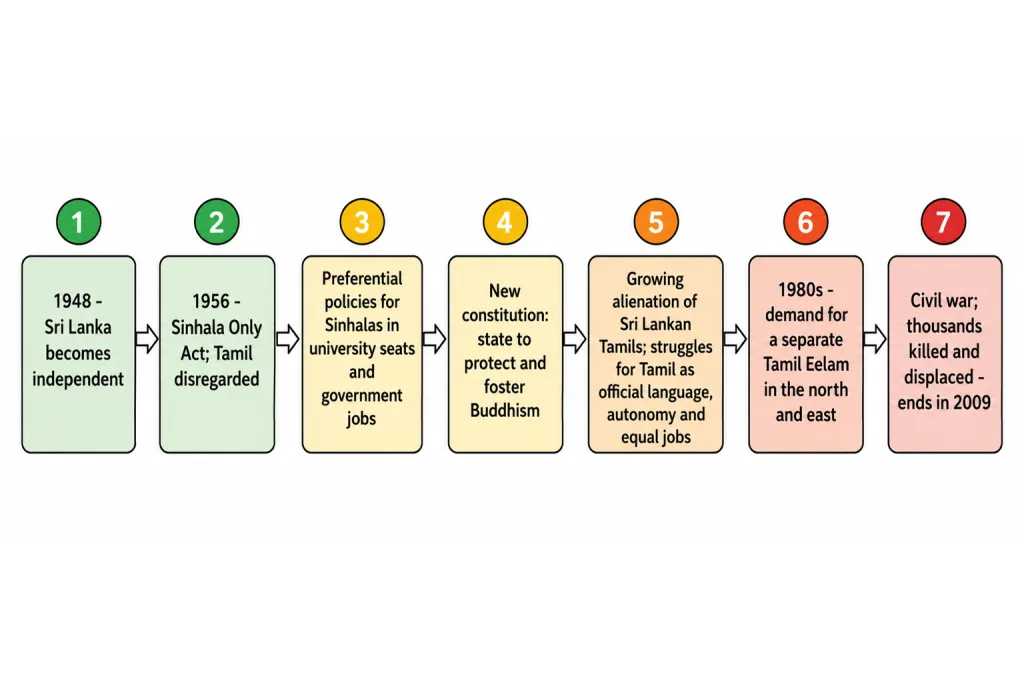
Sri Lanka emerged as an independent country in 1948. The leaders of the Sinhala community sought to secure dominance over the government by virtue of their majority. As a result, the democratically elected government adopted a series of majoritarian measures to establish Sinhala supremacy.
The key idea here is majoritarianism — the belief that the majority community should be able to rule a country in whichever way it wants, by disregarding the wishes and needs of the minority. Sri Lanka shows what can happen when a majority uses its numbers not to share power but to dominate.
The Majoritarian Measures
The government's majoritarian measures came one after another:
- In 1956, an Act was passed to recognise Sinhala as the only official language, thus disregarding Tamil.
- The governments followed preferential policies that favoured Sinhala applicants for university positions and government jobs.
- A new constitution stipulated that the state shall protect and foster Buddhism.
All these measures, coming one after the other, gradually increased the feeling of alienation among the Sri Lankan Tamils. They felt that none of the major political parties, led by Buddhist Sinhala leaders, was sensitive to their language and culture. They felt that the constitution and government policies denied them equal political rights, discriminated against them in getting jobs and other opportunities, and ignored their interests. As a result, relations between the Sinhala and Tamil communities strained over time.
From Struggle to Civil War
The Sri Lankan Tamils launched parties and struggles for:
- the recognition of Tamil as an official language,
- regional autonomy for provinces populated by Tamils, and
- equality of opportunity in securing education and jobs.
But their demand for more autonomy to Tamil-populated provinces was repeatedly denied. By the 1980s, several political organisations were formed demanding an independent Tamil Eelam (state) in the northern and eastern parts of Sri Lanka.
The distrust between the two communities turned into widespread conflict, which soon became a civil war — a violent conflict between opposing groups within a country that becomes so intense that it appears like a war. As a result, thousands of people from both communities were killed. Many families were forced to leave the country as refugees and many more lost their livelihoods. The civil war caused a terrible setback to the social, cultural and economic life of the country. It ended in 2009.
Questions and Answers
Q1. What is majoritarianism? How was it practised in Sri Lanka?
Answer: Majoritarianism is the belief that the majority community should be able to rule a country in whichever way it wants, disregarding the wishes and needs of the minority. In Sri Lanka it was practised through several measures: in 1956 Sinhala was made the only official language; preferential policies favoured Sinhala applicants for university positions and government jobs; and a new constitution made the state protect and foster Buddhism. These steps established Sinhala supremacy and alienated the Tamils.
Q2. What were the main demands of the Sri Lankan Tamils?
Answer: The Sri Lankan Tamils launched parties and struggles demanding:
- recognition of Tamil as an official language,
- regional autonomy for the provinces where they lived, and
- equality of opportunity in securing education and jobs.
When these demands, especially for autonomy, were repeatedly denied, some organisations by the 1980s began demanding a separate Tamil Eelam in the north and east.
Q3. What were the consequences of the majoritarian policies in Sri Lanka?
Answer: The majoritarian policies increased the alienation of the Sri Lankan Tamils and strained relations between the two communities. Distrust grew into widespread conflict and finally a civil war. Thousands of people from both communities were killed, many families became refugees, and many lost their livelihoods. The civil war set back the social, cultural and economic life of Sri Lanka and ended only in 2009.