
Resuming the Tour of Democracy
With this chapter, we resume the tour of democracy that we began last year. We noted then that in a democracy all power does not rest with any one organ of the government. An intelligent sharing of power among the legislature, the executive and the judiciary is very important to the design of a democracy.
In this and the next two chapters, we carry the idea of power-sharing forward. We start with two stories from Belgium and Sri Lanka. Both stories are about how democracies handle demands for power-sharing. They yield some general conclusions about the need for power-sharing in a democracy, and they allow us to discuss the various forms of power-sharing that will be taken up later.
A first, common-sense reaction is to think: "Sharing power = dividing power = weakening the country." One aim of this chapter is to show why that reaction is mistaken.
Belgium — A Small Country with a Complex Ethnic Mix
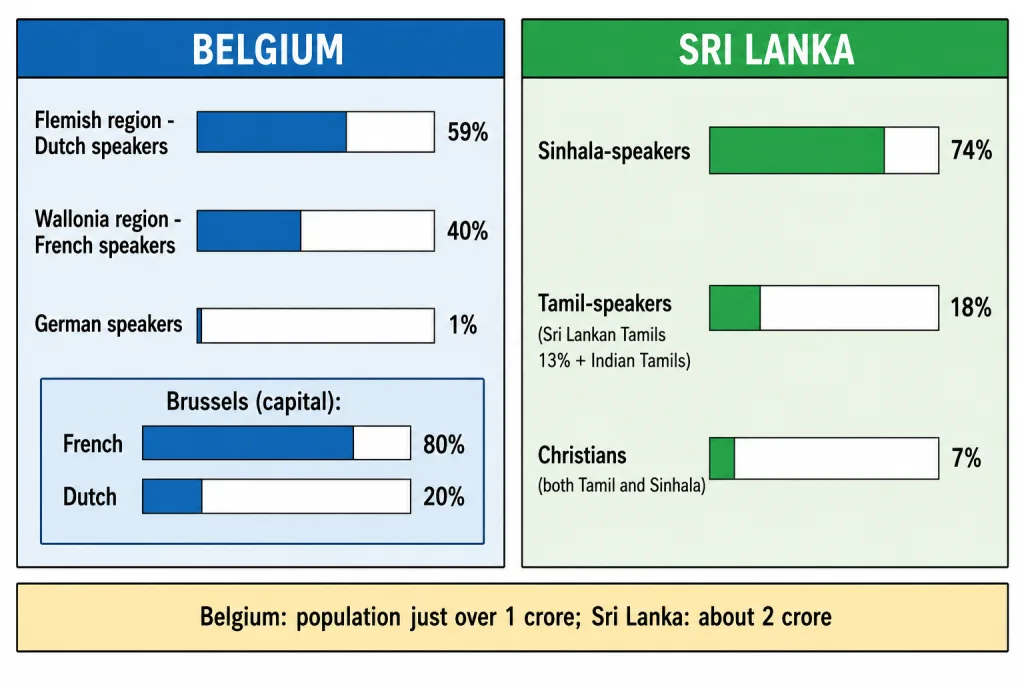
Belgium is a small country in Europe, smaller in area than the Indian state of Haryana. It shares borders with France, the Netherlands, Germany and Luxembourg. Its population is a little over one crore, about half the population of Haryana. The ethnic composition of this small country is very complex.
- Of the country's total population, 59 per cent lives in the Flemish region and speaks Dutch.
- Another 40 per cent live in the Wallonia region and speak French.
- The remaining 1 per cent of Belgians speak German.
- In the capital city, Brussels, 80 per cent of people speak French while 20 per cent are Dutch-speaking.
The minority French-speaking community was relatively rich and powerful. This was resented by the Dutch-speaking community, who received the benefits of economic development and education much later. The result was tension between the two communities during the 1950s and 1960s. The tension was most acute in Brussels, which presented a special problem: the Dutch-speaking people were a majority in the country but a minority in the capital.
Sri Lanka — A Diverse Island Nation
Let us compare this with the situation in another country. Sri Lanka is an island nation, just a few kilometres off the southern coast of Tamil Nadu. It has about two crore people, roughly the same as Haryana. Like other nations of the South Asia region, Sri Lanka has a diverse population.
The major social groups are:
- The Sinhala-speakers — about 74 per cent of the population.
- The Tamil-speakers — about 18 per cent.
Among the Tamils there are two sub-groups. Tamil natives of the country are called 'Sri Lankan Tamils' (about 13 per cent). The rest, whose forefathers came from India as plantation workers during the colonial period, are called 'Indian Tamils'. Sri Lankan Tamils are concentrated in the north and the east of the country.
Most of the Sinhala-speaking people are Buddhists, while most of the Tamils are Hindus or Muslims. There are about 7 per cent Christians, who are both Tamil and Sinhala.
Just Imagine What Could Happen
Just imagine what could happen in situations like these. In Belgium, the Dutch community could take advantage of its numeric majority and force its will on the French and German-speaking population. This would push the conflict among communities further and could even lead to a very messy partition of the country, with both sides claiming control over Brussels.
In Sri Lanka, the Sinhala community enjoyed an even bigger majority and could impose its will on the entire country.
The key term to understand here is ethnic. An ethnic group is a social division based on shared culture. People belonging to the same ethnic group believe in their common descent because of similarities of physical type, of culture, or of both. They need not always have the same religion or nationality.
Now, let us look at what actually happened in these two countries — very different paths that teach us contrasting lessons about power-sharing.
Questions and Answers
Q1. Describe the ethnic composition of Belgium.
Answer: Belgium has a very complex ethnic composition. Of its total population, 59 per cent live in the Flemish region and speak Dutch, 40 per cent live in the Wallonia region and speak French, and the remaining 1 per cent speak German. In the capital, Brussels, 80 per cent speak French and 20 per cent speak Dutch. Thus the Dutch-speaking people form a majority in the country but a minority in Brussels.
Q2. Why was there tension between the Dutch-speaking and French-speaking communities in Belgium?
Answer: The minority French-speaking community was relatively rich and powerful. The majority Dutch-speaking community received the benefits of economic development and education much later, and therefore resented the dominance of the French speakers. This inequality caused tension between the two communities during the 1950s and 1960s. The tension was most acute in Brussels, where the Dutch speakers were a country-wide majority but a local minority.
Q3. Who are the 'Sri Lankan Tamils' and the 'Indian Tamils'?
Answer: Both are Tamil-speaking groups in Sri Lanka.
- Sri Lankan Tamils are the native Tamils of the country and form about 13 per cent of the population. They are concentrated in the north and east.
- Indian Tamils are those whose forefathers came from India as plantation workers during the colonial period.
Together, Tamil-speakers make up about 18 per cent of Sri Lanka's population, while the Sinhala-speakers form about 74 per cent.