
Form 4: Power Shared Among Political Parties, Pressure Groups and Movements
Power-sharing arrangements can also be seen in the way political parties, pressure groups and movements control or influence those in power. In a democracy, the citizens must have the freedom to choose among various contenders for power.
In contemporary democracies, this takes the form of competition among different parties. Such competition ensures that power does not remain in one hand. In the long run, power is shared among different political parties that represent different ideologies and social groups.
Alliances, Coalitions and Interest Groups
Sometimes this kind of sharing can be direct, when two or more parties form an alliance to contest elections. If their alliance is elected, they form a coalition government and thus share power.
In a democracy, we also find interest groups — such as those of traders, businessmen, industrialists, farmers and industrial workers. They too have a share in governmental power, either through participation in governmental committees or by bringing influence on the decision-making process.
A good real-world example is Germany's grand coalition government, which included the two major parties — the Christian Democratic Union and the Social Democratic Party. These two parties are historically rivals, yet they had to form a coalition because neither won a clear majority of seats on its own in the 2005 elections. They take divergent positions on many issues but still jointly run the government. In Unit III, we shall study the working of political parties.
The Four Forms Together
We have now seen all four forms of power-sharing in modern democracies:
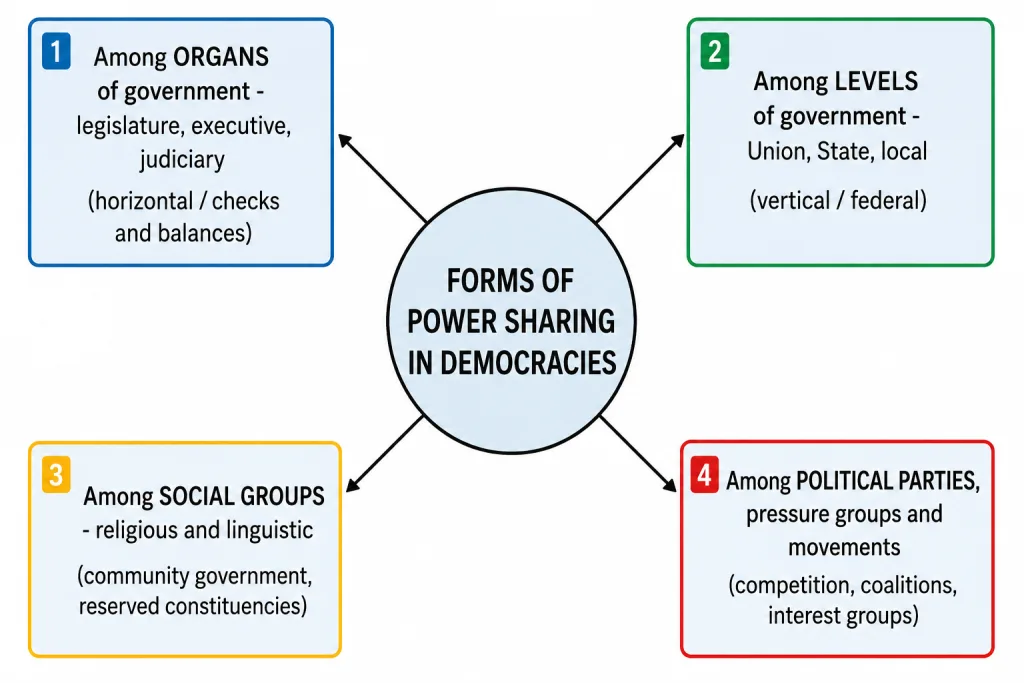
- Among different organs of government — the legislature, executive and judiciary (horizontal distribution, with checks and balances).
- Among governments at different levels — Union, State and local (vertical or federal division of power).
- Among different social groups — religious and linguistic communities (for example, the community government and reserved constituencies).
- Among political parties, pressure groups and movements — through competition, alliances, coalitions and interest groups.
The example of Lebanon shows how far this idea can go: after a bitter civil war, its leaders agreed that the President must be a Maronite Christian, the Prime Minister a Sunni Muslim, the Deputy Prime Minister an Orthodox Christian and the Speaker a Shi'a Muslim. This pact has kept the peace by guaranteeing every community a fixed share in power.
Questions and Answers
Q1. How is power shared among political parties in a democracy?
Answer: In a democracy, citizens have the freedom to choose among various contenders for power, which takes the form of competition among different parties. This competition ensures that power does not remain in one hand; over the long run it is shared among different parties representing different ideologies and social groups. Sharing can also be direct, when two or more parties form an alliance and, if elected, run a coalition government together.
Q2. What are interest groups (pressure groups)? How do they share power?
Answer: Interest groups are organisations of people with common concerns, such as traders, businessmen, industrialists, farmers and industrial workers. They share in governmental power either by participating in governmental committees or by bringing influence on the decision-making process of the government. In this way, groups that are not political parties still get a share in power and can shape public policy.
Q3. Give an example of power sharing through a coalition government.
Answer: When two or more parties form an alliance to contest elections and the alliance wins, they form a coalition government and share power. A good example is Germany's grand coalition of the Christian Democratic Union and the Social Democratic Party. Although these two parties are historic rivals with divergent views, neither won a clear majority in the 2005 elections, so they formed a coalition and jointly ran the government — a direct sharing of power among parties.