
Comparing the Three Sectors
The three sectors produce a huge number of goods and services and employ a huge number of people. To compare them we ask: how much is produced and how many people work in each sector? But we cannot simply add up cars, computers, nails and furniture — it makes no sense. So economists use the value of goods and services instead of their numbers.
For example, if 10,000 kg of wheat sells at Rs 20 per kg, the value of wheat is Rs 2,00,000. The value of 5,000 coconuts at Rs 15 each is Rs 75,000. The values in the three sectors are calculated and then added up.
Final Goods and Intermediate Goods
One precaution: only the value of final goods and services is counted — not every good produced and sold.
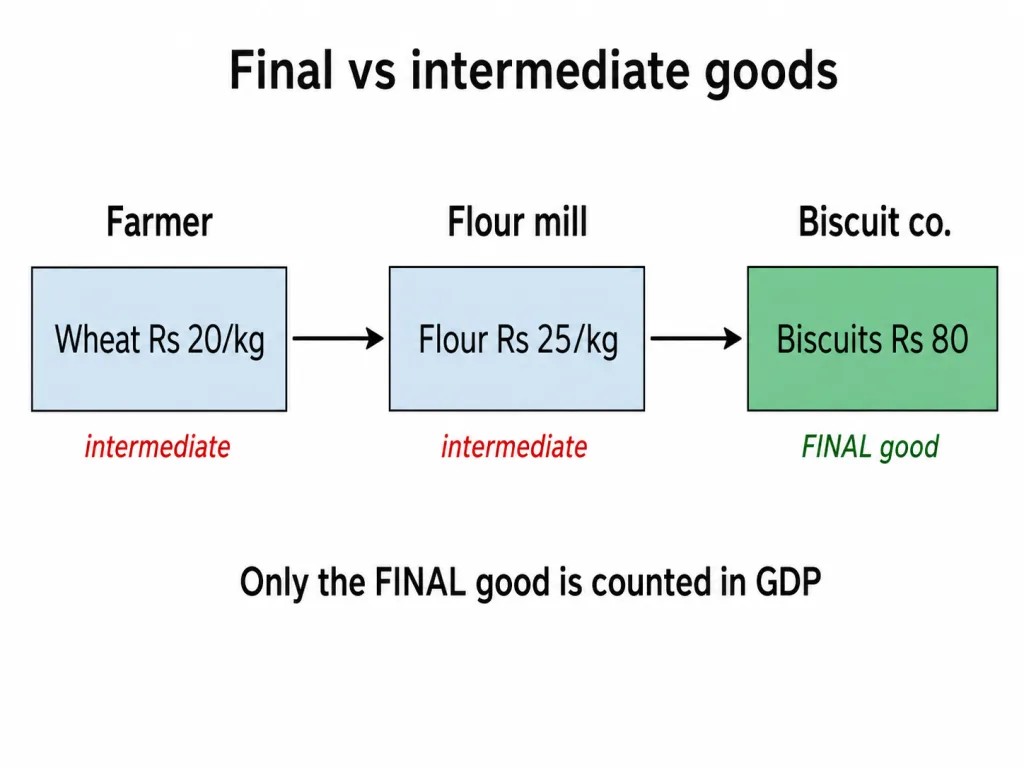
Consider the chain: a farmer sells wheat to a flour mill at Rs 20/kg; the mill sells flour to a biscuit company at Rs 25/kg; the company makes biscuits and sells them to consumers for Rs 80. Biscuits are the final good — they reach the consumer. Wheat and flour are intermediate goods, used up in producing the final good.
The value of the final good (Rs 80) already includes the value of the intermediate goods (the flour at Rs 25 and the wheat). Counting wheat, flour and biscuits separately would count the same value several times — so only final goods and services are counted.
GDP and GVA
The value of final goods and services produced in each sector during a year gives the total production of that sector. The sum of production in all sectors is the Gross Domestic Product (GDP) — the value of all final goods and services produced within a country during a particular year. GDP shows how big the economy is.
In India this huge task is done by a central government ministry, with the help of state and union-territory departments. Recently the government reports each sector's contribution to Gross Value Added (GVA) — which measures the sectors' contribution after adjusting for taxes and subsidies — to match global practice.
Questions and Answers
Q1. What is GDP? Who measures it in India?
Answer: Gross Domestic Product (GDP) is the value of all final goods and services produced within a country during a particular year. It is the sum of the production of the primary, secondary and tertiary sectors and shows how big the economy is. In India, GDP is measured by a central government ministry, with the help of government departments of all the states and union territories.
Q2. Distinguish between final goods and intermediate goods with an example.
Answer: Final goods are goods that reach the consumer and are counted in GDP — e.g., biscuits. Intermediate goods are used up in producing final goods and are not counted separately — e.g., the wheat and flour used to make the biscuits. The value of the final good already includes the value of all intermediate goods, so counting them separately would count the same value more than once.
Q3. Why are only final goods and services counted while calculating GDP?
Answer: Because the value of a final good already includes the value of all the intermediate goods used to make it. In the wheat-flour-biscuit example, the biscuit price (Rs 80) already contains the value of the flour (Rs 25) and wheat. If we counted wheat, flour and biscuits separately, we would count the same value several times and hugely overstate production. Counting only final goods avoids this double counting.