
Division of Sectors as Organised and Unorganised
Another way to classify activities looks at how people are employed — their conditions of work and whether rules and regulations are followed.
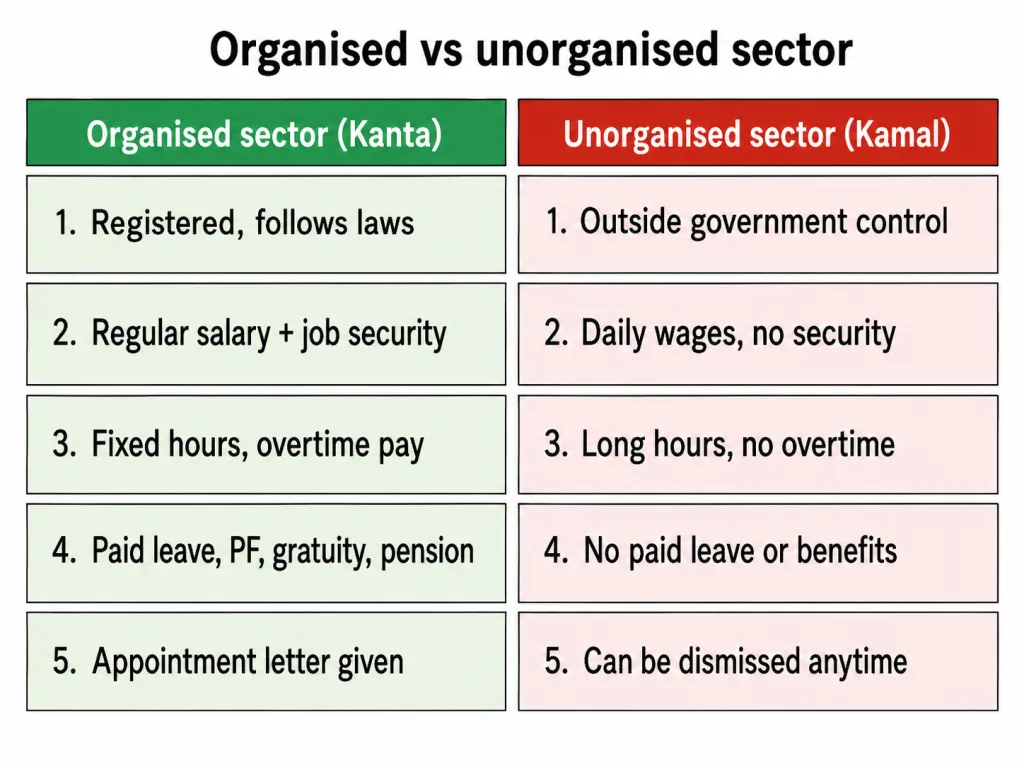
Kanta works in the organised sector. She has fixed office hours (9:30 a.m. to 5:30 p.m.), a regular monthly salary, provident fund, medical and other allowances, paid holidays on Sundays, and an appointment letter stating the terms of her work.
Kamal, her neighbour, is a daily-wage labourer in a grocery shop. He works long hours, gets no allowances, is not paid on days he does not work, has no paid leave, got no appointment letter, and can be asked to leave anytime. Kamal works in the unorganised sector.
Features of the Two Sectors
The organised sector covers enterprises where the terms of employment are regular, so people have assured work. These enterprises are registered by the government and must follow laws such as the Factories Act, Minimum Wages Act, Payment of Gratuity Act and Shops and Establishments Act. Workers enjoy security of employment, fixed working hours, overtime pay, paid leave, provident fund, gratuity, medical benefits, a safe working environment and pensions on retirement.
The unorganised sector is characterised by small and scattered units that are largely outside the control of the government. Rules exist but are not followed. Jobs are low-paid, irregular and insecure, with no provision for overtime, paid leave or holidays, and workers can be dismissed without reason. It includes people who work on their own doing small jobs, and farmers who hire labour as needed.
Protecting Workers in the Unorganised Sector
Organised-sector jobs are the most sought-after, but they have been expanding very slowly, and some enterprises stay in the unorganised sector to evade taxes and labour laws. Since the 1990s many workers have also lost organised jobs and been forced into low-paid unorganised work. So, besides more work, there is a need for protection and support of unorganised workers.
The vulnerable people who need protection include, in rural areas, landless labourers, small and marginal farmers (nearly 80 per cent of rural households), sharecroppers and artisans; and in urban areas, small-scale industry workers, casual workers in construction, trade and transport, street vendors, head-load workers and rag pickers. A majority of workers from scheduled castes, tribes and backward communities are in the unorganised sector and also face social discrimination, so their protection is necessary for both economic and social development.
Questions and Answers
Q1. Distinguish between the organised and unorganised sectors.
Answer: The organised sector has enterprises registered with the government where the terms of employment are regular; workers get job security, fixed hours, paid leave, provident fund, gratuity, medical benefits and pensions, and laws like the Factories Act are followed. The unorganised sector has small, scattered units outside government control, where rules are not followed; jobs are low-paid, irregular and insecure, with no paid leave or benefits and no job security.
Q2. Why do workers in the unorganised sector need protection?
Answer: Because their jobs are insecure, low-paid and irregular, with no benefits like paid leave, provident fund or medical care, and they can be dismissed without reason and are often exploited and underpaid. Many are landless labourers, small farmers, artisans and casual workers, and a large share belong to scheduled castes, tribes and backward communities who also face social discrimination. Protection is therefore needed for both economic and social development.
Q3. Name any four benefits enjoyed by workers in the organised sector.
Answer: Workers in the organised sector enjoy: (i) security of employment; (ii) fixed working hours with overtime pay; (iii) paid leave, holidays and provident fund; and (iv) medical benefits, gratuity and pension after retirement. Employers must also ensure facilities like safe drinking water and a safe working environment under the law.