
Sectors in Terms of Ownership: Public and Private
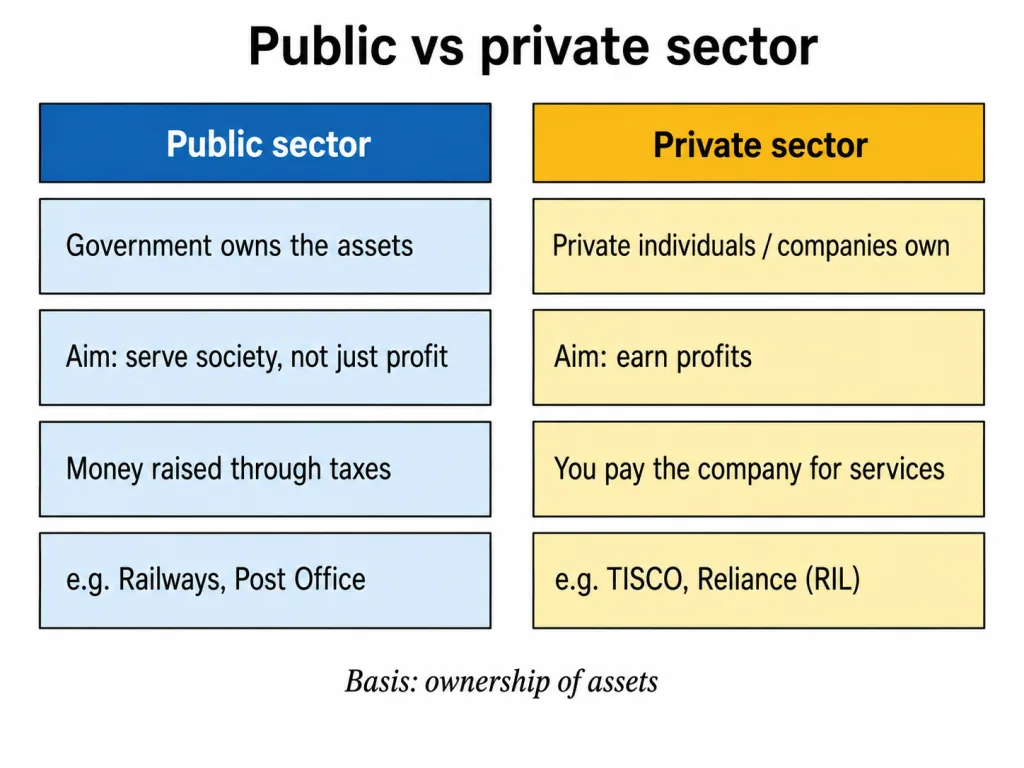
Another way of classifying economic activities is on the basis of who owns the assets and is responsible for delivering services.
- In the public sector, the government owns most of the assets and provides the services. Examples: Railways and the post office.
- In the private sector, ownership of assets and delivery of services is in the hands of private individuals or companies. Examples: Tata Iron and Steel Company (TISCO) and Reliance Industries Limited (RIL).
Activities in the private sector are guided by the motive to earn profits. To get such services, we must pay money to these individuals and companies. The purpose of the public sector is not just to earn profits — governments raise money through taxes to meet the expenses of the services they provide.
Why the Government Must Spend
There are several things needed by society that the private sector will not provide at a reasonable cost, either because they need very large sums of money or because collecting charges from many users is difficult. Examples: roads, bridges, railways, harbours, generating electricity, and irrigation through dams. Governments must undertake such heavy spending so that these facilities are available to everyone.
The government also supports some activities. For example, it may supply electricity at affordable rates so that small industries do not shut down (bearing part of the cost), and it buys wheat and rice from farmers at a fair price, stores them, and sells them cheaply to consumers through ration shops — supporting both farmers and consumers.
The Government's Primary Responsibilities
Some activities are the primary responsibility of the government. Providing health and education for all is one example — running proper schools and providing quality elementary education is the government's duty, and India still has one of the world's largest illiterate populations.
The government must also address human development: nearly half of India's children are malnourished; infant mortality in states like Odisha (36) or Madhya Pradesh (43) is higher than in some of the world's poorest regions. So the government must attend to safe drinking water, housing for the poor, food and nutrition, and take special care of the poorest and most ignored regions through greater spending.
Questions and Answers
Q1. On what basis are activities classified into public and private sectors? Give one example of each.
Answer: They are classified on the basis of who owns the assets and is responsible for delivering services. In the public sector the government owns most assets and provides services — e.g., Railways or the post office. In the private sector, ownership and delivery are in the hands of private individuals or companies — e.g., TISCO or Reliance Industries (RIL).
Q2. Why must the government spend on activities like roads, bridges and dams?
Answer: Such activities need very large sums of money that are beyond the capacity of the private sector, and it is hard to collect charges from the many people who use them. If the private sector provided them at all, it would charge a high price. So the government must undertake this heavy spending to ensure that facilities like roads, bridges, railways, harbours, electricity and irrigation dams are available to everyone.
Q3. How does the government support both farmers and consumers through the Public Distribution System?
Answer: The government buys wheat and rice from farmers at a 'fair price', which gives farmers an assured and reasonable income. It stores these grains and sells them at a lower price to consumers through ration shops (the Public Distribution System). Thus the same policy supports farmers (a fair price for their crops) and consumers (affordable food), with the government bearing part of the cost.