
Historical Change in Sectors
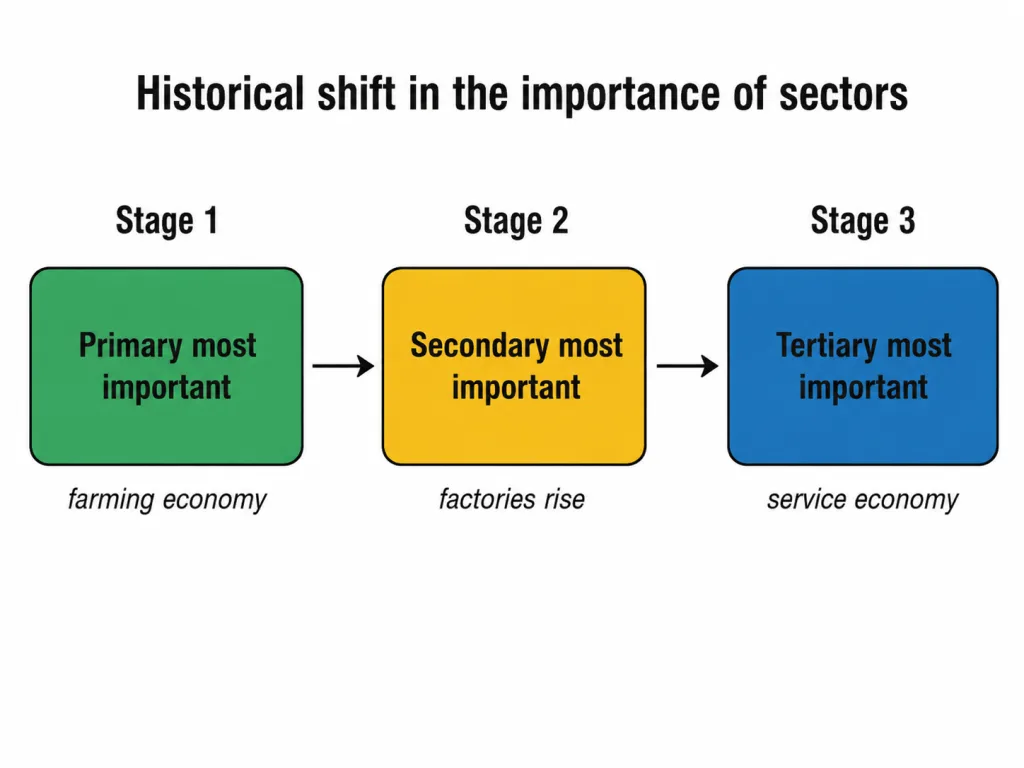
The histories of many now-developed countries show a clear pattern. At the initial stages of development, the primary sector was the most important sector of economic activity, because most goods were natural products and most people worked on farms.
As methods of farming improved, agriculture produced much more food than before. Many people could now take up other activities — there were more craftspersons and traders, and buying and selling increased. Besides farmers, there were transporters, administrators and the army.
Shift to Secondary, then Tertiary
Over more than a hundred years, and especially because new methods of manufacturing were introduced, factories came up and expanded. People who had worked on farms began to work in factories in large numbers, and used more factory-made goods. The secondary sector gradually became the most important in production and employment — a shift had taken place.
In the past 100 years, developed countries saw a further shift from the secondary to the tertiary sector. The service sector became the most important in total production, and most working people are now employed in services. This is the general pattern observed in developed countries.
Questions and Answers
Q1. Describe the historical shift of sectors that took place in developed countries.
Answer: In developed countries the importance of the sectors shifted over time in three stages: first the primary sector was most important (farming); then, as manufacturing methods improved and factories grew, the secondary sector became the most important in production and employment; finally, over the past hundred years, there was a further shift to the tertiary (service) sector, which is now the largest in both production and employment. This is the general pattern of development.
Q2. How did improvement in farming lead to the growth of other sectors?
Answer: When methods of farming improved, agriculture produced much more food than before. This meant that not everyone was needed on the farms, so many people could take up other activities — crafts, trade, transport and administration. In this way the surplus from a prosperous primary sector released labour and demand that helped the secondary and tertiary sectors to grow.
Q3. What is meant by a 'shift' in the importance of sectors?
Answer: A shift means that the sector which is most important in total production and employment changes over time. For example, when the secondary sector overtakes the primary sector as the largest producer and employer, a shift has taken place from the primary to the secondary sector. Historically, developed countries shifted from primary to secondary and then to the tertiary sector.