
Rising Importance of the Tertiary Sector in India
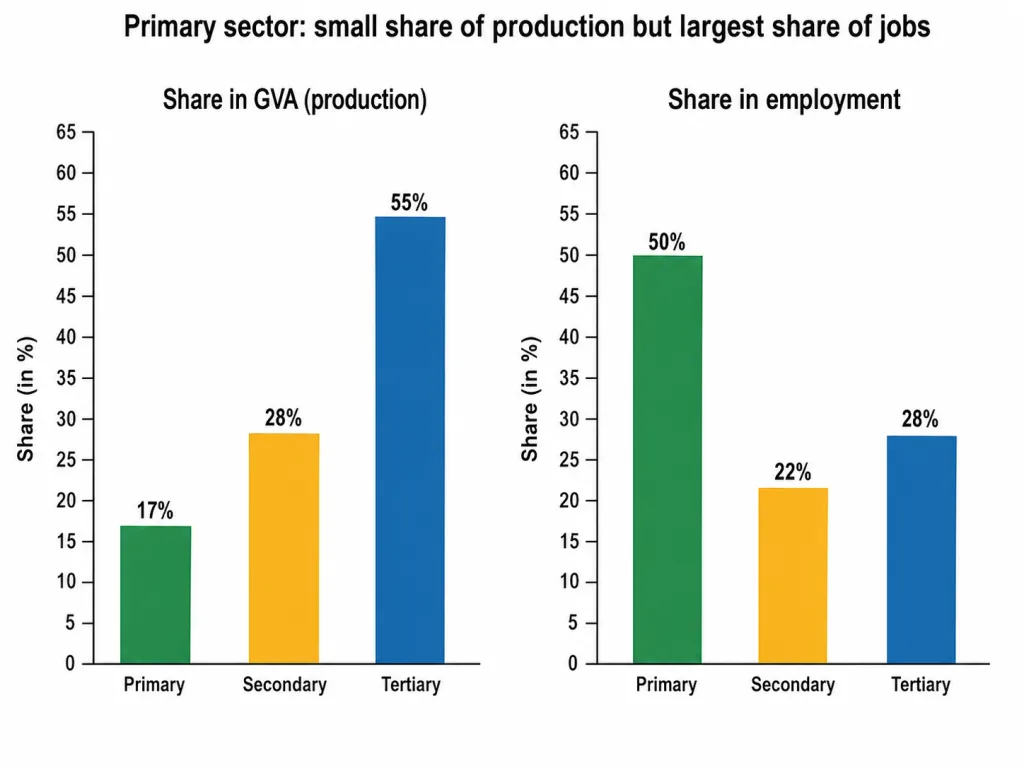
Comparing the years 1977–78 and 2017–18, production in all three sectors increased, but it increased the most in the tertiary sector. As a result, in 2017–18 the tertiary sector became the largest producing sector in India, replacing the primary sector. Why has the tertiary sector become so important? There are several reasons.
Four Reasons for the Growth of Services
- Basic services. Every country needs services like hospitals, schools, post and telegraph, police, courts, banks, insurance, defence and transport. In a developing country the government must take responsibility for providing these basic services.
- Development of primary and secondary sectors. As agriculture and industry develop, they need more services like transport, trade, storage and banking. The greater the growth of the primary and secondary sectors, the more the demand for such services.
- Rising incomes. As income levels rise, people start demanding more services — eating out, tourism, shopping, private hospitals, private schools and professional training. This is visible especially in big cities.
- New services. New services based on information and communication technology (ICT) have become important, and their production has been rising rapidly.
But Not All Services Grow Equally
We must remember that not all of the service sector is growing equally well. At one end there are a limited number of services that employ highly skilled and educated workers. At the other end there are a very large number of workers in services like small shopkeepers, repair persons and transport workers, who barely manage to earn a living and do these jobs only because no better opportunities are available. So only a part of the service sector is truly growing in importance.
Questions and Answers
Q1. Give any three reasons for the rising importance of the tertiary sector in India.
Answer: (i) Basic services — a developing country needs the government to provide hospitals, schools, police, banks, transport, defence, etc. (ii) Development of agriculture and industry raises the demand for services such as transport, trade, storage and banking. (iii) Rising incomes make people demand more services like tourism, eating out, and private schools and hospitals. (A fourth reason is the rapid growth of new ICT-based services.)
Q2. 'Not all of the service sector is growing equally well.' Explain.
Answer: The service sector has two very different ends. One end has a small number of highly skilled, well-paid jobs (like IT professionals and specialists). The other end has a very large number of workers — small shopkeepers, repair persons, street vendors, transport workers — who barely earn a living and take up these jobs only because they have no better options. So only a part of the service sector is genuinely growing in importance, while many service workers remain poor.
Q3. Which sector became the largest producing sector in India by 2017-18, and why?
Answer: The tertiary (service) sector became the largest producing sector by 2017–18, replacing the primary sector. Over the forty years from 1977–78, production in all three sectors rose, but it rose the most in the tertiary sector — because of the need for basic services, the growth of agriculture and industry, rising incomes demanding more services, and the rapid rise of new ICT-based services.