
Sectors of Economic Activities
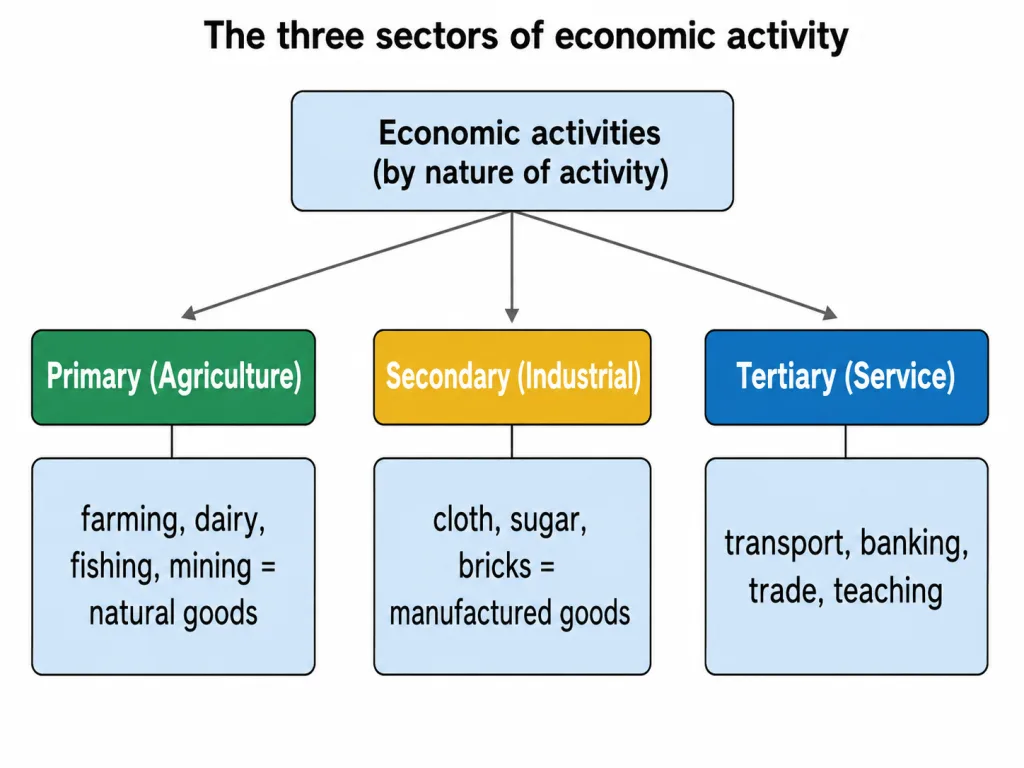
All around us people are engaged in many economic activities — some produce goods, others produce services. To understand them, we classify (group) them using an important criterion. These groups are called sectors. On the basis of the nature of the activity, economic activities are grouped into three sectors: primary, secondary and tertiary.
Primary Sector (Agriculture and related)
When we produce a good by exploiting natural resources, it is an activity of the primary sector. Examples: cultivation of cotton, dairy (milk), fishing, forestry, and mining of minerals and ores. The products — cotton, milk, minerals — are natural products.
It is called primary because it forms the base for all other products we make afterwards. Since most natural products come from agriculture, dairy, fishing and forestry, this sector is also called the agriculture and related sector.
Secondary Sector (Industrial)
The secondary sector covers activities in which natural products are changed into other forms through manufacturing. The product is not made by nature — it must be made, so some process of manufacturing is essential, in a factory, a workshop or at home.
For example: using cotton fibre we spin yarn and weave cloth; using sugarcane we make sugar or gur; we convert earth into bricks to build houses. Since this sector is associated with different industries, it is also called the industrial sector.
Tertiary Sector (Service)
The tertiary sector includes activities that help in the development of the primary and secondary sectors. These activities do not produce a good by themselves but are an aid or support to the production process — so they generate services rather than goods, and the sector is also called the service sector.
Examples: transport, storage, communication, banking, trade. It also includes essential services such as teachers, doctors, barbers, washermen, lawyers, and administrative and accounting work. In recent times, new services based on information technology — internet cafes, ATMs, call centres and software companies — have become important.
Sectors Are Interdependent
The three sectors are highly interdependent. If farmers refuse to sell sugarcane to a sugar mill, the mill (secondary) shuts down — the secondary sector depends on the primary. Farmers buy tractors, pumpsets and fertilisers (secondary) and need transporters (tertiary) to move their produce. A strike by transporters would make food scarce in cities and leave farmers unable to sell. So the sectors constantly depend on one another.
Questions and Answers
Q1. On what basis are economic activities divided into primary, secondary and tertiary sectors? Give one example of each.
Answer: They are divided on the basis of the nature of the activity.
- Primary: producing goods by exploiting nature — e.g., farming (cotton, wheat), fishing, mining.
- Secondary: changing natural products into other forms through manufacturing — e.g., making cloth from cotton, sugar from sugarcane.
- Tertiary: activities that support production and provide services — e.g., transport, banking, trade.
Q2. Why is the tertiary sector also called the service sector?
Answer: Because its activities generate services rather than goods. Transport, storage, communication, banking and trade do not by themselves produce a good; they are an aid or support to the production process and provide services to people. Since these activities produce services, the tertiary sector is also called the service sector.
Q3. 'The three sectors of the economy are interdependent.' Justify with an example.
Answer: The sectors constantly depend on one another. For example, a sugar mill (secondary) cannot run without sugarcane from farmers (primary); farmers in turn need fertilisers and tractors (secondary) and transport and trade (tertiary) to buy inputs and sell produce. If any link fails — say transporters strike — the others suffer. This mutual dependence shows the sectors are interdependent.