
Where Are Most People Employed?
A remarkable fact about India is that while the share of the three sectors in GVA has changed, a similar shift has not taken place in employment. The primary sector continues to be the largest employer even now.
Why? Because not enough jobs were created in the secondary and tertiary sectors. Even though industrial output rose more than nine times over the period, employment in industry rose only about three times; and while service-sector production rose about 14 times, service employment rose only about five times.
The Employment–Production Mismatch
As a result, more than half of the workers in the country are in the primary sector (mainly agriculture), yet they produce only about one-sixth of the GVA. In contrast, the secondary and tertiary sectors produce the rest of the output while employing only about half the workers.
This means there are more people in agriculture than is necessary. Even if some are moved out, production will not fall — the extra workers are underemployed.
Disguised (Hidden) Unemployment
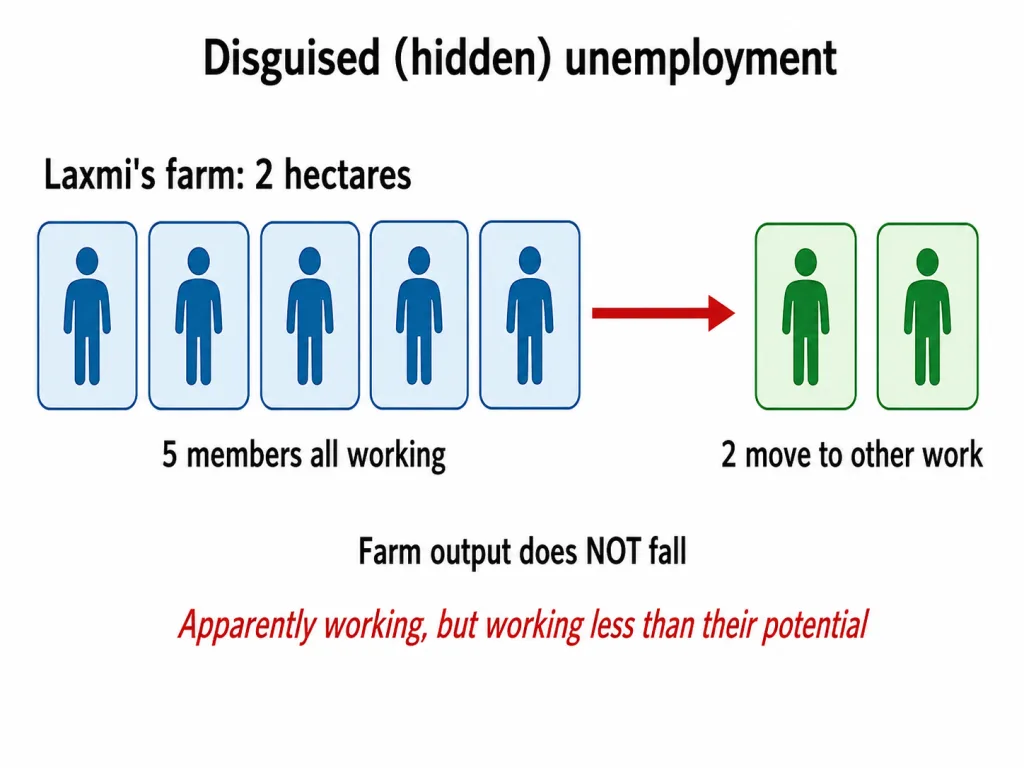
Take Laxmi, a small farmer with about two hectares of unirrigated land, where all five members of her family work through the year because they have nowhere else to go. Everyone appears busy, but the work is divided among them, so no one is fully employed. This is underemployment — people are apparently working but are made to work less than their potential.
Because this unemployment is hidden (unlike a jobless person who is clearly visible), it is called disguised unemployment. If two members left to work elsewhere, the farm's output would not fall, and the family's total income would rise. Disguised unemployment also occurs in other sectors — for example, casual daily-wage workers, street vendors and repair persons in towns who spend the whole day but earn very little.
Questions and Answers
Q1. Why has a shift out of the primary sector NOT happened in employment in India, unlike in production?
Answer: Because not enough jobs were created in the secondary and tertiary sectors to absorb workers from agriculture. Although industrial and service production rose sharply (about 9 times and 14 times), employment in these sectors rose much less (about 3 times and 5 times). So the primary sector remains the largest employer, holding more than half the workers even though it produces only about one-sixth of GVA.
Q2. What is disguised (underemployment) unemployment? Explain with an example.
Answer: Disguised unemployment (underemployment) is a situation in which people appear to be working but are actually working less than their potential, so that removing some of them would not reduce output. For example, in Laxmi's family all five members work on a small two-hectare plot; the work is shared, so none is fully employed. If two members left, the farm's production would not fall. Because the unemployment is hidden, it is called disguised unemployment.
Q3. Why should we be worried about underemployment?
Answer: Underemployment is a waste of the country's human resources: people are willing and able to work more but are not fully productive, so their incomes stay low. It keeps families poor and hides the real scale of the employment problem. Reducing underemployment — by creating productive work in and outside agriculture — would raise incomes and total output and improve people's lives.