
How to Create More Employment
There is considerable underemployment in agriculture, and some people are not employed at all. How can we increase employment? Several practical steps can help, starting with Laxmi's two-hectare farm.
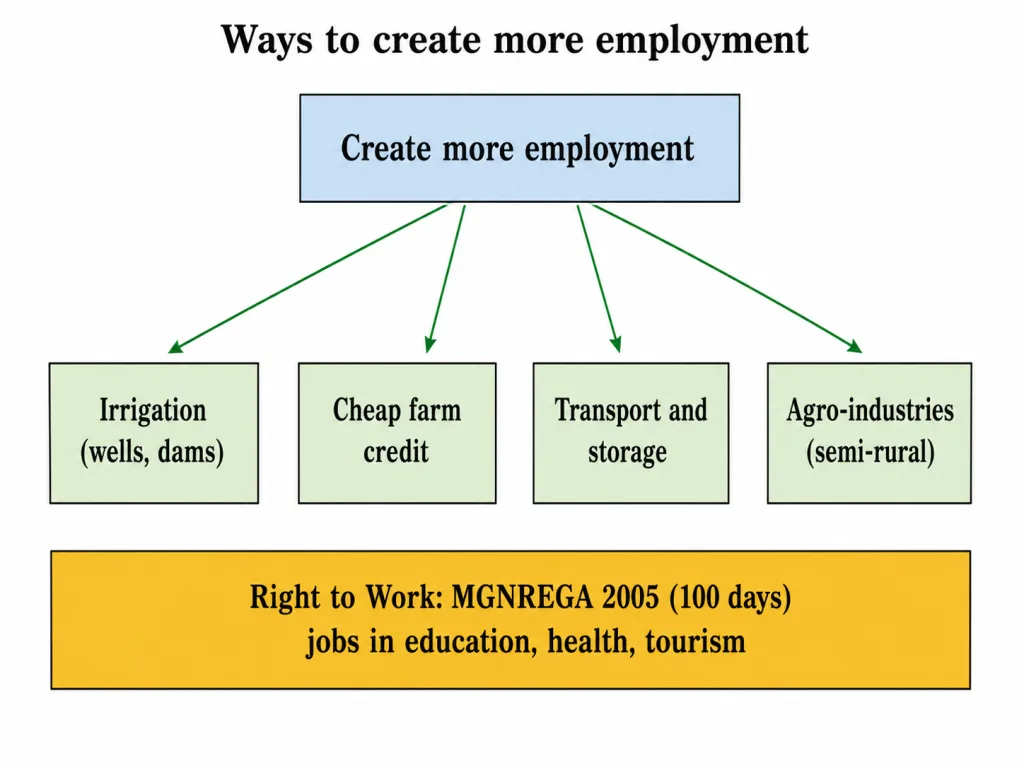
Irrigation and dams. If the government spends money, or a bank gives a loan, to build a well for Laxmi, she can irrigate her land and take a second (rabi) crop such as wheat — employing more family members. A new dam and canals to irrigate many farms could create a lot of employment within agriculture itself, reducing underemployment.
Credit, Transport and Agro-industries
Cheap credit. Laxmi also needs seeds, fertilisers, equipment and pumpsets. Being poor, she must borrow from moneylenders at high interest. If a local bank gives credit at a reasonable rate, she can buy inputs in time and cultivate well. So farming needs both water and cheap agricultural credit (discussed in Chapter 3).
Transport and storage. If the government invests in transport, storage and better rural roads, farmers can move and sell their produce — creating work for those in transport and trade too.
Agro-based industries in semi-rural areas. We can promote industries and services in semi-rural areas — for example, setting up a dal mill, a cold storage for potatoes and onions, or honey collection centres near forests. Processing vegetables and farm produce provides employment near villages, not only in big cities.
Services and the Right to Work
Creating jobs in education and health also helps development. About 60 per cent of India's population is aged 5–29, but only about 51 per cent attend educational institutions. The erstwhile Planning Commission (now NITI Aayog) estimated that nearly 20 lakh jobs could be created in the education sector alone, and improving tourism could give employment to more than 35 lakh people a year.
For quick, short-term relief, the government made a law implementing the Right to Work. The Mahatma Gandhi National Rural Employment Guarantee Act 2005 (MGNREGA 2005) guaranteed 100 days of employment a year to all rural people able and willing to work; if the government failed to provide work, it paid an unemployment allowance. Work that raises future production from land was preferred. In 2025, this Act was replaced by the Viksit Bharat–Guarantee for Rozgar and Ajeevika Mission (Viksit Bharat–GRAMG 2025).
Questions and Answers
Q1. How can employment be increased in rural (agricultural) areas?
Answer: Employment in rural areas can be raised by (i) providing irrigation — wells, dams and canals — so farmers can take a second crop; (ii) giving cheap agricultural credit so poor farmers can buy seeds, fertilisers and equipment in time; (iii) investing in transport, storage and rural roads to help farmers sell their produce; and (iv) setting up agro-based industries in semi-rural areas such as dal mills, cold storage and food-processing units.
Q2. What is MGNREGA 2005 and why is it called the 'Right to Work'?
Answer: The Mahatma Gandhi National Rural Employment Guarantee Act 2005 guaranteed 100 days of wage employment in a year to every rural household whose adults were willing to do unskilled manual work. If the government failed to provide work, it had to pay an unemployment allowance. Because it made employment a legal guarantee that people could demand from the government, it is called the Right to Work. In 2025 it was replaced by the Viksit Bharat–GRAMG 2025.
Q3. How does providing irrigation and marketing facilities increase income and employment?
Answer: Irrigation (wells, dams, canals) lets farmers grow a second crop, which employs more people and raises output. Marketing facilities — transport, storage and rural roads — let farmers sell their produce at good prices instead of distress-selling. Together they create productive work not only for farmers but also for people in transport and trade, raising the total income of the rural economy.