
What Decides Where an Industry Locates?
The location of an industry is influenced by several factors. The most important are the availability of:
- Raw material — industries that use bulky, weight-losing raw materials (like sugar and iron and steel) locate near the source of the raw material.
- Labour — a supply of cheap and skilled workers.
- Capital — money to invest.
- Power (energy) — a regular supply of electricity or fuel.
- Market — nearness to where the goods will be sold.
The ideal location is where the cost of production is the lowest. Sometimes several of these factors are found together at one place, while at other times a suitable location has to be specially developed.
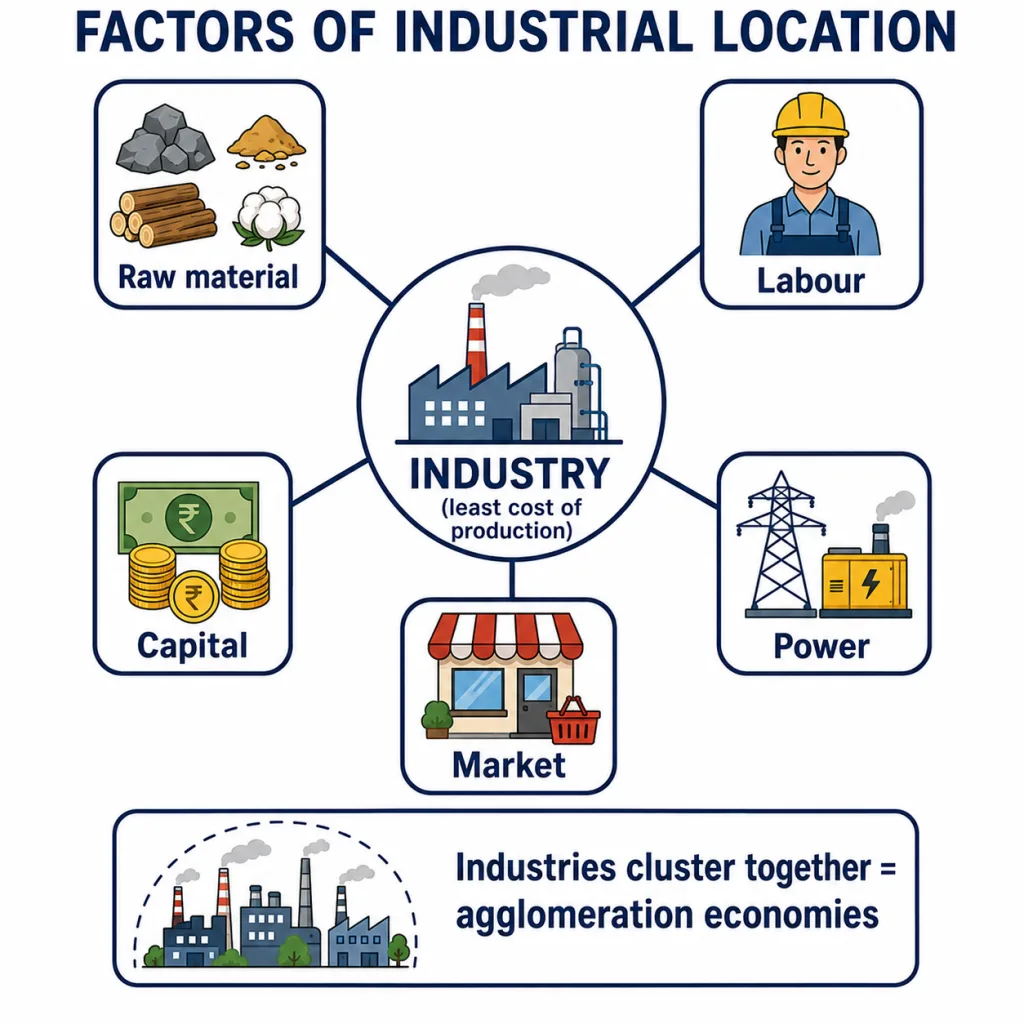
Agglomeration Economies
Industries tend to come together and cluster at certain locations — usually near towns and cities — because being close to one another gives them shared advantages. These benefits of clustering are called agglomeration economies:
- Ready availability of banking, insurance, transport, labour and consultancy services.
- Shared infrastructure (roads, power, water).
- A large nearby market and pool of workers.
This is why cities like Mumbai, Kolkata, Delhi, Chennai, Bengaluru, Ahmedabad and others have grown into major industrial centres.
Industry and Urban Growth
There is a close, two-way relationship between industries and towns:
- Industries are attracted to towns for their markets, labour, banking and transport.
- In turn, industries help towns grow larger and provide employment, which draws more people to the cities.
Exam tip: Remember — bulky raw material → industry near raw material (sugar, iron & steel); clustering near cities → agglomeration economies. These are commonly asked.
Questions and Answers
Q1. What factors influence the location of an industry?
Answer: The location of an industry depends on the availability of raw material, labour, capital, power (energy) and market. Industries locate where the cost of production is the lowest. Industries using bulky, weight-losing raw materials locate near the source, while others locate near the market or transport.
Q2. What are agglomeration economies?
Answer: Agglomeration economies are the benefits that industries gain by clustering together, usually near towns and cities. By being close to one another they can share banking, insurance, transport, labour, infrastructure and a large market, which lowers their costs and helps them grow.
Q3. Why do industries using bulky raw materials locate near the source of the raw material?
Answer: When the raw material is bulky and weight-losing — that is, it loses weight during processing (like sugarcane, whose sucrose reduces on haulage, or iron ore) — it is cheaper to process it near the source than to transport large quantities over long distances. So such industries locate near the raw material.