
What is Manufacturing?
Manufacturing is the production of goods in large quantities by processing raw materials into more valuable products. Making paper from wood, sugar from sugarcane, iron and steel from iron ore, and aluminium from bauxite are all examples of manufacturing.
People engaged in manufacturing are part of the secondary sector of the economy.
The Importance of Manufacturing
Manufacturing is considered the backbone of economic development because it:
- Helps in modernising agriculture and reduces the heavy dependence of people on farming by providing them jobs in secondary and tertiary sectors.
- Brings down unemployment and poverty, especially in backward regions.
- Reduces regional disparities by setting up industries in less-developed areas.
- Expands trade and brings in foreign exchange through the export of manufactured goods.
A country's economic strength is measured by the development of its manufacturing industries. Agriculture and industry are not exclusive of each other — they move hand in hand and support one another.
Classifying Industries — Raw Material and Role
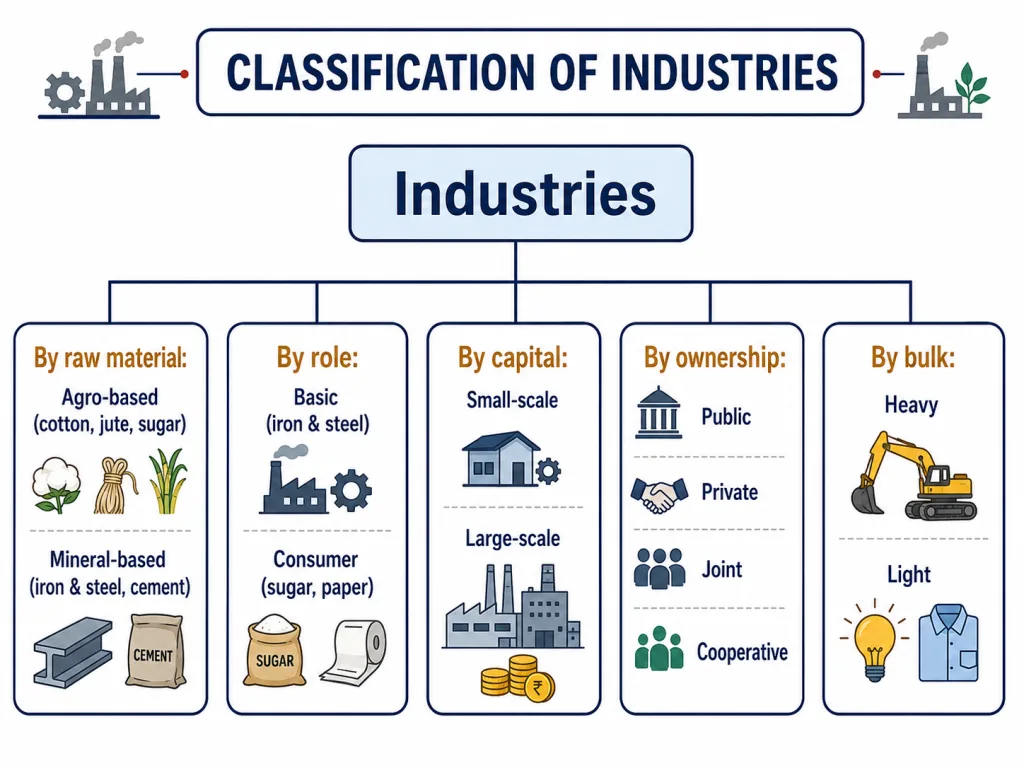
Industries are grouped on several bases. On the basis of the source of raw material:
- Agro-based industries use farm produce — e.g. cotton, jute, silk and woollen textiles, sugar, tea, coffee and edible oil.
- Mineral-based industries use minerals and metals — e.g. iron and steel, cement, aluminium, machine tools and petrochemicals.
On the basis of their main role:
- Basic (or key) industries supply their products to other industries — e.g. iron and steel, copper smelting and aluminium smelting.
- Consumer industries produce goods for direct use by consumers — e.g. sugar, toothpaste, paper, sewing machines and fans.
Classifying Industries — Capital, Ownership and Bulk
On the basis of capital investment:
- Small-scale industries (investment below a fixed limit) and large-scale industries (investment above it).
On the basis of ownership:
- Public sector — owned and run by government agencies (e.g. BHEL, SAIL).
- Private sector — owned by individuals or companies (e.g. TISCO, Bajaj Auto, Dabur).
- Joint sector — run jointly by the state and private companies (e.g. Oil India Ltd).
- Cooperative sector — owned by producers or workers (e.g. sugar mills in Maharashtra, coir industry in Kerala).
On the basis of the bulk and weight of raw material and finished goods:
- Heavy industries (e.g. iron and steel) and light industries (e.g. electronics).
Questions and Answers
Q1. What is manufacturing? Why is it called the backbone of development?
Answer: Manufacturing is the production of goods in large quantities by processing raw materials into more valuable products. It is called the backbone of development because it modernises agriculture, provides employment in secondary and tertiary sectors, reduces poverty and regional disparities, and brings in foreign exchange through exports.
Q2. On what bases are industries classified?
Answer: Industries are classified on the basis of (1) source of raw material — agro-based and mineral-based; (2) main role — basic/key and consumer industries; (3) capital investment — small-scale and large-scale; (4) ownership — public, private, joint and cooperative sector; and (5) bulk and weight — heavy and light industries.
Q3. Distinguish between basic (key) industries and consumer industries with examples.
Answer: Basic (key) industries supply their products as raw material to other industries — e.g. iron and steel, copper smelting, aluminium smelting. Consumer industries produce goods for direct use by consumers — e.g. sugar, toothpaste, paper, fans.
Q4. Distinguish between the public and cooperative sectors, with examples.
Answer: Public sector industries are owned and operated by government agencies — e.g. BHEL and SAIL. Cooperative sector industries are owned and operated by the producers or suppliers of raw materials, or the workers — e.g. the sugar mills of Maharashtra and the coir industry of Kerala.